

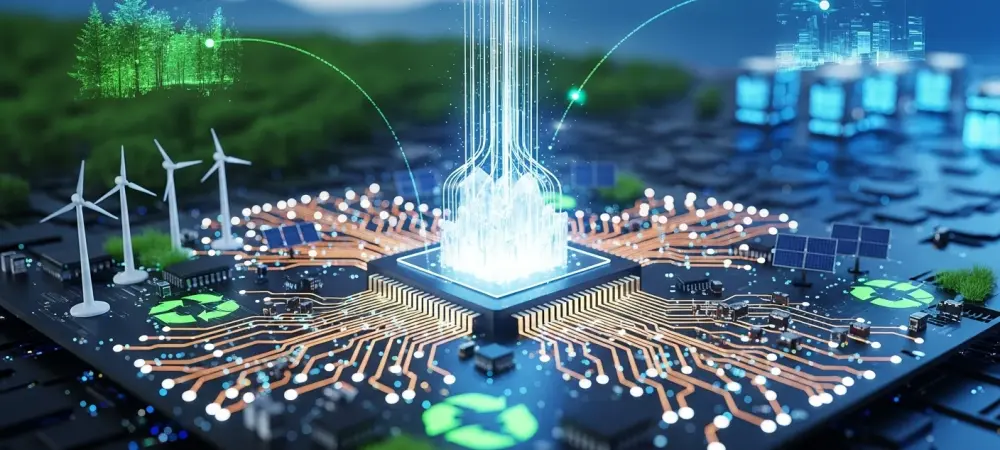
The relentless pursuit of artificial intelligence has pushed the global energy infrastructure to its breaking point, forcing a radical departure from the electron-based semiconductors that have defined the digital age for over half a century. As large language models expand in complexity, the heat generated by traditional silicon chips has become a physical barrier that threatens to stall innovation. Photonic computing, which utilizes light rather than electricity to perform calculations, has emerged as the most viable pathway toward sustaining this growth without catastrophic environmental consequences. This shift represents a fundamental reimagining of the hardware layer, moving away from the resistive limitations of copper and silicon toward the near-instantaneous efficiency of optical waves.
The Shift from Silicon to Light-Based Architectures
Growth Drivers and Current Adoption Statistics
The phenomenon known as the “Power Wall” has transitioned from a theoretical concern to a primary bottleneck for global technological expansion. Current electronic semiconductors are struggling to keep pace with the exponential energy demands of generative AI, leading to a situation where the physical limits of electricity are being reached. Data from the International Energy Agency indicates that the projected power demand for data centers is on track to double by late 2026, driven almost exclusively by the massive overhead required to train and run neural networks. This trajectory suggests that the traditional approach to scaling—simply adding more transistors—is no longer sustainable within the constraints of the existing power grid.
Furthermore, market insights from Goldman Sachs predict a 160% surge in utility requirements for AI workloads by 2030, highlighting a looming crisis for the utility sector. The statistical evidence of the slowing of Moore’s Law is now undeniable, as the diminishing returns of traditional Dennard scaling mean that each new generation of chips provides smaller efficiency gains for higher thermal costs. This stagnation has created a market vacuum that only a non-electronic solution can fill. Consequently, the industry is witnessing an urgent pivot toward architectures that can handle massive data throughput without the associated carbon footprint.
Real-World Applications and Prototyping Success
The transition toward optical hardware is being validated by rigorous scientific evidence and successful industrial prototypes. A recent landmark study published in Nature demonstrated optical neural networks capable of maintaining accuracy parity with the most advanced digital processors. This research proved that the inherent noise in analog light signals could be managed effectively, allowing for complex matrix multiplications—the bedrock of AI—to be performed with high fidelity. Such success has cleared the primary intellectual hurdle that previously kept photonics confined to the periphery of computer science.
Industry pioneers like Lightmatter are already capitalizing on these findings through platforms like “Passage,” which focuses on photonic interconnects to reduce data-transfer bottlenecks. Simultaneously, startups such as iPronics are deploying programmable photonic circuits that facilitate high-speed mathematical operations at a fraction of the power used by traditional GPUs. Hyperscalers including Microsoft, Meta, and Google are now actively exploring these technologies to reconcile their massive AI investments with their publicly stated carbon-neutrality goals. These real-world applications suggest that the transition is moving out of the laboratory and into the foundational infrastructure of the modern data center.
Industry Perspectives on the Optical Transition
The technical consensus among hardware engineers is shifting toward the belief that Mach-Zehnder interferometer (MZI) meshes are the key to unlocking the next level of computational performance. These meshes allow for the manipulation of light phases to perform calculations as the signal travels through the chip, effectively reducing latency to the duration of the light’s flight. This mechanism bypasses the traditional clock-cycle limitations of electronic CPUs, offering a path toward near-real-time processing for even the most complex models. The reduction in latency is not just a performance metric but a fundamental change in how the temporal costs of AI are calculated.
Sustainability experts have increasingly focused on the necessity of “Joule heating” elimination as a prerequisite for preventing a global energy crisis. Because photons do not possess mass or electrical charge, they do not encounter the same resistance that electrons do when passing through a medium. This lack of resistance means that photonic chips produce almost no waste heat, drastically lowering the energy required for cooling systems. Strategic analysis of current developments suggests a hybrid computing model will dominate the near future, where electronics are reserved for control logic and data management while photonics handle the heavy mathematical throughput. This architectural pivot is seen by many experts as the only way to maintain the current pace of AI development without exhausting planetary resources.
Future Outlook: Scaling Challenges and Global Impact
While the benefits of light-based computing are clear, the industry faces significant assessment hurdles regarding manufacturing and supply chain maturity. Specialized fabrication needs for photonic integrated circuits currently differ significantly from the high-volume CMOS standards that have been perfected over decades. Current yield limitations mean that producing these chips at a scale necessary to support trillion-parameter models is still an expensive and delicate endeavor. However, the semiconductor industry is beginning to retool, with major foundries exploring ways to integrate optical component manufacturing into their existing workflows to achieve the necessary economies of scale. The environmental benefits of achieving low-thermal AI inference at the speed of light cannot be overstated, as it offers a way to decouple digital progress from environmental degradation. By slashing the operational cost per query through radical energy efficiency, photonic computing has the potential to democratize advanced AI. This could move powerful computational tools out of the exclusive hands of a few tech giants and into the broader economy, as the cost of electricity will no longer be the primary barrier to entry. As the technology matures, the semiconductor industry will likely undergo a total transformation, with optical infrastructure becoming the standard for any high-performance computing environment.
Summary and the Path to Green Intelligence
The convergence of photonic research and environmental necessity established a new paradigm for the future of artificial intelligence. It was recognized that the tension between AI innovation and sustainability could only be resolved by changing the physical medium of calculation. Breakthrough research successfully proved that the accuracy of optical domains could match that of digital electronics, effectively silencing critics who viewed analog light as an unreliable substitute. This realization shifted the industry’s focus from incremental silicon improvements to a radical overhaul of the processor itself.
The adoption of light-based architectures became the primary strategy for managing the astronomical utility requirements predicted by global financial institutions. By eliminating the heat associated with traditional electron movement, engineers were able to design systems that operated with unprecedented efficiency. This shift not only protected the global energy grid but also allowed for the continued scaling of large language models that would have otherwise been physically impossible to power. The transition was ultimately viewed as an inevitable evolution, marking the point where the speed of light became the new benchmark for human intelligence.
The path forward required a dedicated commitment to rebuilding the global supply chain for optical components and refining specialized fabrication processes. As the industry moved beyond the limitations of Moore’s Law, the focus turned toward the democratization of these efficient systems. The resulting infrastructure allowed for a more equitable distribution of AI capabilities, reducing the barrier to entry for smaller organizations. In the final analysis, the move to photonic computing was seen as the only viable route to achieving a future where advanced machine intelligence and environmental stewardship could coexist.