

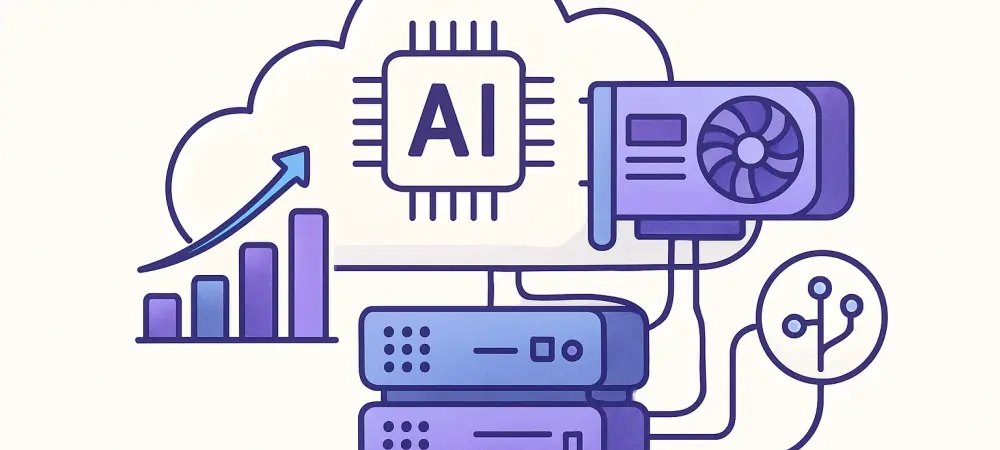
The Explosive Rise of AI and the Neocloud Solution
In an era where artificial intelligence is transforming industries at an unprecedented pace, global data center capacity faces immense strain, with demand for computational power skyrocketing beyond the limits of traditional infrastructure. AI workloads, often requiring massive GPU resources for tasks like machine learning and deep learning, have pushed the boundaries of what conventional hyperscale data centers can deliver. Enter neocloud services, a specialized segment of cloud computing that offers GPU-as-a-Service (GPUaaS), emerging as a vital solution to bridge this gap. These providers are redefining how enterprises access high-performance computing, catering specifically to AI-driven needs. This analysis delves into the ascent of neoclouds, their transformative impact on data center landscapes, expert perspectives, future possibilities, and essential insights for stakeholders navigating this dynamic trend.
The Surge of Neocloud Services in the AI Landscape
Market Expansion and Driving Forces
Neocloud services have witnessed remarkable growth, with a reported compound annual growth rate (CAGR) of 82% projected from a few years prior through the current period, according to research by JLL. This surge reflects the urgent need for specialized infrastructure as AI applications demand unprecedented GPU availability. Supply-demand imbalances persist, with many enterprises struggling to secure adequate resources for intensive workloads, a challenge underscored by insights from Omdia indicating persistent bottlenecks in GPU provisioning across traditional providers.
Beyond raw numbers, the nature of AI workloads amplifies this trend, as they often require over 100 kW per rack—a stark contrast to the capabilities of standard hyperscale setups. Traditional data centers, built for broader compute and storage needs, are often ill-equipped to handle such density without significant retrofitting. Neoclouds, with their focus on tailored GPU solutions, are stepping in to address this critical shortfall, reshaping market dynamics in favor of agility and specialization.
Practical Implementations and Success Stories
Across various sectors, neocloud providers are enabling transformative applications by offering GPUaaS for AI training, machine learning inference, and even blockchain processing. Startups, often constrained by budget and scalability needs, have turned to these services for flexible access to high-performance computing without the burden of heavy capital investment. Research teams, similarly, benefit from on-demand GPU resources to accelerate experimentation and innovation.
Specific industries like gaming and scientific modeling stand out as prime beneficiaries of neocloud agility. In gaming, developers leverage these platforms to render complex graphics and simulations in real time, ensuring seamless user experiences. Meanwhile, scientific communities utilize neoclouds for intricate simulations, such as climate modeling, where computational demands fluctuate unpredictably, highlighting the adaptability of these specialized services in real-world scenarios.
Industry Voices on Neoclouds and AI Infrastructure
Insights from Thought Leaders
Industry experts provide a nuanced view of neoclouds’ role in the AI ecosystem, emphasizing their strategic importance. Muhd Syafiq of JLL highlights the value of local expertise in site selection for neocloud facilities, noting that proximity to power sources and regulatory alignment are critical for operational success. This perspective sheds light on the practical challenges of scaling such specialized infrastructure in diverse geographic markets.
Alexander Harrowell of Omdia offers a financial angle, pointing to the role of GPU vendor financing in propelling neocloud expansion. This investment dynamic, where hardware providers often fund infrastructure growth, underscores a symbiotic relationship within the AI supply chain. Such arrangements enable neoclouds to scale rapidly, though they also introduce complexities in balancing vendor influence with provider autonomy.
Complementary Dynamics and Challenges
A consensus among thought leaders positions neoclouds as a complementary force to hyperscalers rather than direct competitors. While hyperscalers excel in broad-spectrum cloud services, neoclouds target niche AI demands, creating a balanced ecosystem. However, challenges loom large, particularly the substantial upfront capital costs required to build high-density data centers, which can deter smaller players or cautious investors despite the promise of higher rental premiums.
Evolving Horizons for Neocloud Services in AI Applications
Innovations on the Horizon
Looking ahead, advancements in high-density infrastructure design promise to further elevate neocloud capabilities. Developments like Nvidia’s NVL72 rack-scale systems are setting new benchmarks for power efficiency and scalability, tailored specifically for AI workloads. Simultaneously, cutting-edge cooling technologies, such as immersion cooling, are being integrated to manage the heat generated by densely packed GPU setups, ensuring operational stability. These technological strides are poised to enhance cost efficiencies, with neoclouds already offering up to 66% reductions in GPU instance pricing compared to traditional hyperscalers. Flexible contract terms, often spanning two to five years, further democratize access to high-performance computing, making it feasible for a wider range of enterprises to harness AI without long-term financial commitments. Such benefits signal a shift toward more inclusive computational access.
Potential Risks and Broader Impacts
Despite the optimism, investment risks remain a concern due to shorter lease terms that can affect financial predictability for neocloud operators. Specialized site selection, requiring proximity to robust power grids and favorable regulatory environments, adds another layer of complexity to expansion plans. On a broader scale, the rise of neoclouds is likely to drive diversification in the data center sector, encouraging a mix of specialized and general-purpose providers to coexist and cater to varied enterprise needs.
Reflecting on the Neocloud Revolution
Reflecting on the journey, neocloud services have carved a transformative path in addressing the GPU capacity constraints fueled by AI’s relentless growth, complementing hyperscale providers in a symbiotic ecosystem. Their ascent has reshaped how computational resources are accessed, offering agility and cost savings that traditional models struggle to match. For businesses and investors, the next steps involve closely monitoring neocloud innovations, particularly in infrastructure and cooling technologies, to capitalize on emerging opportunities. Strategic partnerships with local experts for site selection emerge as a practical solution to mitigate expansion challenges. As AI continues to redefine technological boundaries, staying attuned to neocloud developments becomes essential for navigating the evolving landscape of high-performance computing.