

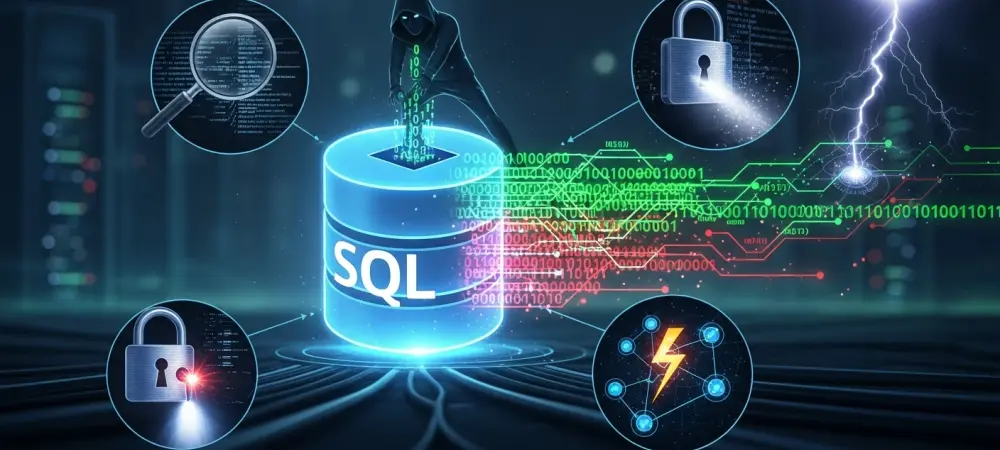
The persistent threat of database infiltration has shifted from sporadic ransomware attacks to a systematic, long-term campaign of infrastructure mapping that threatens the very core of corporate data integrity. While many security teams still brace for the sudden impact of file encryption, the modern reality involves a much more patient adversary. As MS-SQL servers remain a cornerstone of corporate data management, their exploitation now serves as a gateway for building vast, interconnected networks of compromised “zombie” assets that can be activated at a moment’s notice. This article examines the technical evolution of threat actors like Larva-26002, the transition from financial extortion to stealthy reconnaissance, and the strategic shifts required to secure modern database environments against these invisible intruders.
The Shifting Landscape of Database Intrusion
Statistical Trajectory of MS-SQL Vulnerabilities
Analysis of recent digital forensics reveals a significant increase in brute-force and dictionary attacks targeting internet-exposed database instances. Since the beginning of this year, there has been a noticeable spike in automated scripts that relentlessly probe for weak administrator credentials. This surge is not merely a numbers game but a concentrated effort to find a foothold in legacy systems that have been neglected by standard update cycles. Moreover, trends in malware development highlight a decisive shift from older C++ frameworks to memory-safe languages like Rust and Go to achieve enhanced cross-platform compatibility while bypassing traditional signature-based detection systems. Data regarding the persistence of “zombie” server networks suggests that once a server is compromised, it is often kept in a dormant state for months, serving as a reliable node for wider scanning operations.
Real-World Application: The Larva-26002 Campaign
The operational history of the Larva-26002 group provides a chilling case study in adaptability, marking a transition from loud Trigona and Mimic ransomware attacks to the sophisticated ICE Cloud scanning initiative. This group has moved away from immediate monetization through extortion, choosing instead to focus on the ICE Cloud project which maps out thousands of potential targets. This shift indicates that the value of a mapped network now outweighs the quick payout of a single ransom.
Documentation of this technical progression shows a move from using common remote monitoring and management tools like Teramind to deploying custom Go-based binaries. This evolution is paired with a clever “living off the land” tactic involving the Bulk Copy Program utility to export malicious payloads directly from database tables to local paths, effectively hiding movements within the noise of standard database operations.
Cybersecurity Perspectives on Tactical Adaptation
Threat actors are increasingly prioritizing long-term infrastructure compromise over immediate financial gains to build a comprehensive inventory of vulnerable entry points that can be sold or used for coordinated global strikes. By maintaining a low profile, these groups avoid the intense law enforcement scrutiny that typically follows a high-profile ransomware incident, allowing their “zombie” networks to grow undisturbed.
Expert analysis suggests that generative AI is likely playing a role in this rapid malware evolution, as evidenced by unusual language strings and emojis found in recent ICE Cloud binary samples. These anomalies indicate that code is being generated or modified at a pace that suggests automation rather than manual craftsmanship. Furthermore, the continued success of these campaigns points toward a systemic failure in organizational security hygiene, where weak credentials and default configurations remain the path of least resistance for intruders.
Future Horizons and the Evolution of Infrastructure Mapping
Projections indicate that large-scale scanning initiatives like ICE Cloud will enable coordinated, global-scale exploitation efforts throughout the coming months. As threat actors build more comprehensive directories of vulnerable database assets, the window between vulnerability discovery and weaponization will continue to shrink. This creates a landscape where a single successful scan can lead to a cascade of compromises across multiple industries simultaneously.
The challenge of detecting these techniques will intensify as attackers increasingly weaponize legitimate administrative tools. Because these tools are essential for daily database management, simply blocking them is not an option for most enterprises. Consequently, global data privacy faces a significant threat as actors curate vast databases of vulnerable servers, turning the infrastructure of legitimate businesses into a distributed platform for future cyber warfare.
Strategic Defensive Conclusions
The transition from high-noise ransomware to low-signal reconnaissance tactics was clearly marked by the rise of sophisticated scanners and modular malware. This shift underscored the reality that a quiet compromise is often more dangerous than a loud one. Organizations that focused solely on preventing encryption were often left blind to the persistent presence of “zombie” agents operating within their perimeters.
To counter these evolving threats, database administrators must enforce rigorous credential policies and implement strict firewalling to isolate servers from the open web. Restricting external access and monitoring for unusual activity from tools like the Bulk Copy Program became essential practices. Ultimately, the industry recognized that maintaining infrastructure integrity required a proactive stance against the subtle signs of reconnaissance before they escalated into full-scale breaches.