

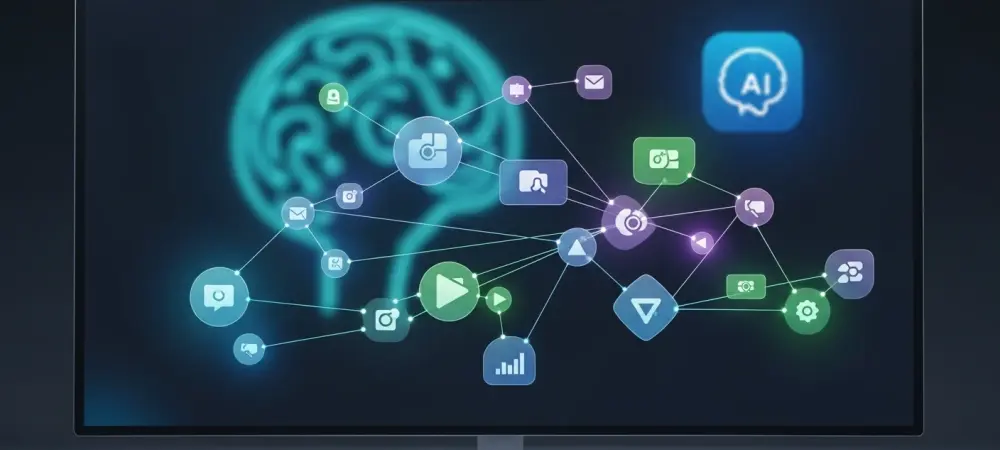
The transition from experimental chatbots to production-ready autonomous agents marks a definitive turning point in how modern enterprise technology functions within a global digital economy. This shift is not merely an incremental update; Microsoft has fundamentally rebuilt Copilot Studio, moving beyond simple interface tweaks to a robust orchestration engine that redefines how businesses deploy AI at scale. By focusing on the underlying architecture rather than just the user experience, the platform now serves as a high-performance foundation for sophisticated corporate automation. This analysis examines the technical performance breakthroughs, the strategic shift toward “Skills-based” authoring, expert insights on governance, and the emerging role of agentic workflows in the corporate ecosystem.
Current Trajectory and Performance Benchmarks
Quantitative Gains: Efficiency and Orchestration
The move from the classic “black box” model to a redesigned instruction-following orchestration engine has introduced a new level of predictability into enterprise AI. In the past, developers often struggled to understand why an agent reached a specific conclusion, but the new engine prioritizes logic and direct adherence to developer-defined parameters. This transition ensures that recursive tasks—where an agent must evaluate its own intermediate steps—are executed with much higher fidelity. By removing manual tuning levers, the platform has traded idiosyncratic control for a standardized, high-level performance that fits the rigorous demands of production environments.
Data from recent implementations demonstrates that these structural changes yield tangible business results. Specifically, there has been a documented 20% improvement in evaluation performance, alongside a 50% reduction in net token consumption. These metrics are critical because they address the two primary barriers to AI adoption: accuracy and cost. As organizations move toward 2027 and 2028, the ability to run more complex agents at half the previous computational cost will likely accelerate the displacement of traditional, rigid automation scripts in favor of flexible, intelligent agents.
Cross-Platform Implementation: The Skills Paradigm
The consolidation of the development environment into a unified “Build” surface has dramatically changed the consultant and developer experience. By reducing the number of configuration interfaces, the platform has lowered the barrier to entry for technical teams, reportedly cutting onboarding time from several weeks to just a few hours. This streamlining allows organizations to pivot from proof-of-concept projects to full-scale implementations without the friction of complex environment setups. The focus remains on the “Skills” paradigm, where the focus is on what the agent can do rather than how the interface looks. Markdown-based “Skills” represent a significant leap toward cross-platform portability. Because these skills are drafted in standardized markdown, they are no longer locked into a single proprietary ecosystem. Logic developed within Copilot Studio can now be mirrored or transitioned to environments like GitHub Copilot or Claude Code with minimal friction. Furthermore, the rise of “computer-using agents” allows these skills to interact with legacy ERP systems via the user interface. This capability bridges the gap between modern generative AI and older software that lacks contemporary APIs, ensuring that even the most established corporations can participate in the agentic revolution.
Expert Insights: Governance and Strategic Deployment
The introduction of the “one-way door” migration policy has become a central point of discussion among IT strategists. Because there is no direct path to upgrade “Classic” agents to the new architecture, leaders must treat new developments as greenfield projects. This policy forces a necessary inventory of existing bots, prompting organizations to decide which legacy assets are worth rebuilding and which should be retired. Experts suggest that prioritizing new projects on the enhanced engine is the only viable way to avoid accumulating technical debt as the older framework is gradually phased out of development focus. Strategic deployment now follows a rigorous “Agent Lifecycle” that includes distinct stages for creation, building, testing, publishing, and monitoring. This structured approach mirrors traditional software development lifecycles, bringing a sense of order to what was once a chaotic experimental field. The emphasis on the “Monitor” phase is particularly important for meeting audit requirements, as it provides granular logs showing every file accessed and every action taken by an agent. For highly regulated industries, this level of transparency is not just a feature but a prerequisite for deploying autonomous systems.
Maintaining security in an agent-dense environment has led to the adoption of Entra Agent Identities. These unique identities allow security teams to govern AI agents with the same precision applied to human employees, using granular permissions to restrict access to sensitive data. By integrating these identities into the existing security perimeter, organizations can mitigate the risks of unauthorized data egress or accidental logic loops. The consensus among professionals is that these governance tools are the bridge that transforms AI from a risky novelty into a trusted corporate asset.
Future Outlook: Autonomous Agents and Integrated Ecosystems
As the platform matures, it is increasingly viewed as the “central nervous system” for complex, multi-agent corporate environments. Rather than having a single bot that attempts to solve every problem, the trend is moving toward specialized agents that communicate through open protocols. This interconnected landscape allows a customer service agent to hand off a request to a logistics agent, which in turn might interact with an accounting agent to process a refund. This modularity ensures that each component remains optimized for its specific task while contributing to a seamless, organization-wide workflow.
The long-term benefits of “agentic reasoning” lie in the hybrid environment where structured logic and AI judgment coexist. Organizations are finding that the most effective workflows are those that use deterministic nodes for predictable steps and agentic nodes for tasks requiring nuance. This hybridity allows businesses to maintain the reliability of traditional programming while leveraging the adaptability of generative models. As these systems become more native to the business process landscape, the distinction between “software” and “AI” will likely continue to blur until they are indistinguishable.
However, the path forward is not without challenges, particularly regarding the management of technical debt as the classic architecture reaches its end of life. Organizations that delay their transition may find themselves supporting outdated agents that cannot communicate with the newer, more efficient ecosystem. The role of open agent-to-agent protocols will be decisive here, as they provide the language through which diverse agents interact. By adopting these standards early, companies can ensure that their digital workforce remains cohesive and capable of adapting to the rapid evolution of business needs.
Summary: Preparing for the Next Phase of AI Maturation
The shift from experimental AI to a unified, portable, and high-performance development platform provided a necessary foundation for future corporate growth. Organizations that moved quickly to consolidate their instruction sets into markdown-based Skills and conducted thorough inventory assessments of legacy bots positioned themselves to lead. The transition demonstrated that the value of AI lies not in the novelty of the interface, but in the robustness of the orchestration engine and the transparency of its governance.
The integration of Entra Agent Identities and the adoption of the standardized Agent Lifecycle offered a blueprint for secure, scalable automation. By verifying performance gains through proprietary data testing, technical leaders confirmed that the new architecture was indeed more efficient and cost-effective than its predecessor. Mastering these orchestration tools finally determined which organizations possessed the competitive edge in an environment defined by autonomous business processes. Moving forward, the focus shifted from simply building bots to managing a sophisticated digital workforce that operated with precision and accountability.