

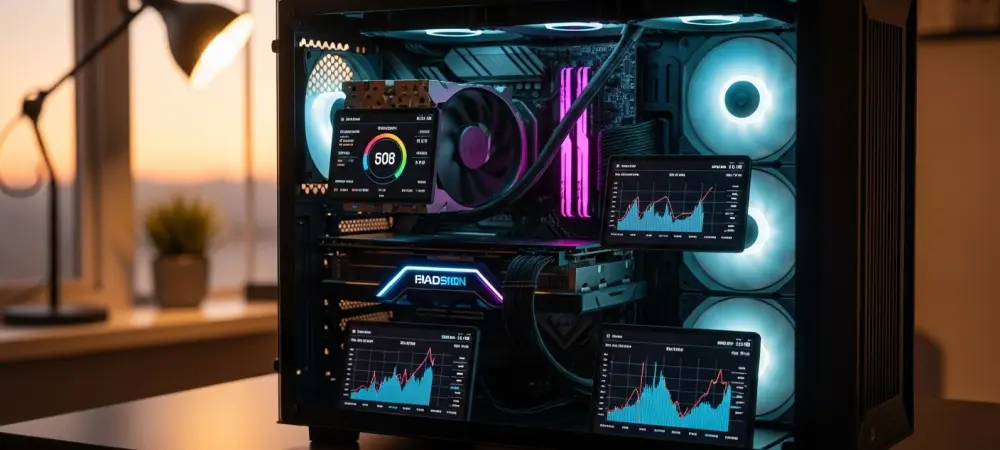
The expansive journey of PC customization has meticulously transformed simple beige boxes into dazzling spectacles of synchronized ARGB ecosystems, and now it stands on the precipice of a new era defined by functional, data-rich component displays. This evolution marks a significant shift beyond mere aesthetics, venturing into a realm of deep personalization and real-time data visualization directly on the hardware itself. This analysis explores the rapid growth of this trend, examines a surprisingly affordable product pushing its boundaries, and considers the future implications for the PC building community.
The Rise of the Onboard Display
From Niche Novelty to Mainstream Feature
The progression of integrated screens began modestly, first appearing as a premium feature on high-end all-in-one (AIO) CPU coolers and select flagship motherboards. These early adopters offered a glimpse into a future where users could monitor core temperatures or display custom animations without relying on desktop software. Initially dismissed by some as an expensive novelty, the concept quickly gained traction among enthusiasts seeking the ultimate personalized build. Driven by a growing demand for unique aesthetics and the practical desire for at-a-glance system monitoring, the trend expanded its reach. Soon, high-performance GPUs, premium RAM modules, and even power supplies began to incorporate small displays. This proliferation was fueled by manufacturers looking to differentiate their products in a fiercely competitive market, offering consumers a tangible feature that was both visually impressive and functionally useful for monitoring system health during intensive tasks like gaming or content creation.
Case Study: The Zalman ZM-VS3 Pushes Accessibility
Korean manufacturer Zalman has recently redefined the accessibility of this trend with its ZM-VS3, a product that exemplifies how premium features can migrate to the budget segment. It ingeniously combines the practical utility of an anti-sag GPU support bracket with the modern aesthetic of an integrated system monitor. Featuring a small LCD screen, customizable ARGB lighting, and a 45-degree tilt for improved visibility, it brings a formerly high-end feature to a component category known for its simplicity.
The ZM-VS3 is designed to display essential system data, including CPU and GPU temperatures and the current time, connecting via standard motherboard headers for USB and ARGB. Its primary limitation is the lack of support for custom images or GIFs, focusing purely on data visualization. However, its most disruptive feature is its price. At approximately $12, it starkly contrasts with non-display premium brackets like the $43 ASUS ROG Herculx, positioning it not just as a support bracket with a screen but as a new standard for value.
Evaluating the Practicality and Purpose
The proliferation of these displays sparks a critical debate within the PC building community: are they genuinely useful tools for enthusiasts or an exercise in aesthetic excess? From the manufacturer’s standpoint, the answer is clear. In a crowded marketplace, an integrated screen is a powerful differentiator, providing a visible, marketable feature that can justify a higher price point or, as Zalman has shown, create a new value category entirely.
For enthusiasts, the verdict is more nuanced. The benefit of instant hardware monitoring without on-screen display software is undeniable, offering a clean, unobstructed view during gameplay or creative work. Conversely, each new display adds another layer of software complexity and a potential point of failure. Yet, for the budget-conscious builder, the ZM-VS3 has fundamentally altered this calculation. It transforms the integrated display from an out-of-reach luxury into an affordable and practical addition, making the trend accessible to a much broader audience.
Future Outlook and Implications
Looking ahead, the trajectory of this trend points toward even deeper integration. It is plausible to imagine future components like SSDs displaying real-time transfer speeds or case fans showing their current RPM. This progression will likely be accompanied by technological advancements, such as higher-resolution OLED screens, touchscreen interactivity for on-the-fly adjustments, and more unified software suites to manage the growing number of displays in a single system.
However, this future is not without its challenges. The industry must navigate the risk of diminishing returns, where the added cost and complexity of a screen outweigh its functional benefit. There is a fine line between a useful feature and a gimmick, and oversaturating the market with low-effort implementations could devalue the concept. The key will be to ensure these displays offer meaningful integration and an intuitive user experience, enhancing the user’s connection to their hardware rather than merely adding to the visual noise.
Conclusion: A New Standard or a Passing Fad? The journey of the integrated PC component display, from a high-end luxury to an accessible, mainstream feature, is vividly illustrated by the market disruption of the Zalman ZM-VS3. This evolution underscored a fundamental shift in what builders expect from their hardware, moving beyond raw performance to include deeper personalization and data awareness.
The central question of whether this trend represented a meaningful step forward in PC design or was simply a temporary aesthetic indulgence was debated intensely. Ultimately, the relentless demand from users for greater control and more immediate access to system information drove this wave of innovation, suggesting that a future where every component could communicate its status visually was not only possible but perhaps inevitable.