

The global race for artificial intelligence supremacy has evolved far beyond the refinement of complex algorithms to become a high-stakes competition for physical real estate and massive power reserves. As training requirements for large language models continue to escalate, the limitations of traditional data center designs have become a primary bottleneck for technological progress. This shift has necessitated a fundamental reimagining of how silicon and site facilities interact, moving away from a model of general-purpose hosting toward highly integrated, purpose-built environments. The infrastructure imperative now dictates that competitive advantage is no longer found solely in the efficiency of a chip, but in the synergy between hardware and the facility that provides its thermal and electrical sustenance.
This evolution represents a strategic pivot for the entire technology sector, where the physical foundation of AI is being prioritized to ensure long-term scalability. The following analysis explores the massive scaling of critical IT capacity, the emergence of rack-scale technical synergies, and the transition of major hardware manufacturers into comprehensive infrastructure facilitators. By securing vast amounts of power and specialized space, the industry is laying the groundwork for a future where the ability to compute is limited only by the scale of the physical plant.
The Evolving Landscape of High-Density AI Computing
Market Trajectory and the Surge in Critical IT Capacity
The current market trajectory is defined by an unprecedented demand for electricity, marking a definitive transition from megawatt-scale operations to massive gigawatt-scale deployments. Analysts project a revenue potential of approximately $14 billion in AI-specific colocation services as enterprises scramble to find homes for high-performance hardware. This demand has fundamentally reshaped the geographic footprint of data centers, driving expansion away from traditional hubs and toward regions with favorable power costs and available land, particularly across the American Southeast and Southwest.
Moreover, the nature of these infrastructure investments has shifted toward a long-term horizon that was previously unseen in the digital sector. Infrastructure providers and their tenants are now entering into 15-year lease terms, often accompanied by multi-decade extension options that stretch into the 2040s. This stability is necessary to justify the massive capital expenditure required to build facilities capable of supporting hundreds of megawatts of concentrated computing power. Consequently, power availability has replaced fiber connectivity as the most critical metric for site selection in the modern AI era.
Real-World Application: The AMD and Core Scientific Strategic Alliance
The strategic alliance between Advanced Micro Devices and Core Scientific serves as a definitive blueprint for how hardware vendors are securing domestic AI sovereignty. By moving beyond its role as a component manufacturer, AMD has facilitated the lease of 377 megawatts of critical IT capacity to ensure its customers have immediate access to high-performance silicon environments. This arrangement specifically targets high-density facilities in states like Texas, Oklahoma, and Georgia, creating a distributed network of specialized infrastructure that can support the most demanding AI training and inference tasks.
In contrast to traditional cloud models, this partnership illustrates the rise of the neocloud provider, where a hardware vendor secures dedicated capacity to bypass the constraints of established hyperscalers. By controlling the physical environment across five dedicated facilities, the alliance ensures that high-density server configurations are not limited by the power or cooling restrictions often found in multi-tenant legacy data centers. This model provides a “turnkey” solution that allows AI model developers to scale their operations without the delays associated with building their own proprietary facilities from the ground up.
Industry Perspectives on Vertical Integration and Infrastructure Sovereignty
Shifting from Component Manufacturing to Comprehensive AI Facilitation
Industry experts increasingly highlight the concept of infrastructure sovereignty as a mandatory evolution for hardware designers seeking to challenge established market leaders. Vertical integration now extends from the instruction set of the silicon to the complex liquid cooling systems that keep those chips operational under intense workloads. By managing the entire stack, companies can optimize every component for maximum efficiency, offering comprehensive solutions that traditional component-only manufacturers cannot match. This approach reduces the friction of deployment for enterprise clients who require immediate, reliable access to large-scale computing clusters.
Furthermore, the strategic use of financial instruments, such as equity warrants and performance-linked incentives, has aligned the interests of hardware designers and infrastructure providers. By securing equity in the infrastructure side, semiconductor companies gain a vested interest in the long-term viability and expansion of the physical sites, further solidifying the bond between the digital and physical realms of AI development. By securing equity in the infrastructure side, semiconductor companies gain a vested interest in the long-term viability and expansion of the physical sites, further solidifying the bond between the digital and physical realms of AI development.
The Strategic Pivot from Specialized Computing to AI Colocation
A significant professional consensus has emerged regarding the value of repurposing existing high-power assets, particularly those formerly dedicated to specialized tasks like cryptocurrency mining. These sites already possess the heavy-duty electrical permits and physical security required for high-density AI workloads, allowing for a faster market entry than greenfield developments. As these assets are converted to AI colocation centers, the focus shifts toward providing the “critical IT capacity” that modern GPUs demand, which involves substantial upgrades to power delivery and thermal management systems.
This “walled garden” approach to infrastructure allows hardware companies to remove scaling bottlenecks for their end-users by securing massive power reserves years in advance. By locking up gigawatts of future capacity, these organizations are essentially pre-empting the competition for the most scarce resource in the AI economy: electricity. This strategic foresight ensures that as models grow in complexity, the physical space required to house the necessary compute cycles will be ready and waiting, regardless of broader market shortages.
Future Outlook: Scaling the Physical Foundation of Artificial Intelligence
Technological Evolution of the Helios Architecture and Liquid Cooling
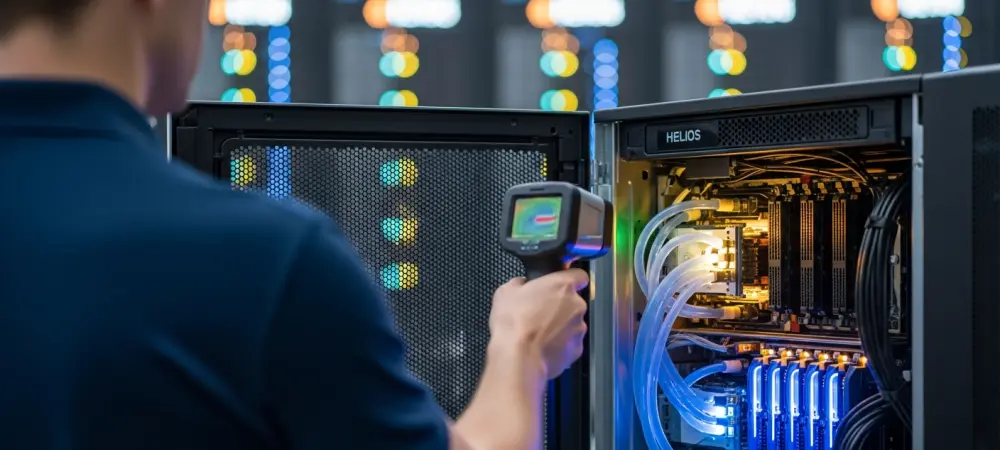
The future of high-density computing is inextricably linked to advanced rack-scale architectures, such as the Helios reference design, which integrates networking, processors, and specialized accelerators into a unified environment. Such systems are designed to operate as a single cohesive unit, requiring sophisticated power distribution and cooling solutions that exceed the capabilities of air-cooled racks. By 2027 and beyond, liquid cooling will likely transition from a specialized niche to a non-negotiable requirement for any data center aiming to host top-tier AI training operations.
However, upgrading legacy facilities to meet these rigorous thermal and electrical demands remains a significant challenge for the industry. Modern AI racks can consume more power than an entire row of traditional servers, placing immense strain on aging electrical grids and facility plumbing. As a result, the industry is seeing a bifurcation between older data centers that are being relegated to general-purpose enterprise tasks and a new generation of facilities built specifically to manage the extreme power densities of the Helios-class architecture.
Long-Term Market Implications and the Race for Terawatt-Scale Capacity
As hardware companies continue to lock up gigawatts of power through the late 2020s, the market is poised for a major consolidation of resources. Those organizations that fail to secure long-term infrastructure commitments today may find themselves unable to compete in large-scale model development due to a lack of available physical capacity. This race for terawatt-scale capacity is not just a financial competition but a geopolitical one, as nations recognize that their domestic AI capabilities are limited by the physical size and power of their data center fleets.
Environmental and regulatory considerations will also play an increasingly dominant role in the expansion of these massive facilities. The sheer scale of power consumption required to maintain technological leadership will force a deeper integration with sustainable energy projects and grid modernization efforts. Ultimately, the winners of the next decade of technological competition will be those who can most effectively bridge the gap between high-performance silicon and the immense physical infrastructure required to keep it running.
Conclusion: The Infrastructure-Led Future of AI Innovation
The transformation of the semiconductor industry into a holistic infrastructure-driven sector became the defining characteristic of the recent technological landscape. Organizations recognized that the success of future artificial intelligence models remained inextricably linked to the physical capacity of the data centers that housed them. The shift toward integrated environments, such as the strategic alliances between hardware designers and high-density colocation providers, established a new baseline for how large-scale computing must be deployed. This integration successfully moved the focus from individual component performance to the collective efficiency of the entire physical stack.
Moving forward, the primary challenge shifted toward maintaining this infrastructure-led growth while navigating the complexities of power availability and environmental sustainability. Future leadership in the sector required an proactive approach to securing terawatt-scale resources and implementing advanced cooling technologies well before they became industry standards. By prioritizing the physical foundation of AI, the industry ensured that the next decade of technological innovation would be supported by a robust and scalable infrastructure. This strategic alignment of silicon and site proved to be the most critical factor in securing a competitive edge in the global digital economy.