

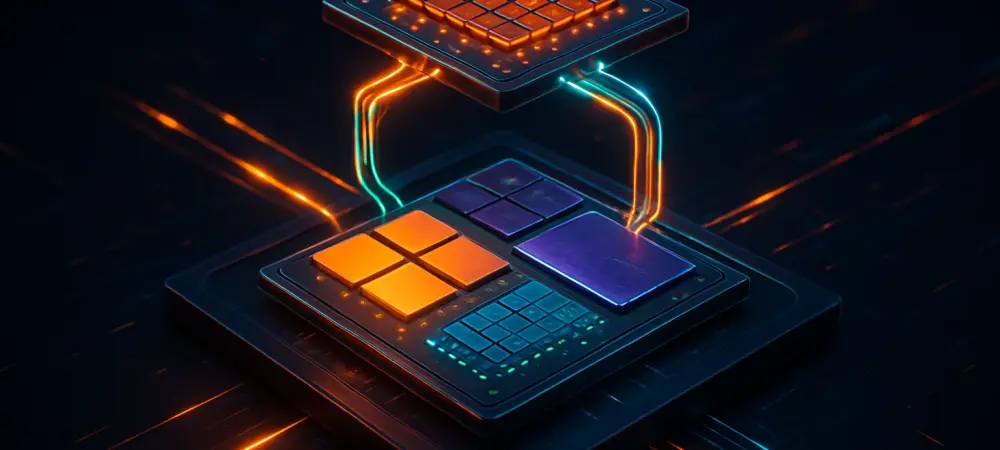
The long-reigning era of the monolithic chip, where a processor’s entire identity was etched into a single piece of silicon, is definitively drawing to a close, making way for a future built on modular, interconnected components. This fundamental shift toward hybrid chiplet technology represents more than just a new design philosophy; it is the industry’s strategic answer to the slowing pace of Moore’s Law, unlocking next-generation performance and efficiency that a single-die approach can no longer sustain. This analysis will dissect the rise of this powerful trend, using AMD’s forthcoming Zen 6 “Medusa Point” architecture as a forward-looking case study on how processors are being reimagined from the ground up.
The Hybrid Chiplet Revolution: Data and Application
The Rise of Multi-Die Architectures
Recent evidence of the industry’s pivot toward modularity comes from a newly spotted shipping manifest detailing AMD’s Zen 6 “Medusa Point” processors, which validates the accelerating adoption of multi-die designs. What began as a method to connect multiple identical compute chiplets has evolved into a far more complex strategy. Modern hybrid designs now integrate diverse components—from high-performance CPU cores to specialized I/O and graphics—onto a single package, behaving as a unified system.
This strategic move is a direct response to the escalating costs and physical constraints of manufacturing massive, single-die processors on cutting-edge nodes. By breaking a large chip into smaller, more manageable chiplets, manufacturers can significantly improve production yields and reduce waste. Consequently, this modular approach is no longer a niche solution but a core tenet of modern semiconductor strategy, enabling a new level of scalability and customization.
Case Study: AMD’s “Medusa Point” Architecture
AMD’s “Medusa Point” architecture exemplifies the potential of this hybrid approach. Its design centers on a primary monolithic die that itself is a complex system, integrating a mix of standard Zen 6 performance cores, high-density Zen 6c cores, and new Low Power Zen 6 cores. This main die also incorporates an I/O die and an RDNA 3.5+ GPU, forming a complete system-on-chip that can function independently.
The true innovation, however, lies in its modularity. This primary die can be augmented with an optional, secondary compute-only chiplet to dramatically increase performance. A rumored 22-core flagship model illustrates this perfectly, with the main chip providing ten diverse cores and the secondary chiplet adding another twelve high-performance Zen 6 cores. This design allows for unprecedented product segmentation, enabling powerful 45W configurations for high-performance laptops and efficient 28W single-chiplet variants for ultra-thin notebooks and handheld gaming devices.
Strategic Implications: An Expert Breakdown
The strategic thinking behind Medusa Point extends to its manufacturing process, which reportedly involves a split-node approach. The primary combo-chiplet will be fabricated on TSMC’s N3P node, a mature and cost-effective process, while the optional secondary compute chiplet will leverage the more advanced and powerful N2P node. This method brilliantly optimizes cost, yield, and performance by reserving the most cutting-edge—and expensive—process technology for the component where it will deliver the greatest impact: raw computational power.
This architectural evolution is mirrored by changes in physical hardware. The manifest reveals the introduction of a new FP10 socket for mobile devices, which at 25mm x 42.5mm is approximately 6% larger than the current FP8 socket. This increase in size signals a necessary design shift to accommodate the more complex power delivery and high-speed interconnects required by advanced chiplet-based processors, preparing the ground for future generations of devices.
The Road Ahead: Future Trajectories and Challenges
The Medusa Point model offers a clear glimpse into the future of processor design, where greater customization and scalability become the norm. This “building block” approach could allow for tailored processors with varying combinations of chiplets to meet specific performance, power, and cost targets. With the preceding “Gorgon Point” generation expected in 2026, Medusa Point’s anticipated debut around 2027 places it firmly within AMD’s long-term roadmap to push this modular vision forward.
However, this path is not without its challenges. The increasing complexity of inter-chiplet communication demands ultra-fast, low-latency interconnects to ensure the separate dies function as a cohesive whole. Furthermore, software schedulers must become more sophisticated to intelligently assign tasks to the diverse core types (performance, efficiency, and low-power). Finally, managing the thermal output of these densely packed, high-performance components within compact form factors like laptops and handhelds remains a critical engineering hurdle.
Conclusion: Embracing a Modular Future
The shift toward hybrid chiplets is not merely a passing trend but a foundational evolution in semiconductor design. AMD’s Medusa Point architecture showcases the profound potential of this approach, blending architectural innovation with a shrewd split-process manufacturing strategy to maximize performance, flexibility, and efficiency. This move away from monolithic design is a clear indicator of the industry’s direction. As these technologies mature, hybrid chiplet processors are set to unlock new capabilities and fundamentally reshape the computing landscape, redefining performance expectations across gaming, artificial intelligence, and mobile computing for years to come.