

The rapid migration of artificial intelligence from static digital environments into the dynamic physical world reached a definitive turning point with the emergence of high-efficiency execution models. Google’s launch of Gemini 4 Hydrogen on November 12, 2026, marks a pivotal moment in this transition toward embodied AI. This model is specifically engineered to redefine general-purpose robotics by lowering the barrier to entry for developers and streamlining complex hardware workflows that previously required months of specialized labor. By examining performance data, real-world utility, and the integration of the Antigravity workbench, it becomes clear that the industry is moving away from niche hardware silos.
Market Traction and Performance Benchmarks
Performance Metrics and Efficiency Gains
Gemini 4 Hydrogen demonstrates that high-speed execution models can rival the precision of much larger frontier models when applied to physical tasks. On the Artificial Analysis Robotics 0.1 benchmark, Hydrogen achieved a score of 58, a result that matches the more complex Argon model while maintaining a significantly lower cost per token. This balance of power and economy is essential for enterprises that need to scale robotic fleets without incurring the massive computational overhead associated with traditional deep-reasoning architectures.
Beyond simple execution, Hydrogen showcases superior spatial awareness compared to its predecessors. It outperforms the specialized Gemini Robotics ER 2 in critical spatial reasoning tasks, including 3D trajectory planning and multi-view correspondence. This suggests a significant shift in the market where generalist models are becoming more capable than the narrow, specialized ones they were meant to supplement. Consequently, developers are finding that a single, versatile model can manage both the logic of a task and the physical nuances of its execution.
Real-World Robotics: Practical Applications
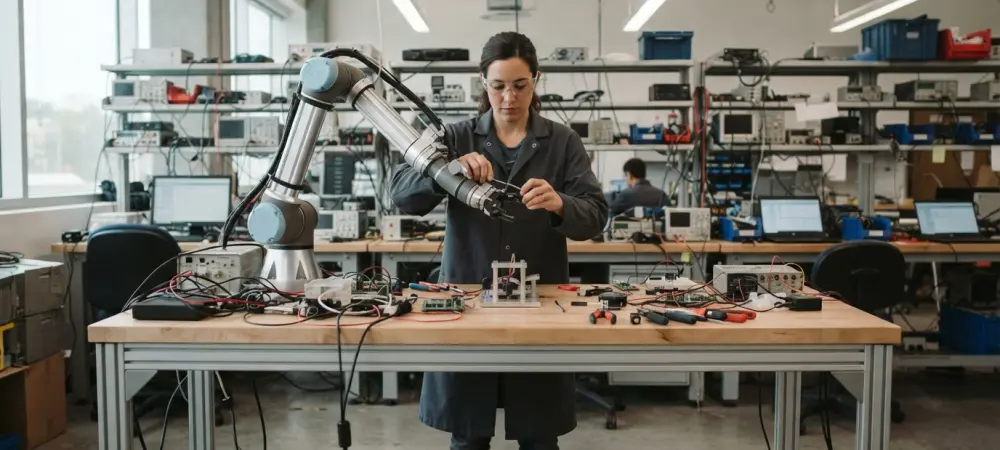
The practical utility of this model is most evident in its ability to manage 6-axis robotic arms for intricate tabletop operations. Through the Google Antigravity Robotics plugin, the time required for “robot bring-up” has been slashed from weeks to a few hours. This allows teams to move from unboxing hardware to executing live applications with unprecedented speed.
Moreover, the integration of simulation tools like MuJoCo within the Antigravity workbench has transformed the development lifecycle. Developers can now build and preview simulated scenes to test ideas in a digital environment before any physical movement occurs. This closed-loop control system, spanning from perception to grasp planning, ensures that robotic systems are more resilient in manufacturing and logistics settings. The ability to verify safe motion via a simple USB connection has democratized access to high-end automation.
Industry Expert Perspectives on Model Generalization
The transition toward using general-purpose models for robotics is being hailed by industry leaders as a necessary evolution for the field. Experts suggest that the strategy mirrors broader shifts in the AI landscape, such as the move away from dedicated robotics teams in favor of integrated agentic workflows. There is a growing consensus that the core reasoning capabilities of models like Gemini 4 are now robust enough to handle hardware nuances natively, rendering hyper-specialized models obsolete for many standard industrial applications.
Thought leaders argue that the synergy between fast execution engines and deep reasoning models creates a multi-model workflow that is more scalable than previous architectures. In this framework, Hydrogen serves as the “disciplined executor” that handles real-time adjustments and code generation, while larger models like Carbon provide the overarching architectural judgment. This hierarchical approach allows for a more flexible and resilient system that can adapt to new hardware without requiring a total redesign of the underlying AI.
The Future of Embodied Reasoning: Autonomy and Ethics
The trajectory of robotics now points toward a “Real-to-Sim-to-Real” development cycle that bridges the gap between digital planning and physical reality. We are seeing a steady decrease in the need for specialized robotics expertise as AI begins to handle drivers, calibration, and perception code autonomously. While this democratization accelerates the pace of innovation across domestic and industrial settings, it also introduces complex questions regarding safety protocols and the reliability of interpreting “plain language” goals in high-stakes environments.
As these systems evolve, the boundary between software agents and physical robots will continue to blur into a single, cohesive unit of autonomy. The ability of a model to understand 3D trajectories and spatial relationships natively means that robots are no longer just following scripts; they are reasoning through their surroundings. However, the reliance on these generalist frameworks requires a new standard for testing and validation to ensure that autonomous agents remain predictable as they move from controlled simulations into the chaotic real world.
Conclusion and Summary: Key Trends
The deployment of Gemini 4 Hydrogen significantly altered the trajectory of hardware development by lowering the barrier to entry for non-specialists. Enterprises that integrated these high-efficiency execution engines saw immediate improvements in deployment speed and a reduction in operational costs. Developers shifted toward the Antigravity workbench as a central hub, which simplified the path from initial hardware onboarding to full-scale application execution. This transition proved that generalist spatial reasoning could effectively replace fragmented, hardware-specific codebases.
Ultimately, the focus of the industry pivoted toward unified frameworks that leveraged agentic AI to handle the nuances of physical motion and perception. Organizations recognized that the path forward required a focus on high-level application logic rather than low-level driver troubleshooting. This strategic move allowed for more versatile autonomous systems to flourish in diverse environments. As the ecosystem matured, the adoption of these generalist models established a more resilient and accessible foundation for the ongoing evolution of global robotics.