

Patches landed with a thud, and within weeks quietly weaponized chains were prying open domestic platforms at industrial scale, turning routine maintenance cycles into live-fire windows for determined intruders. The recent run of intrusions against Russian organizations showcased a striking pattern: actors focused on local software, built private exploits rather than waiting for public proof-of-concepts, and then mixed bespoke tools with commodity utilities to burrow across networks at speed. The tempo mattered as much as the technique, because the gap between “fix available” and “fix applied” kept serving as the decisive opening.
The Shift: Why Domestic Platforms Became Prime Targets
A convergence of incentives pushed this trend forward. Widely deployed Russian software created expansive attack surfaces, while familiarity with deployment patterns, admin behaviors, and integration quirks offered attackers an edge. Video conferencing platforms, collaboration suites, and sector-specific stacks sat at the center of daily operations, so any foothold there bought reliable reach, steady traffic cover, and natural opportunities for lateral movement. Moreover, organizations often treated these platforms as internal plumbing rather than frontline risk, which blunted urgency around patch adoption.
Timing anchored the story. TrueConf Server, a ubiquitous choice across enterprises and government entities, shipped fixes on August 27, 2025. By mid-September, exploitation was already in progress without any public exploit circulating. That sequence underscored two realities: capable operators were conducting independent research, and the mean time to exploit was now brushing against, or beating, the mean time to patch. Each week of lag effectively extended a runway for intrusion at scale.
The Case Study: PhantomCore’s Exploit Chain and Its Aftermath
PhantomCore, a pro‑Ukrainian hacktivist group, epitomized the new rhythm. According to technical reporting, the group chained three TrueConf Server flaws in a clean arc: an access control bypass to reach sensitive administrative paths (BDU:2025-10114), an arbitrary file read to harvest valuable data (BDU:2025-10115), and a high‑severity command injection to seize command execution (BDU:2025-10116). The chain produced unauthenticated control of unpatched servers and converted a conferencing node into a reliable operator workstation inside the perimeter.
What followed showed practiced tradecraft. Compromised TrueConf servers became pivot points. Web shells enabled discrete tasking and file handling; a PHP proxy reframed malicious requests to look like routine traffic. Credentials surfaced through memory tools and backup extraction, fueling privilege escalation and domain reach. Movement favored low-friction channels—WinRM and RDP—while reverse tunnels and SOCKS relays masked command-and-control. In several incidents, a rogue “TrueConf2” admin user, implanted through a DLL mechanism, cemented durable access that survived basic cleanup.
The Arsenal: Blending Custom Utilities With Everyday Tools
Tool choice revealed strategic pragmatism. Custom components such as PhantomPxPigeon (a modified TrueConf client with a reverse shell), PhantomSscp (DLL), MacTunnelRat (PowerShell), and PhantomProxyLite (PowerShell) carried the actor’s operational signature while exploiting the host software’s context. Yet the stack leaned heavily on public or lightly modified tools—ADRecon for domain mapping, Veeam‑Get‑Creds for backup secrets, DumpIt and MemProcFS for memory collection, and Velociraptor for remote operations. SOCKS utilities like microsocks, rsocx, and tsocks rounded out covert egress. This hybrid approach cut development overhead and blended into administrator norms, complicating attribution and detection. It also made intrusions modular. If a custom implant raised alarms, operators could swap it for an off‑the‑shelf alternative without altering the playbook. The result was resilience: the operation persisted even as specific binaries were burned, because the method—credential-centric expansion over familiar channels—remained intact.
The Constellation: Parallel Actors, Shared Norms, Divergent Motives
PhantomCore did not operate in isolation. A financially motivated cluster known as CapFIX leaned on the ClickFix social engineering technique to deliver a backdoor dubbed CapDoor into industrial and aviation targets, later folding in commodity RATs such as AsyncRAT and SectopRAT. Meanwhile, several “Werewolf” clusters—Paper Werewolf (GOFFEE), Versatile Werewolf (HeartlessSoul), and Eagle Werewolf—distributed EchoGather, Sliver, SoullessRAT, and AquilaRAT via hijacked or themed Telegram channels and niche websites advertising Starlink or drone tooling. Reports indicated Versatile Werewolf experimented with generative AI to speed coding tasks and lure production.
Two “Likho” clusters—Geo Likho and Mythic Likho—mirrored those social engineering patterns while tying into a deeper technical lineage: overlaps with ExCobalt through the Megatsune rootkit and a Loki backdoor compatible with the Mythic framework. Across these clusters, the campaign mechanics converged: phishing that looked official, abuse of trusted platforms, loader‑to‑backdoor stages, and an operational emphasis on stealth, persistence, and credentials. Yet motives, sectoral focus, and tooling specialization diverged, producing discrete fingerprints within a shared grammar of intrusion.
The Evidence: Scale, Tempo, and Adoption Gaps
Signals across vendor analyses pointed to a sustained wave rather than isolated spikes. TrueConf’s ubiquity magnified impact, because even a small percentage of unpatched instances translated into a sizable footprint for exploitation. Positive observations tied PhantomCore’s activity to the post‑patch window in September 2025, while parallel assessments described concurrent clusters independently arriving at similar tradecraft. The absence of a public PoC for the TrueConf chain strengthened the inference that independent exploit development had become normal among capable actors.
Patch-adoption lag reappeared as the recurring hinge. Operational reality meant maintenance windows, change control, and testing cycles often stretched for weeks, particularly on platforms perceived as stable infrastructure. Adversaries tuned their timing accordingly, clustering exploitation in the immediate aftermath of vendor updates and then widening to phishing-led entries as patches propagated. In this pattern, speed was strategy: compress research-to-weaponization cycles to land before defenders could mobilize.
The Practitioner View: From Detection To Containment
Security teams emphasized that initial exploit signatures were fleeting and brittle. Post-exploitation behaviors—web shells on collaboration servers, unexpected PHP proxies, WinRM lateral movement, Veeam credential access, or sudden SOCKS egress—proved more reliable as detection anchors. Moreover, defenders reported that identity compromise, not malware uniqueness, determined blast radius. Kerberos tickets, backup vault secrets, and helpdesk-admin tokens repeatedly opened the door to domain-wide reach.
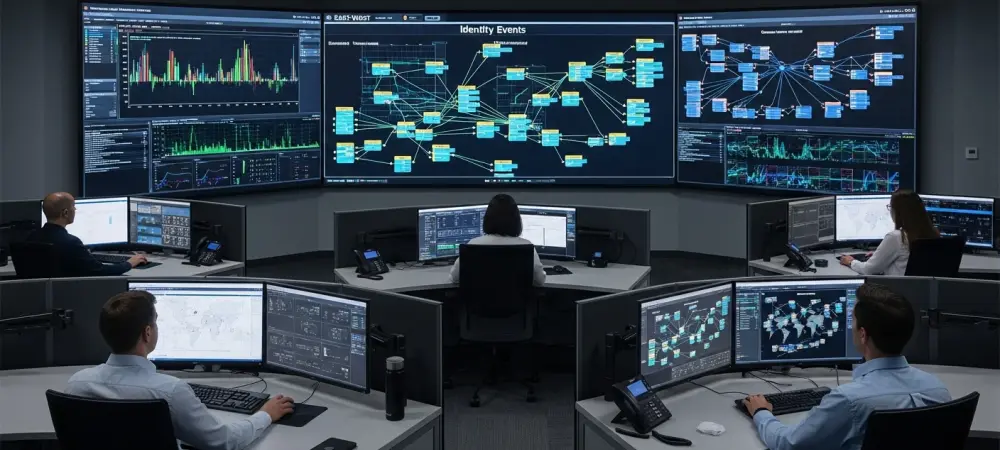
Response playbooks that prioritized east–west visibility and egress control showed better containment. Where segment boundaries forced attackers through monitored chokepoints, web shells lost their cover and tunnels stood out. Conversely, flat networks and unmonitored service accounts let intrusions mature into long dwell times. The lesson echoed across incidents: focus on identity security, memory and backup hardening, and behavior analytics tailored to admin channels.
The Trajectory: Where the Trend Led Next
Looking ahead from current conditions, exploitation of domestic platforms was set to accelerate because it aligned incentives, reduced discovery friction, and rewarded speed. Credential-first expansion would remain the throughline, while hybrid arsenals continued to blur the line between legitimate and malicious administration. Selected clusters were likely to deepen AI-assisted development and lure generation, shrinking iteration cycles and enabling rapid refresh of delivery chains when indicators became noisy.
Defenders faced shrinking patch windows and a need to map exploit surfaces across domestic stacks with the same rigor long applied to global tech. The monitoring lens would keep shifting from perimeter events to identity-centric telemetry, backup systems, memory-resident artifacts, and anomalous egress rooted in proxies and tunnels. Organizations that treated collaboration servers and messaging gateways as Tier‑0 adjacent rather than routine utilities would reduce exposure by default.
The Bottom Line: Risks, Metrics, and Practical Steps
Two scenarios framed the stakes. In the best case, rapid patch adoption, behavior-based detections, and segmented architectures limited attacker leverage and shrank dwell times. In the worst case, persistent patch lag, covert tunnels, and harvested credentials drove widespread domain compromise from a single unpatched service. Practical metrics offered early warning: mean time to patch versus mean time to exploit, spikes in credential-theft detections, lateral movement on admin channels, proxy anomalies, and lure telemetry emanating from Telegram and niche technical sites.
Organizations that tuned playbooks to these signals—treating identity as the new perimeter and domestic software as high-value exposure—were better positioned to push attackers off timeline advantage. Concrete priorities included hardening credential stores and backup systems, constraining remote admin pathways, enforcing egress policies, and building software asset intelligence for local stacks. Over time, metrics-driven remediation SLAs and continuous validation helped compress the gap adversaries had been exploiting.
Conclusion: Action, Not Aftermath
The pattern described here had reinforced a simple truth: private exploit research against domestic platforms met sluggish patch culture at exactly the wrong moment, and the resulting collisions reshaped intrusion economics across Russian networks. Effective response hinged on collapsing patch windows, elevating collaboration and messaging platforms into critical-asset tiers, and moving detections from malware names to behaviors that revealed web shells, tunnels, and identity abuse. Teams that invested in identity threat detection and response, hardened memory and backup pathways, and enforced egress-aware architectures reduced dwell time and blunted lateral spread. As the ecosystem matured, the distinguishing advantage lay in disciplined asset intelligence and metrics‑driven operations that kept pace with compressed research‑to‑weaponization cycles, turning a recurring liability into an increasingly manageable risk.