

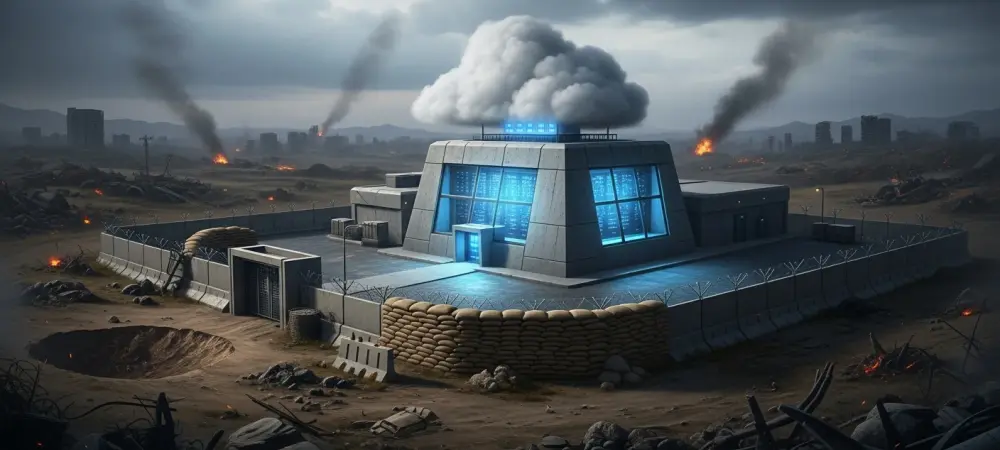
Cloud computing has long been marketed as a nebulous, indestructible force, yet recent geopolitical escalations have shattered this illusion by demonstrating that digital assets are deeply tethered to vulnerable physical sites. As kinetic strikes target the physical heart of the digital world, the “invisible” cloud is proving to be a primary front in modern combat. This analysis explores the transition of data centers from corporate hubs to Tier 1 military targets, examining how global powers are reimagining infrastructure resilience to survive a new era of multi-domain warfare. The current landscape suggests that the era of treating data as a purely virtual entity has ended, replaced by a reality where a single drone strike can paralyze the digital economy of an entire region.
The Shift From Digital Disruption to Physical Destruction
Data-Driven Insights on Regional Infrastructure Vulnerabilities
Recent conflict data underscores a drastic shift in how digital assets are prioritized during military operations. Reports from Cloudflare Radar indicate that during coordinated strikes in late February 2026, internet traffic in conflict zones such as Iran plummeted to less than 1% almost instantly. This sudden collapse was not the result of software glitches or standard cyber warfare but rather the systematic targeting of the physical nodes that facilitate connectivity. Statistics show that the reliance on concentrated cloud regions has created a “centralization trap,” where the destruction of a few key physical locations can effectively disconnect a nation from the global network.
Adoption of cloud services in the public sector has grown exponentially, but statistics on “resilience readiness” suggest that the physical hardening of these sites has not kept pace with their strategic importance. While many organizations have migrated to the cloud to avoid the risks of on-premise hardware failure, they have inadvertently traded localized risks for a broader vulnerability. Current mapping of global data centers reveals a dangerous lack of geographical diversity, with massive amounts of critical data stored in a handful of high-density clusters that remain exposed to conventional military ordnance.
Case Studies: Kinetic Attacks on Cloud Facilities in the Middle East
The February and March timeline of this year provides concrete evidence of this trend. On March 2, Amazon Web Services confirmed that two facilities in the United Arab Emirates and one in Bahrain suffered physical damage from drone strikes and kinetic impacts. These incidents moved beyond traditional hacking, involving structural fires and hardware loss triggered by emergency suppression systems. This represents a paradigm shift where the objective of an adversary is no longer to steal data, but to physically annihilate the capability to process it, causing immediate and irreparable disruptions to both military and civilian logistics.
Real-world examples demonstrate that adversaries are now using a “multi-domain” blueprint—combining the cyber-disruption of Industrial Control Systems with physical bombardment to blind opponents. In these scenarios, the internal fire-suppression mechanisms of the data centers often caused as much hardware damage as the initial impacts, as the high-pressure water and chemical systems ruined sensitive server racks. This combination of physical force and automated failure highlights a critical oversight in current infrastructure design, where safety systems intended for accidental fires become liabilities during active combat.
Perspectives From Cybersecurity and Defense Leaders
Industry experts, such as Kathryn Raines of Flashpoint and Kim Larsen of Keepit, argue that the “geographic invisibility” of the cloud is a dangerous fallacy. Thought leaders emphasize that while the industry has mastered “high availability” for environmental disasters or power outages, it remains woefully unprepared for military-grade targeting. The consensus among professionals is that the “60-mile radius” rule for backup data centers—originally designed to ensure low latency—is a strategic liability in warfare. This proximity ensures that both primary and secondary assets often fall within the same kinetic strike zone, rendering redundancy protocols useless against a determined state actor.
Experts stress that the future of defense lies in acknowledging the physical nature of digital storage: servers, undersea cables, and power grids are now the most critical vulnerabilities in any national defense posture. There is a growing movement toward treating cloud providers as “digital utilities” that require the same level of anti-aircraft and physical security as nuclear power plants. Defense analysts suggest that the next phase of cloud evolution will involve a radical departure from the current model, prioritizing survival and physical fortification over the speed and low costs that drove the initial cloud boom.
The Future of Sovereign Data and Global Resilience
Evolution Toward Allied Data Sovereignty
The future of cloud infrastructure will likely be defined by a shift from localized data residency to what is becoming known as “Allied Data Sovereignty.” As nations realize that keeping data strictly within physical borders makes it an easy target for nearby adversaries, legal frameworks will evolve to allow critical information to be mirrored across “safe-haven” allied nations. This evolution will balance the need for data privacy with the necessity of survival, ensuring that a digital state can continue to function even if its physical territory is temporarily compromised or under siege.
This shift toward distributed sovereignty marks the end of the isolationist approach to data management. Governments are beginning to recognize that a “digital government-in-exile” capability is essential for modern continuity of operations. By leveraging infrastructure in geographically distant but politically aligned regions, nations can ensure that their essential services—ranging from tax collection to military command and control—remain operational despite the physical destruction of local hardware.
Long-Term Implications for High-Stakes Industries
Looking ahead, sectors such as finance, healthcare, and logistics must adopt “true resilience” protocols that go far beyond simple software backups. The trend points toward the physical hardening of data centers to match the security levels of military bases, potentially including underground construction or reinforced concrete shells. While these developments promise a more robust global network, they also present challenges, including significantly higher infrastructure costs and complex jurisdictional disputes over data access in third-party countries.
Ultimately, the cloud will transition from a tool of convenience to a hardened, distributed fortress. High-stakes industries will likely move away from a single-provider model, opting instead for multi-cloud strategies that span different tectonic plates and political alliances. This diversification will be necessary to mitigate the risks of “cascading failures,” where the loss of one provider’s region impacts global supply chains. The cost of this security will be high, but the alternative—total digital blackout during a conflict—is becoming an unacceptable risk for the modern state.
Conclusion: Redefining Security in a Cloud-Dependent World
The recent strikes in the Middle East served as a definitive wake-up call, stripping away the myth of the cloud’s untouchability. Organizations and governments realized that digital security was inseparable from physical survival, prompting a rapid reassessment of infrastructure priorities. Decision-makers moved to implement strategic redundancy that accounted for kinetic threats, rather than just technical glitches. The development of international cooperation frameworks became a priority to protect the physical nodes of the digital existence as fiercely as the data they held. Industry leaders successfully pushed for the integration of physical hardening into the standard cloud architecture. This transition ensured that the global digital economy could withstand the pressures of multi-domain warfare through a unified strategy of geographic distribution and physical defense. Ultimately, the lessons learned from these conflicts transformed the cloud into a resilient, fortified asset capable of supporting national survival in an increasingly volatile world.