

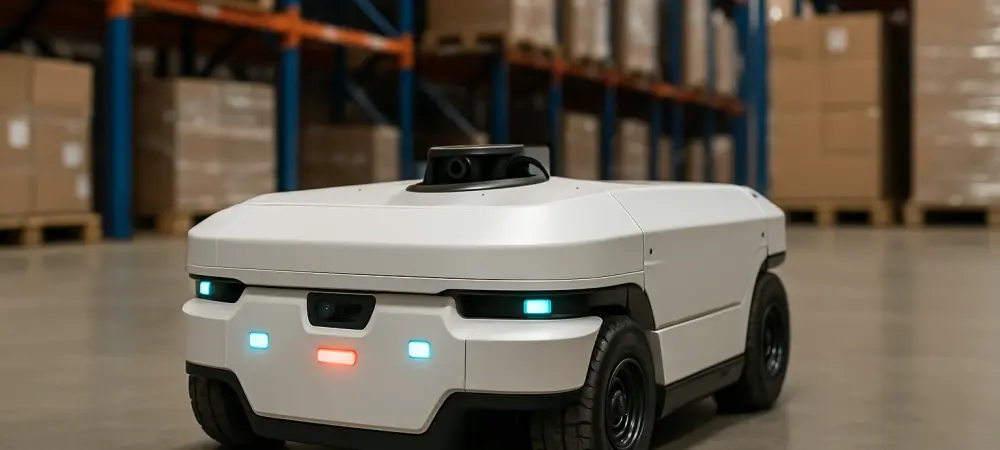
Imagine a bustling warehouse where goods move seamlessly from one point to another without human intervention, guided by machines that navigate tight spaces with precision and safety. This is no longer a vision of the future but a reality driven by autonomous mobile robots (AMRs) transforming the logistics sector. A standout in this revolution is KUKA’s latest innovation, the KMP 250P, a game-changer designed to redefine efficiency in material handling. This cutting-edge technology exemplifies how automation is tackling some of the most pressing challenges in modern industrial operations, setting a new standard for smart logistics.
The Rise of Autonomous Mobile Robots in Logistics
Market Growth and Adoption Trends
The logistics industry is witnessing an unprecedented surge in the adoption of AMRs, fueled by the need for greater efficiency and scalability. According to recent market reports, the global AMR market is projected to grow significantly from 2025 to 2030, with a compound annual growth rate exceeding 20%. This rapid expansion reflects a shift toward automation as companies strive to meet rising consumer demands and optimize supply chains. Investments in robotic solutions have soared, particularly in warehousing and manufacturing, where AMRs are increasingly seen as essential tools for streamlining operations.
Beyond financial projections, the adoption rate tells a compelling story. Over 60% of large-scale logistics firms have integrated AMRs into their workflows in the past few years, a trend driven by the need to reduce labor costs and enhance productivity. These robots are not just a luxury but a necessity in environments where precision and speed are paramount. As industries face mounting pressure to deliver faster, AMRs stand out as a reliable solution to bridge operational gaps.
This growth is further supported by technological advancements that make AMRs more accessible and cost-effective. Governments and private sectors alike are pouring resources into automation, recognizing its potential to revolutionize material handling. The trajectory suggests that by the end of this decade, AMRs will be a cornerstone of logistics infrastructure across the globe, reshaping how goods are moved and managed.
Real-World Applications and KUKA’s KMP 250P
At the forefront of this trend is KUKA’s KMP 250P, an autonomous mobile robot engineered to handle payloads up to 250 kg, offering a versatile solution for intralogistics. This model integrates seamlessly with other KUKA AMRs, such as the KMP 1500P and KMP 600P, through shared accessories and charging systems, allowing manufacturers to scale operations without overhauling existing setups. Its design prioritizes adaptability, catering to a wide range of industrial needs with a focus on efficiency.
A key feature of the KMP 250P is its compliance with the VDA 5050 communication standard, enabling it to operate within multi-vendor fleets—a critical advantage in diverse industrial settings. Additionally, the robot comes in cleanroom and ESD variants, making it suitable for sensitive environments like electronics or pharmaceutical production. Safety is another hallmark, with 360-degree laser scanners and 3D cameras ensuring obstacle detection and smooth interaction with human workers, minimizing risks in dynamic spaces.
Practical applications of the KMP 250P are already evident in manufacturing, where its modularity and the KUKA.AMR Fleet Manager software optimize fleet coordination. The robot’s ability to enter a sleep mode during idle periods reduces energy consumption, while its differential drive enhances maneuverability in confined areas. Flexible charging options, whether inductive or conductive, further ensure uninterrupted operations, positioning this AMR as a pivotal tool for modern logistics challenges.
Industry Perspectives on AMR Innovations
Insights from industry leaders highlight the transformative potential of solutions like the KMP 250P in autonomous logistics. Representatives from KUKA emphasize that this robot addresses core demands for scalability and safety, ensuring that manufacturers can adapt to fluctuating production needs without compromising worker protection. Such advancements are seen as vital in an era where operational agility often determines competitive advantage.
Experts also point to the importance of energy efficiency and advanced safety mechanisms as key differentiators in the AMR space. Features like sleep mode not only cut costs but also align with sustainability goals, a growing priority across industries. The ability of the KMP 250P to dynamically reroute around obstacles using sophisticated sensors is frequently cited as a benchmark for human-robot collaboration, fostering safer workplaces.
Moreover, the consensus among industry voices is that AMRs must offer adaptable automation to meet diverse operational challenges. The KMP 250P’s compatibility with existing systems and its focus on modular design reflect a broader industry push toward flexible, future-proof solutions. This alignment with current and emerging needs underscores why such innovations are gaining traction among logistics professionals seeking sustainable growth.
Future Outlook for AMRs in Logistics
Looking ahead, KUKA is set to expand its offerings with the KMP 250P-T tagger variant, expected to launch in 2026, capable of pulling loads up to 500 kg. This development promises to enhance material handling flexibility, allowing for the transport of heavier trolleys in complex environments. Such innovations signal a continued push toward broadening the scope of AMR applications in logistics.
The broader implications of AMRs extend to improved productivity and reduced operational costs, though challenges like integration complexities and workforce adaptation remain. As these robots become more prevalent, companies must navigate the learning curve associated with implementing advanced systems while ensuring employees are trained to collaborate with autonomous technologies. Addressing these hurdles will be crucial for maximizing the benefits of automation.
Sustainability also plays a significant role in the future of AMRs, with energy-efficient designs like the KMP 250P’s sleep mode paving the way for greener operations. Advancements in AI, sensor technology, and fleet management systems are expected to further refine these robots, enabling more precise navigation and smarter decision-making. Over the coming years, AMRs are likely to evolve into even more integral components of logistics, driving efficiency while supporting environmental goals.
Shaping the Future of Smart Logistics
Reflecting on the journey of autonomous mobile robots, it has become clear that innovations like KUKA’s KMP 250P have set a high bar for efficiency, safety, and scalability in logistics. Their role in streamlining material handling and fostering safer workplaces marks a turning point for the industry. KUKA’s leadership in this space demonstrates a commitment to addressing both current challenges and future demands with cutting-edge solutions.
As industries move forward, the next steps involve embracing AMR technology as a strategic asset, investing in training programs to ease workforce transitions, and prioritizing seamless integration into existing systems. Exploring partnerships with technology providers to customize solutions for specific operational needs also emerges as a practical approach. These actions promise to unlock the full potential of AMRs in enhancing productivity.
Looking beyond immediate gains, the focus shifts to long-term sustainability, with energy-efficient designs and AI-driven advancements offering a path to greener logistics. Industries are encouraged to stay ahead of the curve by adopting scalable automation that can adapt to evolving market dynamics. This proactive stance ensures that the legacy of AMRs continues to shape a more resilient and innovative future for smart logistics.