

The familiar hum of the automotive assembly line is being orchestrated by an entirely new conductor, one composed of advanced algorithms and sophisticated robotics that promise to redefine mobility itself. The automotive industry is no longer just about building cars; it is about engineering the future of movement. At the forefront of this transformation is the convergence of physical artificial intelligence (AI) and robotics. Hyundai Motor Group’s recent announcements provide a powerful case study of this trend, revealing a future where robots are integral to every stage of the automotive value chain. This analysis will dissect Hyundai’s ambitious strategy, examining the data, real-world applications, strategic partnerships, and future implications of this industry-defining shift.
Deconstructing Hyundai’s Robotics Masterplan
The Strategy by the Numbers
A clear indicator of Hyundai’s commitment to this trend is its staggering $26 billion investment earmarked for the U.S. over the next four years. This capital is not an abstract pledge but is being channeled into tangible infrastructure designed to accelerate the fusion of AI and manufacturing. A cornerstone of this investment is the establishment of the Robot Metaplant Application Center (RMAC) in Georgia, a dedicated hub that will serve as the primary training ground for the next generation of industrial robots.
This financial backing is coupled with a clear and aggressive deployment roadmap. The company has outlined a timeline that sees its advanced Atlas robots handling highly repetitive sequencing tasks by 2028, with a progression toward more complex assembly work by 2030. Furthermore, Hyundai is preparing for scale, with a potential annual production capacity of 30,000 robots by 2028. This demonstrates a concrete plan to move from experimental technology to a core component of its global production operations.
Real-World Applications
At the heart of Hyundai’s manufacturing evolution is the new Atlas humanoid robot from Boston Dynamics, envisioned not as a replacement for human workers but as a “coworker.” These robots are being designed to handle the hazardous, repetitive, and physically demanding tasks that are common on the factory floor. This approach to human-robot collaboration aims to enhance safety and efficiency, freeing human talent to focus on more complex, creative, and strategic aspects of the production process.
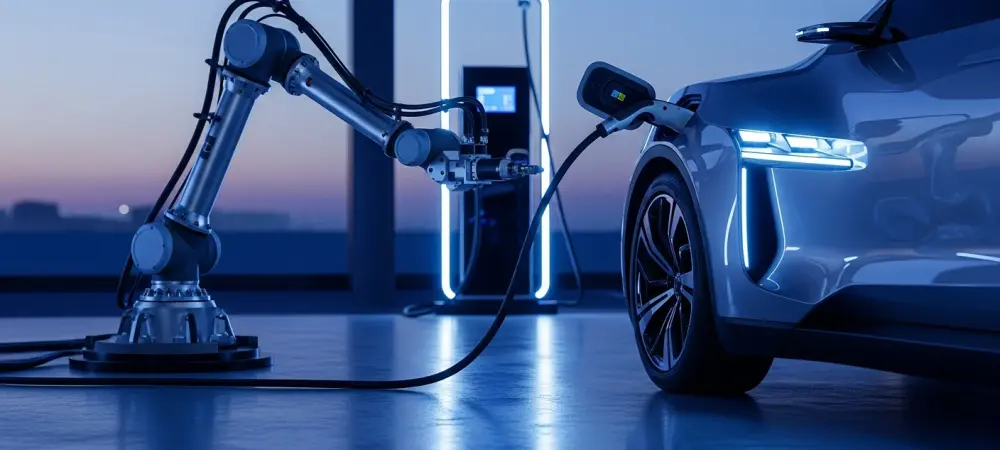
This vision extends far beyond a single robot. The strategy is underpinned by a “software-designed factory” approach, which utilizes vast amounts of real-world production data to create a continuous feedback loop for optimizing robot learning and performance. The application of automation also moves beyond the factory walls. Recent demonstrations included a motorized platform capable of autonomously parking cars and a sophisticated robotic arm designed to charge electric vehicles like the Ioniq 5, signaling a future where robotics enhances the entire vehicle ownership experience.
Forging Alliances: The Power of Strategic Collaboration
Hyundai’s strategy is built on the understanding that pioneering this new frontier requires deep, synergistic partnerships. The company’s majority stake in Boston Dynamics serves as the central pillar of its plan to construct an end-to-end robotics value chain. By integrating Boston Dynamics’ world-leading expertise, Hyundai is accelerating its internal capabilities, from component development to advanced AI systems, rather than simply purchasing off-the-shelf solutions.
Moreover, the company is actively cultivating alliances with other global technology leaders. This is exemplified by Boston Dynamics’ new collaboration with Google DeepMind, a move intended to advance the core AI capabilities that power its robots. In a similar vein, a strategic meeting between Hyundai’s executive chair and Nvidia’s CEO signals a deepening partnership focused on next-generation autonomous driving technologies. These collaborations underscore the trend’s significance, proving that industry leaders are pooling their expertise to overcome immense technical challenges and hasten the pace of innovation.
The Road Ahead
The long-term vision emerging from these initiatives is a fully integrated robotics value chain that touches every aspect of the automotive lifecycle. This includes the development of robotic components, advanced manufacturing and logistics systems, and the direct integration of AI into vehicle technology. The potential benefits of this integrated approach are profound, promising not only increased factory safety and enhanced production efficiency but also the accelerated development of more reliable and capable autonomous vehicle systems.
However, the path forward is not without its challenges. Scaling the production of highly advanced robots like Atlas is a significant engineering and logistical hurdle. Equally complex is the task of training these machines for the nuanced, adaptable, and increasingly intricate tasks required in modern manufacturing. Successfully navigating these obstacles will be critical to realizing the full potential of this technological shift, which could redefine the very nature of automotive manufacturing and set a new standard for automation across all industries.
A New Paradigm for the Automotive Industry
Hyundai’s comprehensive strategy, built on enhancing human-robot collaboration, creating a complete robotics value chain with Boston Dynamics, and forging partnerships with top-tier AI firms, represents a blueprint for the future. This approach confirmed that the integration of AI and robotics is no longer a peripheral experiment but a fundamental component of the entire automotive ecosystem. This shift from viewing robots as mere tools to essential partners in innovation marks a significant turning point. This comprehensive approach signaled a paradigm shift, positioning Hyundai and other early adopters to lead the future of both mobility and intelligent manufacturing.