

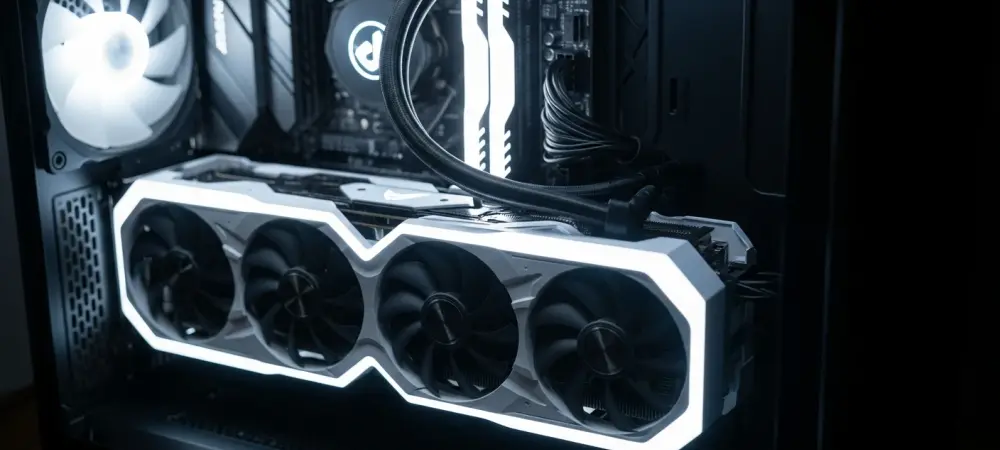
The immense computational power once reserved for sprawling, climate-controlled data centers is now quietly humming away inside the graphics cards of everyday personal computers. This fundamental shift marks a new era for artificial intelligence, moving it from the exclusive domain of large corporations to the hands of individual users. The significance of this transition cannot be overstated, as it promises to democratize AI development, bolster user privacy by keeping data local, and unlock unprecedented creative and productivity tools for everyone. This analysis will explore the rise of this trend, examine a pivotal new software initiative from AMD, consider its broader industry implications, and project the future of on-device AI.
The Democratization of AI From Data Centers to Desktops
The Growing Demand for Local AI Processing
A notable surge in consumer interest for running AI applications locally is reshaping the market. This demand is fueled by mounting concerns over the privacy implications of cloud-based services, the recurring costs of subscriptions, and the performance bottlenecks caused by data latency. When sensitive information is processed on a personal machine, it never has to be uploaded to a third-party server, providing a powerful layer of security and control.
This movement is further accelerated by the proliferation of powerful open-source models. Innovations like Stable Diffusion for image generation and a variety of Large Language Models (LLMs) are now increasingly optimized to operate efficiently on consumer-grade hardware. Consequently, market reports indicate a clear trend toward the adoption of AI-capable consumer GPUs and the software that leverages them, creating a self-reinforcing cycle of demand and development.
Real-World Applications on Consumer Hardware
The practical applications of local AI are already tangible and expanding rapidly. In the creative sphere, users are generating stunning images and video clips directly on their PCs, free from the constraints and costs of online services. Simultaneously, personalized chatbots and assistants can run entirely offline, offering instant responses and complete privacy. For developers, local processing provides an invaluable sandbox for testing and fine-tuning models without incurring cloud computing expenses.
This ecosystem is supported by a growing suite of user-friendly software. Applications like Stable Diffusion Web UIs, LM Studio, and Jan AI have become instrumental, providing intuitive interfaces that empower users to harness their GPUs for highly complex AI tasks. Moreover, this trend is enhancing traditional PC use cases like gaming, where AI-driven technologies deliver advanced graphics upscaling and more dynamic, believable non-player character (NPC) behavior.
AMDs Strategic Push Unifying Hardware and Software
AI Made Simple The New Radeon AI Bundle
In a direct response to this growing demand, AMD is set to release a new optional “AI Bundle” for its Radeon GPUs, integrated directly into its Adrenalin software driver suite on January 21st. The central purpose of this initiative is to dramatically simplify the traditionally convoluted process of setting up a local AI environment. By offering a single, streamlined installer, AMD aims to remove the technical hurdles that have historically discouraged many potential users.
This approach perfectly embodies the company’s new tagline, “AI made simple.” The goal is to make powerful AI tools accessible to a much wider audience, ranging from curious hobbyists and content creators to seasoned developers seeking a more efficient workflow. This move signals a clear understanding that ease of use is just as important as raw performance in driving widespread adoption.
Empowering Creators and Developers
The bundle is designed to equip users with the “essential tools” needed to build and run AI workloads locally. For creators, this means facilitating sophisticated AI-driven workflows, such as image generation and enhancement, without any reliance on external cloud platforms. This allows for greater creative freedom, faster iteration, and complete ownership over the generated content. For the developer community, the bundle introduces a significant advantage: new native support for the popular PyTorch framework on Windows. This addition, combined with easy access to applications for running local LLMs, creates a robust and cost-effective environment for experimentation and innovation. It empowers developers to prototype, train, and test models directly on their personal machines, accelerating the development cycle.
Expert Perspectives Industry Implications of Accessible AI
Industry analysts widely agree that lowering the barrier to entry for AI development will catalyze a new wave of innovation. By simplifying the setup process, initiatives like AMD’s AI Bundle empower independent creators and small-scale developers who were previously sidelined by technical complexity and high costs. This democratization is expected to lead to a more diverse and vibrant AI application ecosystem.
This software push is also viewed as a calculated strategic maneuver in the competitive hardware landscape. For years, NVIDIA has maintained a stronghold on the AI market with its mature CUDA platform. By creating a unified and accessible software ecosystem for its hardware, AMD is mounting a formidable challenge. Analysts note that a cohesive strategy connecting Ryzen AI CPUs, RDNA GPUs, and a simplified software layer like the AI Bundle significantly strengthens AMD’s position in the burgeoning consumer AI market.
The Future of On-Device AI
Potential Developments and Benefits
Looking ahead, the evolution of consumer GPUs will likely focus even more on specialized AI capabilities. Future hardware is expected to feature more dedicated AI cores, a substantial increase in VRAM to accommodate larger models, and greater power efficiency to manage demanding workloads. This hardware progression will enable the next generation of on-device AI. This could lead to the development of truly personal AI assistants that operate entirely on a user’s device, offering unparalleled privacy and deep personalization based on local data. Furthermore, a new wave of highly responsive, AI-native applications for productivity and creativity is on the horizon. These tools will be built from the ground up to leverage local AI, fundamentally redefining the speed, intelligence, and capability of the personal computer experience.
Challenges and Considerations
Despite the promising future, significant challenges remain. The VRAM capacity of most consumer cards is a primary bottleneck, as leading AI models continue to grow in size and complexity. This creates a hardware race where consumer products may struggle to keep pace with the cutting edge of AI research.
Another potential hurdle is the risk of software fragmentation. As AMD, NVIDIA, and Intel each build out their respective AI ecosystems, a lack of interoperability and open standards could create silos that stifle innovation and frustrate users. Beyond the technical aspects, the widespread accessibility of powerful AI tools raises important security and ethical questions that the industry and society must collectively address.
Conclusion The New Frontier of Personal Computing
The migration of intensive AI workloads from remote data centers to local consumer GPUs has become a defining trend in modern technology. Strategic initiatives like AMD’s AI Bundle are not merely a response to this trend but a powerful catalyst accelerating it. The focus on simplifying access to these complex tools proved crucial, empowering a new generation of innovators, creators, and developers to participate in the AI revolution. On-device AI represents the next major evolution in personal computing, a frontier that promises a future of more intelligent, secure, and profoundly capable personal devices.