

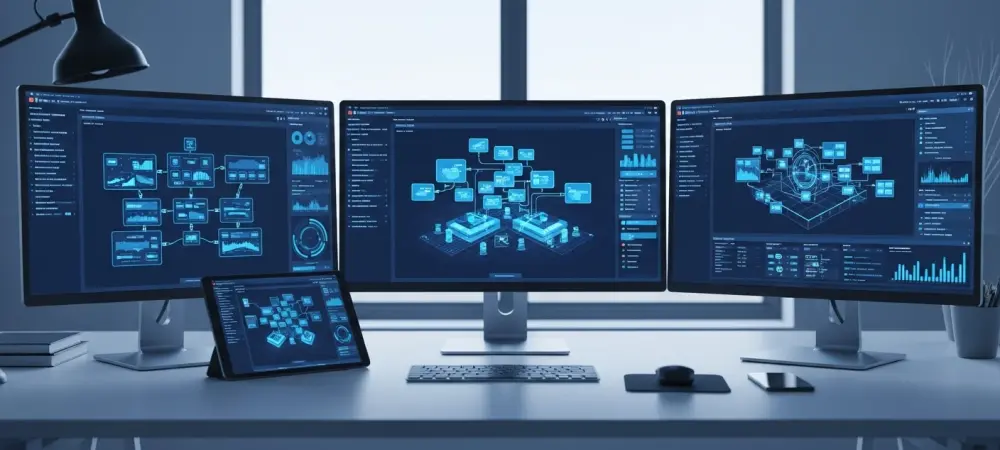
The transition from software that simply responds to prompts toward digital systems that independently execute complex business logic marks a definitive end to the age of passive assistants. We are no longer settling for chatbots that merely talk about productivity; the market has pivoted toward autonomous agents that actively deliver finished professional output. This shift, epitomized by agentic systems like Tencent WorkBuddy, signals a fundamental restructuring of human-to-computer interaction within the corporate world. As global enterprises grapple with increasing operational density, these AI-native tools are bridging the gap between intention and execution by managing workflows that previously required dozens of manual steps. This evolution represents a move away from simple text generation toward a model where the AI acts as a digital colleague capable of high-level task decomposition and autonomous resolution.
Market Evolution and Data-Driven Insights
The Surge of Agentic AI in the Global Workplace
The industry is currently witnessing a massive technical migration from Large Language Models (LLMs) to Large Action Models (LAMs), focusing on the ability to perform multi-step tasks rather than just generating text. Statistical data indicates a significant surge in no-code AI integration, where non-technical employees deploy sophisticated digital workers to handle data-heavy assignments. Companies now prioritize tools that offer tangible results over conversational filler, fueling the growth of the agentic software sector. This evolution reflects a broader demand for systems that can navigate the nuances of professional environments without constant human hand-holding or specialized programming knowledge.
Modern adoption trends suggest that businesses are moving away from monolithic AI platforms in favor of modular, agentic environments. These systems allow for a more granular approach to automation, where specific business functions are handled by specialized sub-units. Moreover, the integration of these tools into the daily routine of non-technical staff has democratized the power of automation. This shift is not merely about efficiency but about redefining the scope of what a single professional can achieve within a standard workday.
Bridging the Gap: Real-World Implementation via Tencent WorkBuddy
Tencent WorkBuddy serves as a prime example of this trend, transforming natural language requests into complex spreadsheets, detailed research briefs, and ready-to-present slide decks. The platform introduces the innovative concept of Expert Teams, where specialized sub-agents collaborate on multifaceted projects like financial modeling or software development under a lead supervisor. By offering a Skills Gallery with over 100 pre-configured roles, the system democratizes specialized technical knowledge, making high-level expertise accessible to every office worker regardless of their background.
This approach effectively converts a single user into a manager of a digital department, significantly scaling individual output through orchestration. Instead of writing individual prompts for every step of a project, the user provides a high-level goal, and the agentic system determines the necessary sequence of actions. This level of autonomy reduces the cognitive load on professionals, allowing them to focus on decision-making rather than the mechanical aspects of data processing or document creation.
Expert Perspectives and Industry Impact
Strategic integration into existing communication channels like Slack, Telegram, and Discord allows these agents to function as persistent members of a professional team. The implementation of the Model Context Protocol (MCP) further strengthens this utility by linking AI agents to enterprise standards like GitHub, Google Drive, and Jira. This connectivity ensures that the agent is not an isolated tool but a central hub capable of pulling data from across an entire organization to complete its tasks. Such interoperability is crucial for maintaining a cohesive workflow in an era of distributed teams and fragmented digital ecosystems.
Furthermore, the focus on sandbox environments addresses critical security concerns, providing an isolated space for the AI to process local files while maintaining strict data privacy protocols. Industry experts emphasize that the success of agentic AI depends heavily on this balance between deep system access and robust protection. This security-first architecture is becoming a mandatory requirement for any AI tool seeking broad adoption in the corporate sector. By operating within these secured boundaries, agents can interact with sensitive enterprise data without exposing the organization to external vulnerabilities.
The trend also extends into the creative domain with tools like Tencent Design Miora, which focuses on professional-grade 3D and UI/UX asset generation. This specialization highlights a shift away from generic AI toward high-fidelity agents that understand the specific requirements of design and brand identity. While WorkBuddy handles the technical overhead, creative agents ensure that visual production remains consistent with professional standards. This dual-pronged approach ensures that both the logical and creative functions of a modern business are supported by autonomous, task-oriented intelligence.
The Future of Autonomous Workflows
Looking ahead, the evolution of these expert teams suggests a landscape where entire administrative and creative departments could operate with minimal human oversight. This transition presents a delicate challenge in balancing automation efficiency with the preservation of human creative agency and oversight. The rise of LLM Agnosticism, where users swap underlying models via API keys to optimize for performance or cost, will likely become a standard requirement for enterprise-grade tools. This flexibility ensures that businesses are not locked into a single provider, allowing them to adapt to changing market conditions and regional regulations.
As these agents break down technical and language barriers, they are poised to create a more interconnected global digital economy that prioritizes results over process. The ability of agentic systems to translate complex business needs into finished products across different languages and technical stacks will diminish the friction currently found in international collaborations. This will lead to a more fluid exchange of ideas and professional services, where the speed of execution is limited only by the clarity of the initial prompt.
Concluding Thoughts on the Agentic Era
The migration toward autonomous AI-native agents effectively redefined the boundaries of professional productivity and reshaped how companies approached workforce scaling. Organizations that prioritized early adoption of agentic workflows managed to eliminate substantial administrative friction, allowing their human talent to focus on high-level strategic pivots. This shift moved the needle from simple digital assistance to true digital collaboration, where the AI took ownership of deliverables. Success in this era depended on the seamless integration of these tools into existing security frameworks and the ability to manage digital expert teams as effectively as human ones. Professionals who mastered the orchestration of these autonomous colleagues secured a decisive competitive advantage in a rapidly accelerating global market. The transition confirmed that the future of work was not about working harder, but about managing more intelligent systems to achieve unprecedented results.