

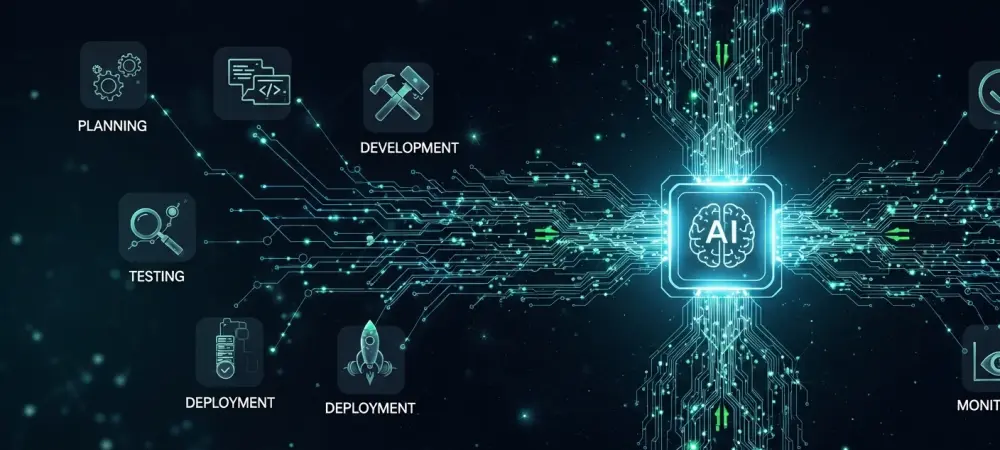
After more than two decades of shaping software delivery, the DevOps movement finds itself at a critical juncture, facing pointed questions about whether it truly delivered on its foundational promises of speed, stability, and developer ownership. The narrative that DevOps has failed, however, misses a crucial nuance: the movement was a philosophy ahead of its time, fundamentally constrained by the available technology. The recent and rapid integration of Artificial Intelligence into the software lifecycle is not just another incremental improvement; instead, AI is emerging as the catalyst that finally unlocks the original, ambitious vision of DevOps. This analysis explores how AI is moving beyond a mere toolset to become the key to creating the intelligent, actionable feedback loops that the movement has always striven for, fundamentally completing its mission rather than replacing it.
The Current Landscape: AI as the DevOps Force Multiplier
The integration of AI into DevOps is no longer a theoretical concept but a rapidly accelerating trend transforming how software is built, tested, and operated. This shift is not about adding more tools to an already crowded landscape; it is about embedding intelligence directly into the delivery pipeline. As organizations grapple with increasingly complex, distributed systems, AI provides the means to manage this complexity, turning a firehose of raw data into the strategic insights needed to maintain velocity without sacrificing quality or security. This infusion of intelligence is effectively acting as a force multiplier, amplifying the core principles of DevOps—collaboration, automation, and feedback—to a degree that was previously unattainable.
From Data Overload to Actionable Intelligence
The most significant impact of AI is its ability to convert the overwhelming volume of system data into clear, actionable intelligence. The adoption of AIOps and AI-driven observability platforms has surged, with recent industry reports indicating that investment in AI tools for automating code testing, security analysis, and incident response is projected to grow exponentially over the next two years. This trend signifies a move away from passive data collection toward predictive and prescriptive analytics.
This evolution is visible in the very architecture of modern developer platforms. Leading cloud providers and software vendors are now embedding AI capabilities directly into their core offerings. These systems no longer just report on what happened; they actively predict potential failures, identify performance degradation before it impacts users, and recommend specific code or configuration changes. This shift is turning the once-aspirational goal of proactive system management into a practical reality for engineering teams of all sizes.
AIOps in Action: Realizing the Feedback Loop
The practical application of AIOps is where the theoretical promise of DevOps meets reality. Organizations are now leveraging AI-powered observability to automatically correlate massive streams of logs, metrics, and traces, providing developers with immediate root-cause analysis. This capability shortens the feedback loop dramatically, allowing engineers to understand the production impact of their code in minutes rather than hours or days. For instance, AI-driven tools are optimizing CI/CD pipelines by predicting test failures, automating the detection of security vulnerabilities early in the development cycle, and intelligently allocating cloud resources to balance cost and performance.
This technology has enabled leading companies to establish “golden paths” for their developers—standardized, automated workflows that balance the need for speed with the requirements for stability and compliance. By automating toil and providing intelligent guardrails, these AI-enhanced platforms allow development teams to maintain autonomy and innovate quickly while ensuring their work aligns with broader organizational standards. This creates a development environment where the path of least resistance is also the path of best practice.
Expert Perspectives: Redefining DevOps Success in the AI Era
Industry leaders are increasingly vocal in refuting the notion that DevOps failed, arguing instead that it was a cultural movement waiting for its technological counterpart. The core problem was never a flawed philosophy but rather an ecosystem of tools that could not keep pace with its vision. The advent of AI has reshaped this conversation, forcing a reevaluation of what “success” in DevOps truly means in an era of intelligent automation.
The definition of a successful DevOps implementation now varies significantly depending on the stakeholder, yet AI is seen as the common thread enabling each group to achieve its goals. For Operations and Site Reliability Engineers (SREs), AI finally provides the mechanism to enable true developer ownership of production systems by translating complex operational data into developer-friendly insights. In contrast, developers view success as the removal of operational friction, where AI automates complex tasks like environment provisioning and security scanning, freeing them to focus on writing code. Meanwhile, for security professionals, AI makes DevSecOps a practical reality by automating threat detection so early in the lifecycle that it becomes a natural part of the development workflow. Ultimately, thought leaders emphasize that DevOps was instrumental in laying the cultural groundwork necessary for AI to be effective. The movement successfully broke down silos and established the collaborative mindset required for cross-functional teams to trust and adopt automated, AI-driven systems. Without this cultural prerequisite, even the most advanced AI tools would fail to deliver their transformative potential, becoming isolated solutions in a fragmented organization.
The Future Trajectory: The Symbiotic Evolution of AI and DevOps
The relationship between AI and DevOps is evolving from a simple tool-user dynamic into a deeply symbiotic partnership. In the near future, AI will transition from an analytical tool to an active participant in the software development lifecycle. We are on the cusp of systems capable of autonomously writing unit tests, suggesting sophisticated code refactors to improve maintainability, and accurately predicting performance bottlenecks before a single line of code is merged into the main branch.
This evolution promises unprecedented benefits, including hyper-automated delivery pipelines that self-optimize for speed and efficiency and self-healing production systems that can detect and resolve incidents without human intervention. The result will be new benchmarks for both development velocity and system reliability. However, this future also introduces significant challenges. The industry must grapple with the need for new skills to develop, manage, and govern these intelligent systems, the inherent risk of over-relying on automated decision-making, and the complex ethical implications of embedding AI into the core of software creation.
This trajectory will inevitably redefine roles within engineering organizations. The position of a “DevOps Engineer,” once focused on building and maintaining CI/CD pipelines, will likely evolve. The future role will be that of a manager of intelligent, autonomous software delivery systems, responsible for training, tuning, and overseeing the AI models that drive the entire development and operations lifecycle.
Conclusion: A Movement Reborn, Not Replaced
The analysis ultimately shows that AI does not replace the DevOps movement but rather completes it, acting as the technological key that unlocks its long-held promise. The cultural principles of collaboration, shared ownership, and continuous feedback that DevOps championed were not missteps; they were the essential foundation upon which these new intelligent systems could be built. Without this groundwork, the introduction of AI would have only automated existing dysfunctions.
In this light, the narrative of failure seems misplaced. DevOps was not a flawed ideology but a visionary one, conceived years before the technology existed to fully support its ambitions. It successfully initiated a necessary cultural revolution that prepared the industry for a more automated, data-driven future.
With AI now a core component of the software delivery toolkit, the industry is only just beginning to realize the true potential of the DevOps philosophy. The journey was not about reaching a static endpoint but about continuous evolution. Now equipped with the tools it always deserved, the industry is entering a new era of building and operating software more intelligently, efficiently, and reliably than ever before.