

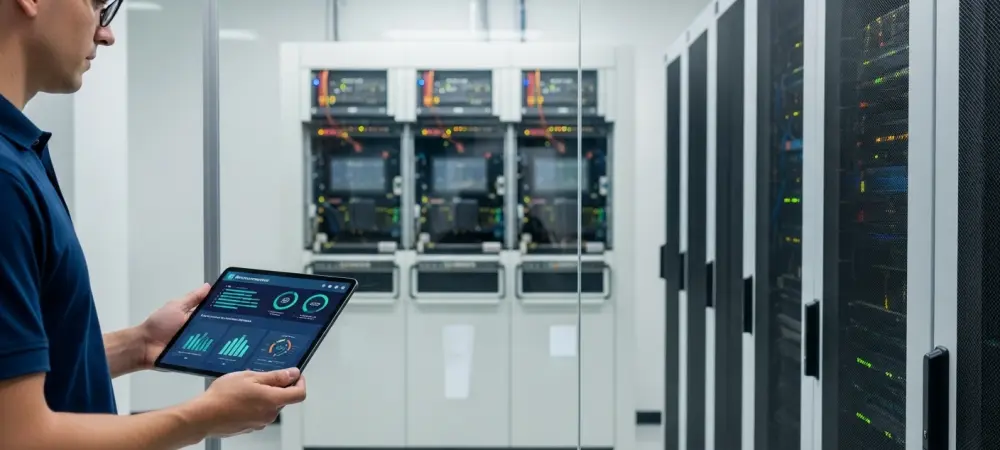
In the relentless pursuit of digital transformation, many enterprises find themselves navigating a complex landscape where cutting-edge, cloud-native platforms must coexist with the enduring power of mainframe systems. These legacy workhorses, renowned for their reliability and security, handle core business processing for countless organizations, yet they often operate in isolated silos, governed by traditional delivery models that clash with modern demands for speed and continuous improvement. This technological divide creates a significant bottleneck, where agile, DevOps-driven teams working on distributed systems are frequently held back by the slower, waterfall-style release cycles of their mainframe counterparts. The challenge is not simply a matter of technical incompatibility but a fundamental barrier to achieving true enterprise-wide agility, slowing innovation, and creating operational friction that can undermine strategic business objectives and delay the time-to-market for critical services.
1. Confronting the Legacy Delivery Model
The core of the issue lies in the deep-seated operational practices that have long defined mainframe application delivery, which stand in stark contrast to the fluid, automated workflows of modern software development. These systems have historically relied on waterfall-style release cycles, where long lead times are the norm and changes are batched into infrequent, large-scale deployments. This approach often involves highly manual build and deployment processes, which are not only time-consuming but also prone to human error. A significant hurdle is the absence of modern, Git-based source control for mainframe code, which prevents teams from leveraging standard version control workflows, collaborative branching strategies, and automated triggers. This lack of integration leads to limited automation and poor visibility into the software development lifecycle, making it difficult to track changes, manage dependencies, and ensure quality. Furthermore, without a clear pipeline, security and vulnerability scanning for mainframe applications becomes an afterthought, leaving critical systems exposed to potential threats.
This disparity between legacy and modern delivery models creates more than just technical debt; it cultivates organizational silos that stifle collaboration and innovation. When mainframe development operates on a completely different timeline and with a different set of tools, it becomes nearly impossible to align with digital engineering teams that practice continuous integration and continuous delivery (CI/CD). This friction results in a two-speed IT environment where one part of the organization moves with agility while the other remains a perceived bottleneck. The consequences are significant, leading to increased delivery and security risks as changes are not uniformly tested or scanned. This operational divide ultimately slows the entire enterprise’s ability to respond to market changes, launch new products, and deliver value to customers, transforming the reliable mainframe from a bastion of stability into an anchor holding back progress.
2. Architecting a Bridge to Modern Practices
The solution to this challenge does not necessitate a costly and high-risk mainframe replacement but rather a strategic modernization of how these systems participate in the software delivery lifecycle. The objective is to integrate mainframe environments into existing enterprise DevOps tooling while preserving the platform’s inherent stability and reliability. This can be achieved by creating a technical architecture that acts as a bridge between the two worlds. A key component of this approach involves implementing tools like the Zowe Command Line Interface (CLI), which enables modern continuous integration tools such as Jenkins to interact directly with mainframe machines (LPARs). Jenkins pipelines can be configured to invoke Zowe CLI commands, which in turn execute build, compile, and deployment operations on the mainframe through Endevor web services. This integration requires a one-time foundational setup, including configuring the Jenkins controller-agent architecture, installing the Zowe client CLI, and enabling the necessary Endevor services and security permissions to allow programmatic access from modern tools.
Once this foundational bridge is established, the next step is to fully integrate source control and enable continuous integration. Tools like the Endevor Bridge for Git facilitate bi-directional synchronization between the mainframe’s source code and enterprise Git repositories. This integration is transformative, allowing mainframe code to be version-controlled in Git and enabling developers to use standard workflows like feature branching and pull requests. Crucially, this approach can be non-disruptive, accommodating developers who prefer to continue working on traditional mainframe green screens while still syncing their changes back to Git. Any file additions or modifications committed to the Git repository can automatically initiate Jenkins pipelines, which then compile and validate the corresponding artifacts on the mainframe. This completes the full CI cycle, bringing automation and consistency to a previously manual process and providing immediate feedback on code quality.
3. Unlocking Business Value and Unified Governance
With mainframe code now managed within Git, it becomes accessible to the full suite of enterprise-grade tooling used across the organization, effectively eliminating long-standing security and compliance blind spots. This unified approach allows for the consistent application of static code analysis, vulnerability scanning, and governance checks across all platforms, both modern and legacy. Mainframe applications, which may have previously operated outside the purview of centralized security and risk management protocols, can now be brought into alignment with organizational standards. This integration significantly enhances the enterprise’s security posture by ensuring that all code, regardless of its origin, undergoes the same rigorous scrutiny before being deployed. The ability to apply uniform compliance checks also simplifies auditing processes and ensures that the entire software portfolio adheres to industry regulations and internal policies, reducing risk and building a more resilient technological foundation.
The successful integration of DevOps principles into the mainframe environment transcends technical improvements and delivers measurable business value. Organizations that adopt this model report significantly reduced release cycles, which enable a faster time-to-market for new features and services that rely on mainframe processing. The introduction of automation brings greater predictability to the delivery process, minimizing errors and increasing the reliability of deployments. This shift fosters a more unified delivery model across legacy and modern platforms, breaking down the operational silos that had previously hindered progress. Perhaps most importantly, it cultivates a stronger alignment between mainframe and digital engineering teams, who can now collaborate within a shared CI/CD framework. As a result, mainframe application delivery processes can transition from being a constraint on agility to becoming an active and integrated participant in the organization’s innovation engine.