

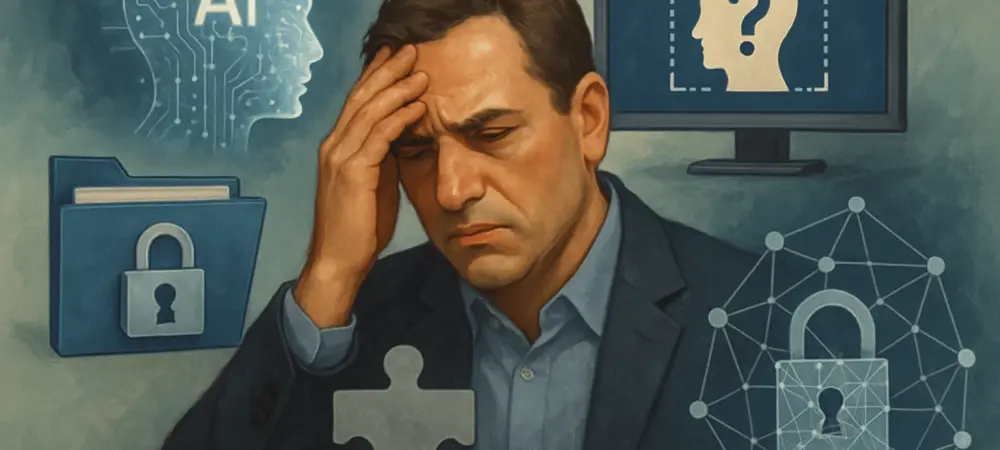
Imagine a world where the most trusted employee in an organization isn’t human, but a sophisticated AI system with access to every corner of the corporate network. This isn’t science fiction—it’s the reality many enterprises face today as artificial intelligence reshapes workflows with incredible speed and efficiency. Yet, with this transformative power comes a pressing question: Should AI be treated as a mere tool, or does it deserve the same scrutiny as a user with insider privileges? The stakes couldn’t be higher when a single misstep by an AI agent can cascade into catastrophic breaches at machine speed.
The significance of this topic cannot be overstated in the current digital landscape. With AI adoption skyrocketing across industries, organizations are integrating these systems into critical operations, from customer interactions to data analysis. However, the cybersecurity risks tied to inadequate governance are becoming alarmingly evident. Many still manage AI with outdated, static controls, leaving gaping vulnerabilities. This analysis dives into the evolving perception of AI as a user, explores real-world implications through examples, taps into expert insights on governance risks, projects future challenges and opportunities, and distills key takeaways for navigating this complex terrain.
The Shift in Perception: AI as a User, Not Just a Tool
Growth of Non-Human Identities in Enterprises
The rise of non-human identities, particularly AI systems, within organizational ecosystems marks a seismic shift in how enterprises operate. Industry reports suggest that the number of machine identities, including AI agents, now often surpasses human ones in many large corporations. According to recent surveys by leading tech research firms, over 60% of businesses have deployed AI-driven automation tools in the last two years alone, with adoption rates climbing steadily. This surge reflects a broader trend of relying on AI for decision-making and operational efficiency, fundamentally altering the identity landscape.
Beyond sheer numbers, the depth of integration is striking. AI systems are no longer confined to backend processes; they’re embedded in front-facing roles that require access to sensitive data and systems. Analysts predict that, from this year onward, the proliferation of these non-human identities will accelerate as organizations chase competitive edges through automation. This rapid growth, while promising, underscores a critical gap: most security frameworks are still tailored for human users, leaving machine identities like AI under-scrutinized and dangerously exposed.
Real-World Applications and Implications
In practical terms, AI often functions as a user within organizations, handling tasks with autonomy that rivals human employees. Take, for instance, AI-powered customer service bots deployed by major retailers. These systems interact directly with clients, process personal data, and even escalate issues to human teams—all while holding significant access privileges. Similarly, development assistants in tech firms generate code, while data analysis agents in financial institutions crunch numbers to inform high-stakes decisions.
Several prominent companies illustrate both the potential and the pitfalls of such implementations. A leading e-commerce giant recently reported a 30% boost in customer satisfaction after integrating an AI bot with broad system access, yet it also faced a near-breach when the bot inadvertently exposed user data due to a misconfiguration. Another case involved a healthcare provider whose AI data agent streamlined patient record analysis but raised alarms when outdated permissions allowed access to restricted files. These examples highlight a dual reality: AI can drive remarkable outcomes, but without proper oversight, it poses substantial risks to security and privacy.
Expert Insights on AI Governance Risks and Strategies
Turning to the frontline of cybersecurity thought leadership, experts like Ric Smith, president of product and technology at Okta, argue that AI agents must be treated as insiders with user-like privileges. Smith emphasizes that AI’s autonomous behavior—its ability to act without direct human input—mirrors the role of an employee, demanding equivalent governance. Static controls, such as unmonitored API keys, are woefully inadequate when AI can execute actions at breakneck speed, potentially amplifying errors or breaches before anyone notices.
Den Jones, founder and CEO of 909Cyber, builds on this by stressing the need to weave AI into the broader identity fabric of an organization. Jones warns against viewing AI as mere infrastructure, a mindset that often results in lax security measures. Instead, integrating AI into identity and access management (IAM) frameworks is crucial, alongside continuous monitoring to detect anomalous behavior. Both leaders agree that without real-time visibility, AI could become the fastest insider threat, exploiting access privileges in ways traditional systems struggle to counter.
Their insights point to a broader consensus: cybersecurity must evolve to address AI-specific risks. This means moving beyond one-time permissions to dynamic, behavior-based controls that adapt to how AI operates. The challenge lies in balancing innovation with caution, ensuring that AI’s potential isn’t stifled while safeguarding against its capacity for rapid, unintended harm.
Future Outlook: Evolving Challenges and Opportunities in AI Governance
Looking ahead, the trajectory of AI identity governance suggests a landscape of both promise and complexity. Advancements in IAM frameworks are expected to better accommodate non-human identities, with emerging tools focusing on machine-specific authentication and monitoring. Proactive behavioral analysis could enhance security by flagging deviations in AI actions before they escalate, offering a layer of protection that static systems lack. Such innovations hold the potential to transform how organizations manage risk in an AI-driven world.
However, challenges loom large on the horizon. Scaling governance across diverse AI systems—each with unique capabilities and access needs—will test even the most robust frameworks. The complexity of enforcing consistent policies across hybrid environments adds another layer of difficulty, especially as AI adoption deepens. Moreover, while improved efficiency remains a key benefit, the risk of amplified errors or breaches due to ungoverned AI cannot be ignored, particularly in sectors like healthcare or finance where stakes are exceptionally high.
On a broader scale, the implications span industries in nuanced ways. Enhanced AI governance could unlock new levels of productivity, streamlining operations from manufacturing to customer engagement. In contrast, failure to adapt risks systemic vulnerabilities, where a single AI misstep could ripple across interconnected systems. The balance between harnessing AI’s advantages and mitigating its downsides will shape the digital strategies of tomorrow, demanding agility from organizations of all sizes.
Conclusion: Navigating the AI Governance Landscape
Reflecting on the journey through this evolving trend, the discussion revealed a pivotal shift in how AI was perceived—from a passive tool to an active user demanding rigorous oversight. The cybersecurity risks tied to inadequate governance stood out as a pressing concern, with real-world cases underscoring the potential for both innovation and disruption. Expert voices reinforced that adapted identity management practices were non-negotiable to keep pace with AI’s autonomy and speed.
Looking back, the urgency to address these challenges became clear as a cornerstone of digital resilience. Organizations that took proactive steps to integrate AI into identity frameworks found themselves better positioned to mitigate risks while unlocking value. The path forward called for a commitment to identity-centric approaches, ensuring continuous visibility and accountability. As the landscape continued to evolve, embracing dynamic governance emerged as the key to safely navigating AI’s integration, offering a blueprint for balancing progress with protection in an increasingly complex world.