

The traditional role of enterprise networking is undergoing a radical metamorphosis, moving away from being merely a conduit for data and toward becoming the sophisticated central nervous system of the autonomous business. This shift marks the definitive transition from “dumb pipes”—infrastructure that simply carries traffic—to intelligent ecosystems capable of understanding, predicting, and reacting to the needs of the organization in real time. In the current landscape, modern IT is no longer just an overhead cost but a primary control plane that governs the efficiency of global operations. As businesses strive for greater agility, the core significance of this pivot lies in the move from experimental AI pilots to a unified architectural foundation where data, security, and connectivity are inextricably linked. This analysis explores the roadmap of this transition, examining the convergence of previously siloed domains and the rise of agentic operations that define the future of the digital enterprise.
The transition toward intelligent ecosystems represents the most significant shift in modern IT because it redefines the relationship between software and hardware. In the past, networking was a static utility, but today, it functions as the substrate for every artificial intelligence initiative within the corporate environment. Without a robust and reactive infrastructure, the most advanced AI models remain isolated, unable to access the real-time telemetry required to generate value. Consequently, organizations are prioritizing investments in platforms that treat the entire stack as a singular, programmable entity rather than a collection of disparate parts. This holistic approach ensures that digital resilience is baked into the foundation of the business, allowing for a level of operational continuity that was previously unattainable through manual management.
The Evolution of Intelligent Systems in the Corporate Environment
The current market trajectory is defined by a massive surge toward unified platforms that consolidate networking, security, and observability into a streamlined architecture. By integrating massive data engines like Splunk directly into the core networking stack, enterprises are now able to achieve a level of digital resilience that goes beyond simple uptime. These unified platforms provide a single source of truth, enabling IT leaders to monitor and secure the entire data lifecycle from a single dashboard. This convergence is essential for managing the sheer volume of data generated by modern applications, as it allows for automated correlation and faster incident response across the globe.
The observability boom is currently fueled by the need for actionable insights rather than just raw telemetry. Organizations are increasingly adopting integrated architectures because they solve the problem of “data fatigue,” where teams are overwhelmed by alerts from disconnected tools. By leveraging advanced analytics, these platforms can distinguish between minor anomalies and critical security threats, significantly reducing the mean time to resolution. Adoption trends indicate that the most successful enterprises are those that have moved past the pilot phase and are now using integrated data engines to drive business outcomes. This shift is not merely about technical efficiency; it is about creating a resilient infrastructure that can adapt to the volatile demands of a global market, ensuring that collaboration and security are always maintained.
Market Trajectory and the Surge of Unified Platforms
The growth of AI-ready architectures is fundamentally changing the way enterprises purchase and deploy technology. There is a clear move toward consumption-based models that allow for rapid scaling and the integration of new capabilities without the need for constant hardware refreshes. Market data suggests that the demand for observability tools has skyrocketed as companies realize that the network is the ultimate source of truth for all digital activities. By centralizing visibility, organizations can better understand the flow of information, which in turn allows for the optimization of performance and reduction of latency for end-users. This trend toward unification is also driving a consolidation of the vendor landscape, as customers favor providers who can offer a comprehensive and cohesive ecosystem.
Digital resilience has become the primary metric for success in the modern corporate environment. The integration of observability into the networking fabric allows for “self-healing” capabilities, where the infrastructure can automatically reroute traffic or adjust security protocols in response to detected threats. This proactive stance is a direct departure from the reactive maintenance models of the past, providing a competitive advantage to those who embrace a unified strategy. Furthermore, the ability to analyze historical data through unified platforms enables better long-term planning and resource allocation. As businesses become more dependent on digital workflows, the value of a resilient, AI-driven infrastructure continues to grow, making it the cornerstone of modern corporate strategy.
Real-World Implementation and Sector Use Cases
The evolution of collaboration tools provides a compelling case study for how AI is being implemented within the enterprise. Platforms like Webex have transitioned from simple communication applications into sophisticated “context engines” that feed enterprise-wide automation. By capturing and analyzing the data generated during interactions, these tools provide valuable insights into employee productivity and organizational health. This context is then used to automate routine tasks, such as scheduling or document summarization, allowing employees to focus on more strategic work. The ability to turn collaboration data into actionable intelligence is a key differentiator for organizations looking to maximize the return on their human capital and improve overall operational efficiency.
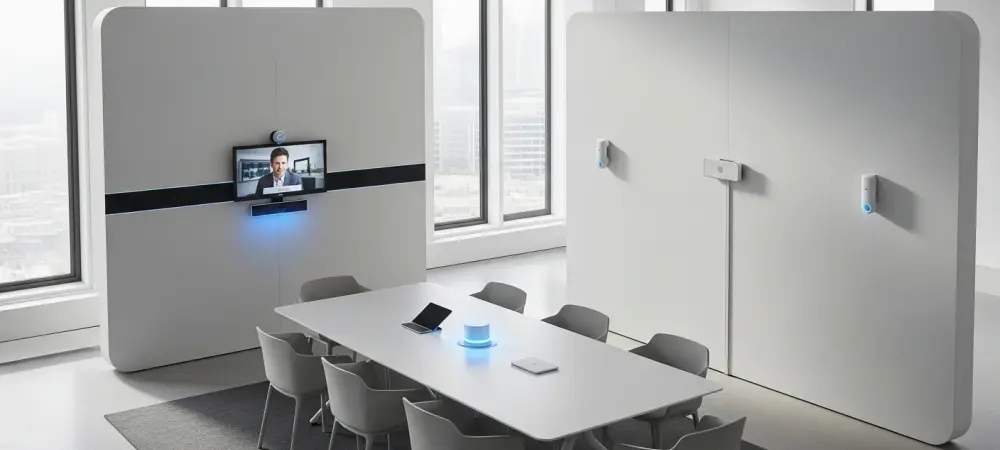
Smart workspaces represent another significant implementation of intelligent hardware within the physical office environment. Devices like the Board Pro G3 utilize computer vision and environmental sensors to transform traditional meeting rooms into data-rich environments. These sensors can monitor room occupancy, lighting, and even air quality, providing workplace analytics that help facilities managers optimize real estate usage. By bridging the gap between the physical and digital worlds, these intelligent endpoints ensure that the office is an active participant in the business process. This level of hardware integration not only improves the employee experience but also contributes to sustainability goals by ensuring that energy and space are used as efficiently as possible.
Industry Perspectives on Infrastructure Convergence
Thought leaders in the industry are increasingly promoting the “control plane” philosophy, which positions the network as the ultimate foundation for scaling enterprise AI. Experts argue that managing security, networking, and collaboration in isolation is no longer sustainable due to the complexity and speed of modern digital threats. The consensus among professionals is that the network must act as the primary orchestrator, providing the necessary visibility and control to manage autonomous agents and distributed workloads. This shift in perspective requires a cultural change within IT departments, moving away from specialized silos and toward a more integrated, cross-functional approach. The goal is to create an infrastructure that is not only powerful but also simple enough to manage at scale without constant human intervention.
Despite the benefits of convergence, analysts have highlighted a potential identity crisis as autonomous AI agents become more prevalent in the workforce. There is a growing need for a unified identity fabric that can accurately identify and secure both human users and AI entities across the entire infrastructure. Managing the security of these agents is a complex challenge, as traditional identity management tools were not designed for the scale or speed of autonomous systems. Industry consensus suggests that solving this identity problem is a prerequisite for the safe and effective deployment of AI agents at the enterprise level. Without a robust identity framework, the risks of unauthorized access and data breaches could outweigh the productivity gains provided by automated workflows.
Navigating the Future of the AI-Ready Enterprise
The industry is rapidly moving beyond providing mere insights and toward the deployment of fully autonomous agentic operations. In this future, infrastructure will be managed by intelligent agents that are capable of self-healing and optimizing performance without human oversight. This shift to autonomy will allow IT professionals to move away from mundane maintenance tasks and focus on strategic orchestration and innovation. The emergence of agentic workflows means that the network will be able to anticipate user needs, dynamically allocating resources and adjusting security policies in real time. This evolution will lead to a more responsive and resilient enterprise, where the technology layer is an active partner in achieving business objectives.
The bridge between physical and digital environments will continue to strengthen as environmental telemetry becomes more sophisticated. Deep hardware integration will allow for the optimization of real estate and employee safety through the constant monitoring of physical conditions. For example, sensors will be able to detect security anomalies or health hazards, triggering immediate automated responses across the network. This convergence of telemetry and automation will create safer and more productive work environments, regardless of where employees are located. As the physical office becomes more integrated into the digital infrastructure, the data generated by these environments will provide even deeper insights into how work is actually performed, leading to more informed decision-making at the executive level.
Technological Evolution and Agentic Operations
Future developments in AI-driven zero-trust architectures will be critical in combating increasingly sophisticated digital threats. As AI becomes more integrated into the infrastructure, it will also be used by malicious actors to launch more complex attacks. To counter this, the enterprise must deploy AI-driven security measures that can detect and neutralize threats at machine speed. A zero-trust approach, where no user or device is trusted by default, will become the standard for securing the agentic enterprise. This requires a level of integration between networking and security that was previously impossible, but is now becoming a reality through the use of unified, AI-ready platforms that offer continuous monitoring and automated enforcement.
The evolution of labor within the IT sector will be one of the most profound changes brought about by automated infrastructure. As routine tasks are handled by AI agents, the role of the IT professional will shift toward that of a strategic architect. This transition will require a new set of skills, focused on the governance, ethics, and orchestration of intelligent systems. While some fear that automation will lead to job displacement, the reality is that it will free up human talent to solve higher-level problems that require creativity and critical thinking. The successful IT professional of the future will be someone who can bridge the gap between business strategy and technical implementation, ensuring that the AI-driven infrastructure aligns with the broader goals of the organization.
Broader Industry Implications and Challenges
Economic outcomes of digital resilience are expected to be overwhelmingly positive, with global productivity and operational efficiency reaching new heights. Organizations that successfully navigate the transition to an AI-ready infrastructure will be better positioned to compete in an increasingly fast-paced and data-driven market. However, there is a significant complexity hurdle that must be overcome to realize these gains. If platforms fail to simplify the user experience, enterprises may suffer from “integration fatigue,” where the cost of managing complex systems outweighs the benefits of automation. Therefore, the success of the AI-driven infrastructure depends on the ability of vendors to provide solutions that are not only powerful but also intuitive and easy to deploy.
The rise of automated infrastructure will also have broader implications for global labor markets and the nature of work. As AI agents take on more responsibilities, the demand for digital literacy and technical expertise will continue to grow across all sectors of the economy. This shift will require a significant investment in retraining and education to ensure that the workforce is prepared for an agentic future. Furthermore, the increased productivity generated by AI-driven systems could lead to a fundamental restructuring of how business is conducted, with a greater emphasis on innovation and agility. While the challenges are significant, the potential rewards for organizations that embrace this technological evolution are even greater, promising a future of unprecedented growth and efficiency.
Synthesis and Strategic Recommendations
The transition of infrastructure into the brain of the modern enterprise was established as the defining technological shift of the current era. This analysis demonstrated that the successful adoption of artificial intelligence was predicated on the integration of data, security, and collaboration into a singular, cohesive architecture. The findings indicated that the network had become the primary control plane for business operations, providing the intelligence and context necessary for autonomous systems to function effectively. By treating the entire infrastructure as a unified platform, businesses were able to reduce complexity and focus on driving innovation through AI-driven insights and automation.
The final evaluation confirmed that prioritizing architectural coherence and identity governance was a prerequisite for any organization seeking to remain competitive in an agentic future. Strategic decisions made during this period emphasized the necessity of a unified identity fabric to secure the interactions between human users and autonomous agents. It was also concluded that the integration of collaboration tools like Webex into the broader infrastructure strategy provided a significant advantage by capturing vital operational context. The move toward intelligent, self-healing systems represented a move away from reactive maintenance and toward a more proactive, strategic orchestration of IT resources. Ultimately, the synthesis of these trends revealed that the network had evolved into an indispensable partner in the modern enterprise’s journey toward full autonomy.
To maintain a competitive edge, organizations were encouraged to accelerate their migration toward AI-ready architectures that offered cross-domain visibility and automated resilience. The analysis suggested that the focus must remain on simplifying the user experience to avoid integration fatigue and maximize the return on investment. Furthermore, it was established that the evolution of IT labor required a commitment to continuous learning and the development of new skills in the orchestration of intelligent systems. By embracing a unified approach to networking, security, and collaboration, businesses were able to build a foundation that was not only resilient but also capable of scaling with the demands of the future. The shift toward an AI-driven enterprise was not just a technical upgrade; it was a fundamental strategic realignment that redefined the role of technology in the corporate world.