

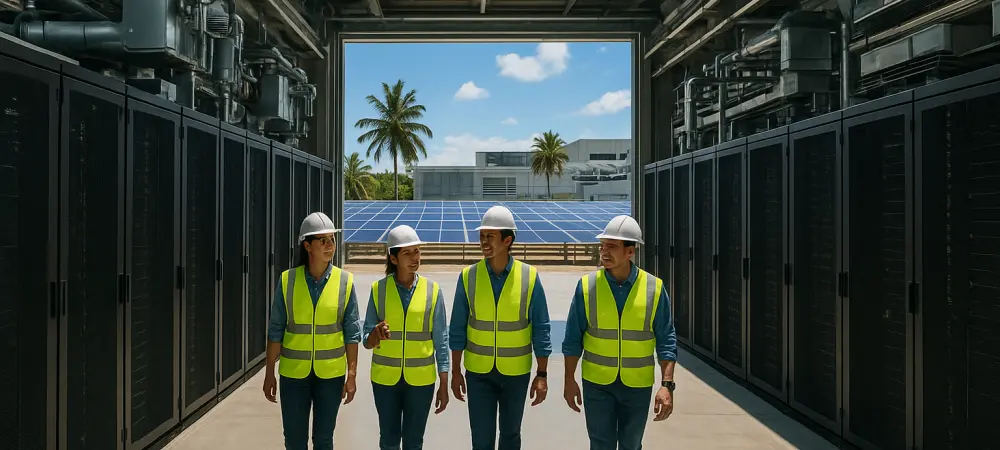
The massive migration of artificial intelligence infrastructure from traditional Western tech hubs toward the Global South represents one of the most significant shifts in the modern geopolitical and economic landscape. This movement, often characterized as a digital gold rush, is no longer a peripheral development but a central pillar of global capital flow as the demand for computational power exceeds the physical capacities of North American and European markets. Emerging Market and Developing Economies, or EMDEs, have transitioned from being mere consumers of digital services to becoming the primary battleground for hyperscale cloud providers looking to secure land, energy, and strategic proximity to the next billion users. The scale of this transformation suggests a permanent reordering of the global tech hierarchy where the physical location of a data center becomes as critical as the code it runs.
The significance of these regions lies in their unique combination of available space and a rapidly digitizing population that is eager for low-latency AI services. While traditional hubs face aging grids and restrictive zoning laws, emerging markets offer a relatively blank slate for the massive, power-hungry campuses required by modern generative AI. Consequently, the world is witnessing a structural shift where the Global South provides the essential “compute” that powers the global economy. This trend analysis explores the intricate dynamics of this expansion, moving through investment statistics, the complex utility requirements that challenge local infrastructure, and the long-term outlook for nations attempting to leverage these physical assets into sustainable prosperity.
The Global Pivot: Mapping the Expansion of AI Infrastructure
Statistical Trajectory and Capital Inflows
The sheer volume of capital directed toward AI infrastructure in emerging markets has reached levels that were unthinkable only a few years ago. Foreign Direct Investment into the data center sector has seen an extraordinary surge, with a 74 percent year-on-year increase that pushed total global commitments beyond the $320 billion mark. This influx reflects a broader realization among institutional investors that the capacity of existing tech hubs is nearing its plateau. What was once a trickle of investment has become a flood, with EMDEs now capturing approximately 40 percent of the total global investment value in this sector, a significant departure from the historical concentration of such assets in Silicon Valley or Northern Virginia.
This capital is not distributed uniformly but is instead gravitating toward specific regional leaders that have positioned themselves as reliable anchors. In Africa, Nigeria and South Africa have emerged as dominant players, each crossing the $5 billion milestone in specialized infrastructure investment. Meanwhile, in Southeast Asia and Latin America, countries like Malaysia, India, and Brazil have become the primary beneficiaries of this shift. These nations are no longer just participating in the digital economy; they are building its foundations, utilizing massive capital inflows to modernize their telecommunications sectors and establish the large-scale facilities required to process the vast amounts of data generated by localized AI applications.
Real-World Applications and Regional Hubs
Hyperscale operators such as Microsoft and Google have recognized the necessity of establishing a massive physical footprint directly within these high-growth regions. By constructing massive data campuses in Southeast Asia and Latin America, these corporations are reducing the distance data must travel, which is a critical requirement for real-time AI processing and high-speed cloud services. These “hyperscalers” are not just building warehouses for servers but are essentially creating sophisticated industrial hubs that serve as magnets for secondary tech industries. The presence of a world-class data center often triggers a secondary wave of growth in cybersecurity, specialized software development, and cloud management services, creating a localized multiplier effect that benefits the entire regional tech ecosystem.
The models for this expansion vary significantly depending on the political and economic context of the host nation. In most EMDEs, the growth is led by foreign entities that bring both the capital and the technical expertise required for high-tier facility management. However, this contrasts sharply with the domestic-driven model observed in China, where internal investment and state-aligned enterprises dominate the landscape. Regardless of the funding source, the outcome remains the same: the physical integration of high-performance computing into the local economy is reshaping how these nations interact with the global digital market, moving them from the periphery of tech consumption to the core of tech production.
Industry Perspectives: Assessing the Infrastructure-Utility Nexus
Economic and energy experts have increasingly pointed to a burgeoning “power competition” that pits industrial data facilities against the basic needs of residential grids. Data centers are unique because of their constant, high-intensity electricity requirements, which do not fluctuate in the same way that residential or traditional commercial demands do. In many emerging markets where the energy supply is already fragile, the introduction of a facility that consumes hundreds of megawatts can strain existing transmission lines to their breaking point. Professionals in the field warn that without massive, concurrent investment in energy generation, the arrival of big tech could inadvertently lead to higher costs or reduced reliability for local citizens.
Furthermore, a significant tension exists between the rapid expansion of AI and the national decarbonization goals that many EMDEs have pledged to uphold. AI data centers are notorious for their environmental footprint, requiring not only vast amounts of electricity but also billions of liters of water for cooling systems. This creates a complex trade-off for policymakers who must decide whether to prioritize the economic gains of tech investment or the long-term sustainability of their natural resources. The environmental impact is especially acute in water-stressed regions, where the cooling requirements of a single massive server farm could potentially rival the consumption of a medium-sized city, forcing a difficult conversation about the true cost of digital progress.
The deciding factor in whether a nation successfully navigates these challenges is often described as the “Policy Readiness” gap. Experts argue that regulatory clarity regarding land use, data sovereignty, and energy rights is what ultimately attracts or repels high-quality, long-term investment. Nations that fail to provide a stable and transparent regulatory framework risk attracting only transient capital or, worse, seeing their infrastructure projects stall before they can deliver any meaningful benefit. In contrast, those that integrate their digital expansion strategies with their energy and water security plans are better positioned to thrive in the competitive landscape of the late 2020s.
Future Outlook: Navigating Risks and Harvesting Prosperity
As technology continues to evolve, the development of “edge computing” and more efficient AI models could provide a mechanism for less-developed nations to bypass some of the traditional infrastructure hurdles. By processing data closer to the user on smaller, more efficient nodes, countries may be able to reduce their reliance on massive, centralized campuses that require extreme power and cooling. This “leapfrog” effect is reminiscent of how many emerging markets bypassed landline telephony in favor of mobile networks. If successfully implemented, this approach could allow a broader range of countries to participate in the AI economy without needing the immediate, overwhelming electrical capacity that current hyperscale models demand.
The long-term economic implications of this trend are multifaceted and carry both promise and peril. On one hand, the automation and productivity gains enabled by local AI infrastructure could drive massive growth across sectors like agriculture, finance, and healthcare. On the other hand, economic modeling suggests that if the infrastructure is not managed carefully, retail electricity prices could rise by as much as 8 to 9 percent by 2030, potentially offsetting some of the gains. Additionally, there is a risk of wage polarization within the labor market, as the demand for high-skilled tech workers increases while low-skilled roles are increasingly automated, necessitating a proactive approach to national education and workforce upskilling.
Managing the social and environmental challenges of the AI era will require a sophisticated balance of interests. The massive water requirements for cooling must be reconciled with the needs of local agriculture and domestic consumption, particularly as climate volatility increases. Strategic investment must be directed toward sustainable cooling technologies and renewable energy sources to ensure that the digital boom does not lead to an environmental bust. If these hurdles are cleared, the potential for emerging markets to transition directly into high-tech service economies is immense, provided that they treat digital infrastructure not just as a series of buildings, but as a vital national utility that must be integrated into the very fabric of their social and economic planning.
Strategic Pathways for the AI Era
The rapid expansion of AI data center investment across the Global South was a phenomenon that redefined the relationship between geography and technology. This transition highlighted a dual nature of progress, where immense economic promise was constantly tempered by severe physical and environmental constraints. The nations that found the most success were those that viewed digital growth as a component of a much larger puzzle involving energy security, water management, and human capital development. It became clear that simply hosting servers was insufficient; the real victory lay in the ability to integrate that computational power into the local industry and workforce.
Governments across these emerging hubs realized that a holistic national strategy was the only way to ensure that the influx of foreign capital resulted in inclusive prosperity. They moved toward policies that synchronized the needs of hyperscale providers with the modernization of national power grids and the protection of vital resources. This proactive approach allowed many regions to avoid the pitfalls of power competition and environmental degradation that initially threatened to derail their progress. Ultimately, the boom in AI infrastructure underscored the necessity of forward-looking policy to ensure that the technological advancements of the present translated into sustainable, long-term economic stability for the future.