

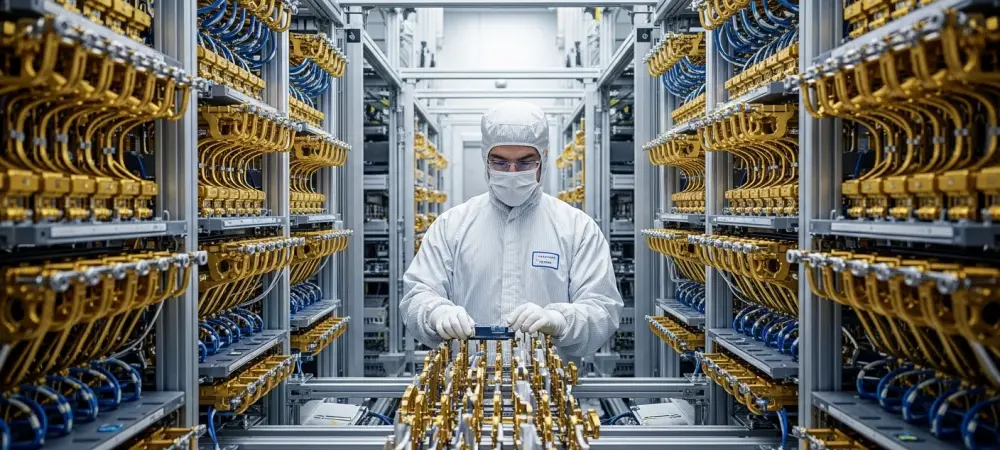
The digital transformation currently sweeping across the globe is no longer just a contest of software algorithms but a high-stakes race to fortify the physical veins of glass and light that move the world’s intelligence. While the rise of artificial intelligence is frequently framed as a revolution of code and neural networks, its ultimate success hinges on a tangible foundation of fiber-optic cabling and specialized hardware. As AI models transition from experimental development to massive-scale commercial deployment, the global economy is witnessing a critical shift. The narrative is pivoting from a compute story centered on raw processing power toward a connectivity story focused on how that power is distributed and utilized. This analysis explores the surging demand for fiber-optic networks, the necessary expansion of data center capacity, and the strategic shifts required to sustain the next generation of digital innovation.
The Global Surge in Digital Infrastructure Requirements
Analyzing Market Growth and Adoption Metrics
Global active data center capacity is on a trajectory of unprecedented expansion, with projections suggesting a sixfold increase between 2026 and 2035. This growth will see capacity rise from 24.4 gigawatts to a staggering 147.1 gigawatts as the digital world expands to meet new demands for intelligent processing. Such an explosion in infrastructure is largely fueled by the relentless integration of AI-driven workloads, which are expected to consume approximately half of all global data center capacity by the end of the current decade. This creates a landscape where physical space and processing potential must expand in lockstep to avoid systemic bottlenecks that could stifle innovation.
Moreover, the proliferation of Fixed Wireless Access and the continued expansion of 5G networks are compounding the pressure on these systems. High-speed mobile services require much more than just airwaves; they necessitate dense fiber backhaul to support the rising volume of mobile-first data consumption. This trend indicates that the digital backbone must become significantly more robust to handle the traffic generated by both consumer devices and industrial machine-to-machine communications. The reliance on fiber-optic networks is becoming absolute, as traditional copper-based systems simply cannot provide the bandwidth necessary for these modern workloads.
Real-World Applications of High-Density Connectivity
Hyperscale data centers are already leading the charge by implementing ultra-low latency interconnects to facilitate the continuous movement of massive datasets across complex cloud environments. These interconnects allow for the seamless synchronization of data that AI models require for real-time learning and inference across distributed server clusters. In contrast to traditional data transfer methods, these high-density links ensure that the physical distance between servers does not become a hindrance to overall system performance. This development is crucial for maintaining the efficiency of large-scale language models and generative systems that operate across multiple geographic nodes.
Simultaneously, edge computing deployments are decentralizing the traditional network architecture by bringing processing power closer to the source of data generation. This shift is particularly evident in the deployment of IoT devices and autonomous systems where every millisecond of delay can impact safety and functionality. System integrators are consequently redesigning metro networks to accommodate the voracious data appetites of smart cities and industrial automation platforms. By placing intelligence at the edge of the network, the industry reduces the load on central cores while providing the instantaneous response times required for modern robotic and sensing applications.
Expert Perspectives on the Evolving Integration Landscape
Industry thought leaders suggest that connectivity infrastructure has evolved from a simple digital enabler into the primary strategic resource defining modern economic competitiveness. In earlier stages of the technological boom, the primary concern for businesses was acquiring the latest high-end chipsets to run their operations. However, experts now point out that while silicon was the initial bottleneck, the ability to transport data across distributed environments has become the chief constraint on scaling. This realization is forcing a major reappraisal of how corporations and governments invest in their long-term digital strategies, moving toward a more holistic view of infrastructure.
Connectivity professionals, including specialists from organizations like Altnets, emphasize that the current challenge requires a move toward intelligent network design and resilient supply ecosystems. Building a network is no longer just about laying cable; it is about creating a flexible architecture that can adapt to shifting traffic patterns and sudden spikes in demand. The focus has moved toward ensuring that every component of the network, from the central office to the final connection point, is optimized for maximum throughput and minimal interference. This sophisticated approach is becoming the standard for any project aiming for longevity and high performance in a data-saturated market.
Future Projections: Power Demands and Long-Term Scalability
The future of AI infrastructure faces a significant hurdle in the form of power availability and grid stability across major urban hubs. In regions like the United Kingdom, proposed data center projects are already seeking grid capacity that exceeds the total national peak demand, highlighting a massive disconnect between technological ambition and utility reality. To address this, the industry is seeing increased collaboration between technology providers and utility firms to synchronize infrastructure rollouts with energy availability. This partnership is essential for ensuring that the power required for cooling and processing does not outstrip the local or national supply, potentially leading to localized brownouts. Networks must be built for unknown future demand through modular and flexible fiber architectures that can be upgraded without a complete overhaul of the existing system. While the rapid expansion offers immense economic potential, a failure to modernize utility grids and supply chains could lead to a stagnation of development in the coming years. Therefore, the strategic placement of new facilities is becoming as important as the technology housed within them, with a preference for locations that offer both high-bandwidth connectivity and stable, sustainable energy sources.
Conclusion: Securing the Future of AI Through Resilient Networks
The analysis summarized the critical transition from focusing on raw processing power to prioritizing the physical interconnects that moved data. It became clear that the limits of artificial intelligence were ultimately determined by the robustness of the physical connectivity supporting the entire ecosystem. This realization prompted a massive reallocation of capital toward subsea cables, metro fiber rings, and advanced optical switching technologies. Leaders who recognized this shift early on were able to secure a dominant position in the global market by ensuring their systems remained functional under the pressure of unprecedented data loads. Moving forward, integrators and planners prioritized long-term infrastructure resilience and modular design to remain competitive in an increasingly demanding global economy. The focus shifted to actionable steps like diversifying supply chains and integrating renewable energy directly into the data center footprint. These measures ensured that the digital foundation was not only fast but also sustainable and capable of supporting future innovations that have yet to be fully realized. By treating connectivity as a foundational asset rather than an afterthought, the industry built a framework that was ready for the next wave of technological evolution.