

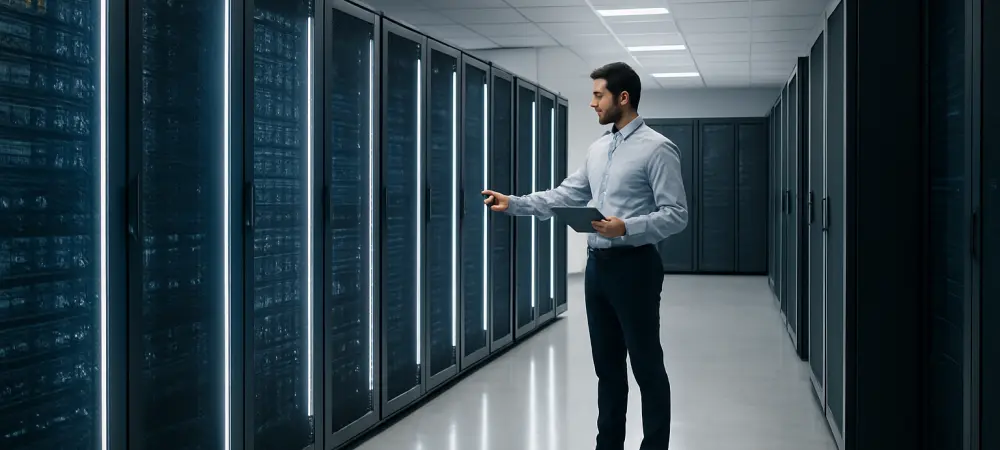
The architectural blueprint of global commerce has fundamentally fractured as the static vaults of the past give way to the pulsating token production lines of the modern economy. For decades, the data center functioned as a digital warehouse, a cost center where enterprises stored records and hosted applications to support their primary business functions. However, the rise of generative intelligence has birthed the “AI Factory,” a facility where the primary output is no longer stored data, but synthesized tokens of intelligence. This shift represents more than a technical upgrade; it is a total economic reorientation where compute power is no longer an overhead expense, but the very commodity being manufactured for the marketplace.
Evolution from Information Silos to Intelligence Production Lines
The transition from traditional facilities to modern AI factories is marked by a move away from fragmented infrastructure toward deeply integrated environments. Jensen Huang, CEO of NVIDIA, popularized this vision by describing a world where intelligence is manufactured much like electricity or consumer goods. In this new era, the hardware must be designed to facilitate the massive scale of large language models. Technologies like the Blackwell architecture and the Vera Rubin NVL72 platform have become the bedrock of this evolution, moving the industry beyond the limitations of legacy server racks that were never intended to handle the thermal and computational density of modern AI. These factories are optimized for “token generation,” which is the fundamental unit of value in the current digital economy. As companies deploy models like DeepSeek V4, the focus shifts from simply having a presence in the cloud to maximizing the production efficiency of every watt consumed. The relevance of this shift cannot be overstated, as the global economy has entered a phase where the ability to generate reasoning and creative content at scale determines competitive advantage. Consequently, the role of compute has moved from the back office to the front line of revenue generation, necessitating a completely different approach to facility design and deployment.
Core Technical and Economic Distinctions
Economic Models: Cost Management vs. Revenue Generation
In the traditional data center model, the primary goal was to maximize uptime while minimizing the cost of IT procurement. Performance was measured by how efficiently a facility could support internal workloads, and any excess compute was seen as wasted capital. In contrast, the AI factory treats compute as a direct revenue driver. The profitability of these facilities is measured by “tokens per watt” and “cost per token.” In this environment, every microsecond of idle time on a GPU represents lost income, making efficiency the most critical factor in the facility’s financial success.
Standard performance benchmarks have also undergone a radical transformation. While traditional IT relied on simple availability metrics, AI-specific key performance indicators now include Time to First Token (TTFT) and Mean Time Between Interruptions (MTBI). High reliability is no longer just about keeping a website online; it is about ensuring that a multi-billion parameter model can complete its reasoning cycle without a catastrophic failure in the middle of a complex inference task.
Processing Architecture: General-Purpose Throughput vs. Agentic Reasoning Loops
The role of the CPU has changed dramatically as we move from general-purpose hosting to agentic AI. Historically, CPUs were judged by their ability to handle high parallel throughput, often by increasing core counts to support multiple tenants on a single server. However, the rise of “agentic” AI—where models perform specific actions like tool calls or database queries—requires high single-threaded performance. When an AI agent reasons through a problem, the GPU handles the heavy lifting of the model, but the CPU must quickly execute sequential code to call an external tool. The NVIDIA Vera CPU was specifically designed to solve the bottlenecks inherent in these agentic reasoning loops. Unlike traditional server processors that may have high core counts but significant memory latency, the Vera CPU focuses on reducing the time it takes for the GPU to receive data from the system. If the CPU is slow to handle a tool call, the expensive GPU resources sit idle, causing a drop in overall factory efficiency. This specialization ensures that the entire system remains in a high-utilization state, which is essential for maintaining the profit margins of a token-producing enterprise.
Networking and Storage: Data Distribution vs. Three-Tiered Logistics
Networking in a traditional data center was primarily about scaling out basic Ethernet connections to move data between servers and centralized storage. In an AI factory, the movement of data is a complex logistics problem that requires a three-layered architecture. Scale-up networking, such as NVLink, handles the high-bandwidth communication within a single rack, which is vital for “mixture-of-experts” models. Scale-out networking, powered by Spectrum-X Ethernet, manages transfers across thousands of servers, while scale-across networking connects geographically dispersed sites to form a unified production line.
Storage has similarly evolved to meet the demands of long-context AI workloads. Standard data paths are often too slow to maintain the “inference state” or “working memory” required for modern agentic workflows. If the storage layer cannot keep up with the processing speed of the accelerators, the entire factory slows down. Modern AI factories require low-latency storage solutions that can feed data into the compute engine with minimal friction, ensuring that the “working memory” of the AI remains accessible and responsive during complex, multi-step tasks.
Constraints, Security, and Operational Challenges
The massive energy demands of AI clusters have made power the single greatest constraint on production. The Vera Rubin platform, for instance, targets a 10x improvement in energy efficiency to help facilities stay within their power budgets. This extreme focus on energy efficiency is not just an environmental concern; it is a prerequisite for scaling the factory to the size required by next-generation models. Cooling technologies have also had to advance, moving toward liquid-cooled systems that can dissipate the immense heat generated by densely packed NVIDIA NVL72 racks.
Security in the AI factory has moved beyond the perimeter to focus on the “production line” itself. Protecting proprietary model weights and customer context is now handled through “inline” security measures like Confidential Computing. Hardware-rooted attestation ensures that models and data remain protected even while they are being processed, preventing malicious actors from intercepting the “intelligence” as it is manufactured. Infrastructure resilience has become paramount, as any downtime in a massive cluster represents a total cessation of revenue, making the cost of failure much higher than in traditional hosting environments.
Strategic Summary and Infrastructure Recommendations
The results of the shift toward integrated hardware-software stacks have been undeniable, as seen in the “extreme co-design” strategy utilized by leading technology providers. By designing networking, compute, and software in unison, these systems outperform fragmented traditional setups. For example, software refinements on the Blackwell architecture allowed the DeepSeek V4 model to achieve a 5x reduction in token costs within a single month without any hardware changes. This highlights how software serves as an economic multiplier in an AI factory, extending the life and profitability of the underlying infrastructure.
Organizations must carefully choose when to maintain a traditional data center model and when to invest in a full AI factory architecture. While general application hosting still benefits from the flexibility of traditional setups, any initiative involving Generative AI or large-scale agentic workflows requires the specialized logistics of an AI factory. The industry realized that the path toward long-term profitability was through the adoption of integrated platforms that maximized token production while minimizing power overhead. Strategic investments shifted away from disparate components and toward unified ecosystems that could scale with the rapid evolution of model complexity.
The transition toward the AI factory required a radical departure from legacy methodologies that prioritized initial procurement costs over long-term operational efficiency. Enterprises that succeeded embraced the integration of hardware and software, recognizing that the efficiency of the production line was the ultimate arbiter of success. The shift was not just technical; it was a total economic reorientation that redefined the value of the data center in the modern era. As the demand for intelligence continued to grow, the industry moved toward these specialized facilities to ensure the steady and cost-effective production of the tokens that drove the global economy.