

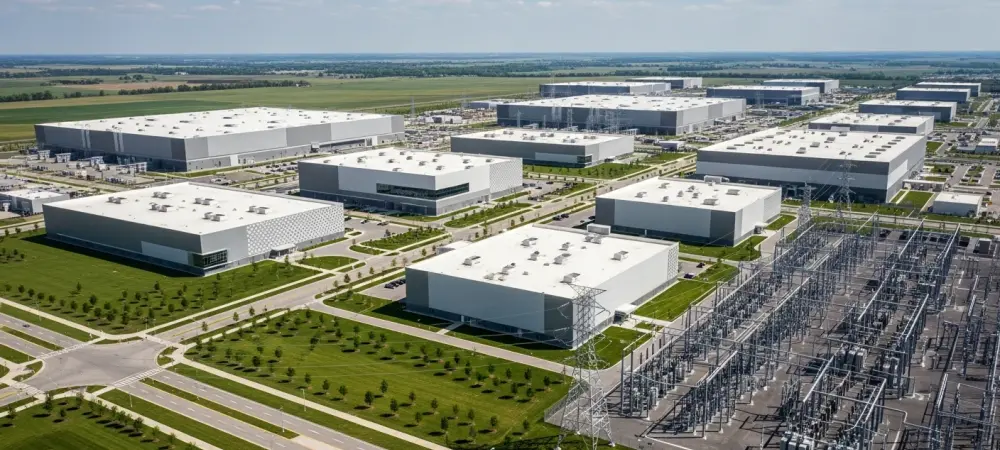
A single gigawatt of electricity is enough to power a city of hundreds of thousands, yet a new development in rural Illinois plans to dedicate that entire capacity to the voracious appetite of the digital world. Data center park developer Tract has officially announced the launch of the Morris Technology Park, a massive campus designed to support the next generation of artificial intelligence and cloud computing. Located 60 miles southwest of Chicago, this project represents a monumental investment in the region’s digital infrastructure, turning a quiet corner of the state into a critical node for the global data economy. The initiative underscores a tectonic shift in infrastructure development, where securing vast amounts of land and power has become the foundational challenge for technological progress.
How a Small Illinois City Became a 1-Gigawatt Digital Hub
The transformation of Morris, Illinois, into a destination for high-tech investment was not a matter of chance but the result of deliberate, long-term planning. The city’s leadership recognized the growing need for large, development-ready sites and took proactive steps to prepare a suitable location. This involved annexing and zoning the land specifically for technological use, a move that significantly streamlined the development process and reduced uncertainty for potential investors. By having a “shovel-ready” site available, Morris created a competitive advantage that directly appealed to developers like Tract, who specialize in rapid, large-scale deployments.
This foresight proved to be the decisive factor in securing the landmark deal. Instead of encountering bureaucratic hurdles and lengthy approval processes, Tract found a willing and prepared partner in the City of Morris. This cooperative environment allowed the project to move from concept to reality with remarkable speed. The city’s initiative serves as a powerful case study for other communities aiming to attract the modern industries that now form the backbone of the economy, demonstrating that strategic preparation is paramount in the race for digital infrastructure investment.
Fueling the Future: Why AI and Cloud Computing Demand Massive New Infrastructure
The insatiable demand for projects like the Morris Technology Park is driven by the explosive growth of artificial intelligence and cloud computing. These technologies, which power everything from streaming services to complex scientific research, rely on immense computational power housed within data centers. AI workloads, in particular, require high-density server racks that consume exponentially more energy than traditional computing tasks. Consequently, the industry is shifting from building smaller, scattered facilities to developing massive, centralized parks capable of delivering power on a utility-like scale. A gigawatt-scale campus is no longer an outlier but is becoming the new standard for meeting the power and cooling requirements of hyperscale clients. These technology giants need certainty that they can scale their operations without interruption, and a master-planned park with pre-secured power provides that assurance. The Morris project is a direct response to this market need, offering a platform where multiple data centers can be built and energized over a multi-year timeline, ensuring a stable and predictable growth path for the foundational infrastructure of the digital age.
Inside the Morris Technology Park: A Project of Unprecedented Scale
The Morris Technology Park is situated on a sprawling 343-acre campus, providing ample space for what is planned to be 2.9 million square feet of data center facilities. The park has secured a total power capacity of 1 gigawatt from Commonwealth Edison (ComEd), a staggering amount of energy dedicated to a single commercial development. This secured power is the project’s cornerstone, guaranteeing that tenants will have the resources needed to support high-density computing loads for years to come.
The development is proceeding on an ambitious but structured timeline. Initial power delivery is slated for June 2028, allowing the first phase of construction to commence with confidence. The full 1 gigawatt of power is expected to be ramped up and available by 2032, accommodating a phased build-out of the campus. Critically, the entire site is fully annexed, zoned, and prepared for construction, making it one of the most significant shovel-ready data center projects in the country and accelerating the timeline for bringing critical digital capacity online.
The Partnership Playbook: How Collaboration Secured a Landmark Deal
The successful launch of the Morris Technology Park was forged through a multi-year, collaborative effort between public and private entities. Tract worked in close coordination with the City of Morris, ComEd, and the Illinois Economic Development Corporation to navigate the complex logistical and regulatory landscape. This partnership was instrumental in aligning the interests of the developer, the utility provider, and the local community, ensuring that the project met both economic and infrastructure goals.
Leaders from all organizations have highlighted this public-private collaboration as the key to the project’s success. The state’s support, combined with the city’s proactive planning and ComEd’s commitment to delivering the necessary power, created a synergistic environment for large-scale investment. This playbook of coordinated action and shared vision serves as a model for how regions can successfully attract and execute the megaprojects required to support the rapidly expanding digital economy.
Tract’s National Strategy: A Blueprint for Land and Power
The Morris Technology Park is a key component of Tract’s broader national strategy to become a dominant land-and-power provider for the data center industry. Founded by Grant van Rooyen, the company’s business model focuses on acquiring vast, strategically located land parcels and preparing them with the necessary permits, zoning, and utility commitments. This approach de-risks the development process for hyperscale clients, who can then acquire sites ready for immediate construction.
Tract’s expansion has been aggressive and far-reaching. The company now controls over 25,000 acres of land with a planned capacity exceeding 25 gigawatts across key markets. This portfolio includes massive campuses of over 1,000 acres and 1 gigawatt of planned power in states such as Arizona, Nevada, and Virginia. This national footprint reflects a clear vision to create a pre-vetted inventory of megaprojects, positioning Tract as a foundational partner for the technology giants building the infrastructure of tomorrow.
The Morris project was more than just a real estate transaction; it represented the convergence of strategic foresight, public-private partnership, and the relentless demand of the digital age. The collaboration between Tract, local officials, and utility providers established a new benchmark for how complex infrastructure projects could be brought to fruition. This development not only promised to reshape the economic landscape of a small Illinois city but also solidified a critical piece of the national infrastructure required to power the next wave of technological innovation.