

The relentless expansion of artificial intelligence is creating a thermal challenge of unprecedented scale, forcing the data center industry to fundamentally reconsider its reliance on a resource becoming scarcer by the day: water. Waterless cooling represents a significant advancement in the data center industry, driven by the dual pressures of rising AI-driven power densities and increasing global water scarcity. This review will explore the evolution of this technology, its key features, performance metrics, and the impact it has had on data center design and location strategy. The purpose of this review is to provide a thorough understanding of waterless cooling, its current capabilities, and its potential future development, using the Edged Dallas campus expansion as a key case study.
The Growing Need for Sustainable Cooling Solutions
The transition away from traditional, water-intensive cooling methods marks a critical pivot for the digital infrastructure sector. For years, evaporative cooling towers, which consume massive volumes of water, were the standard for managing heat loads. However, the emergence of high-density AI hardware has rendered these older methods increasingly inefficient and environmentally unsustainable, pushing operators toward alternatives that align with modern ecological and operational demands.
This technological shift is not merely a matter of efficiency but is becoming essential for the industry’s social license to operate. As communities and regulators scrutinize the environmental footprint of large-scale industrial operations, data centers face growing pressure to demonstrate responsible resource management. Consequently, sustainability has evolved from a corporate ideal into a critical performance metric, driving innovation in cooling systems that can support next-generation computing without straining local ecosystems.
Key Technologies and Methodologies
Advanced Closed-Loop Air Cooling
Modern air-cooling systems that operate without water represent a major leap forward in sustainable data center design. Unlike traditional systems that rely on open-air exchange or evaporative processes, advanced closed-loop designs use contained, refrigerated air cycles to manage heat. This approach effectively isolates the internal data hall environment from external conditions, providing consistent and reliable cooling regardless of ambient temperature or humidity.
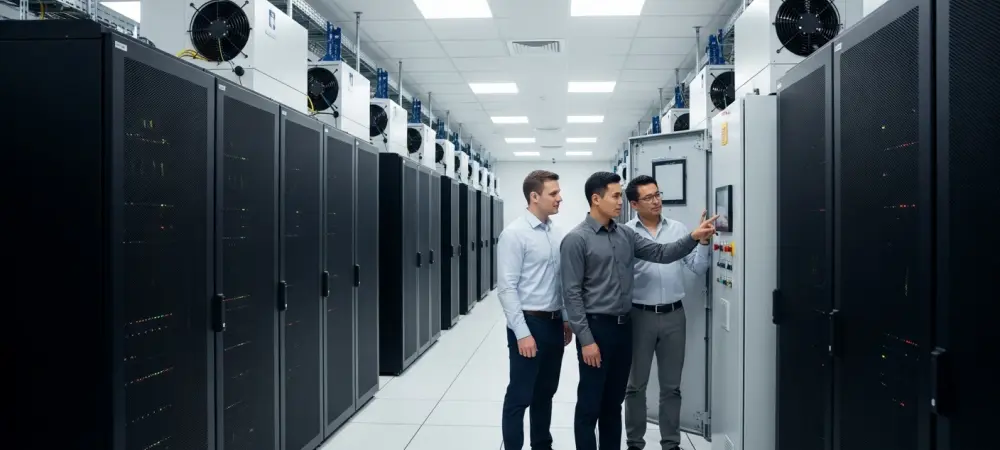
The system developed by ThermalWorks for the Edged Dallas campus exemplifies this methodology. By recirculating and chilling air within a sealed loop, the technology can efficiently dissipate heat loads from infrastructure supporting rack densities of over 120kW. This performance is achieved without consuming a single drop of water for evaporation, directly addressing the core challenges of both high-performance computing and environmental stewardship.
Direct-to-Chip and Rear-Door Liquid Cooling
Another key waterless approach involves closed-loop liquid systems that deliver coolant directly to the heat source, offering an even more potent thermal management solution. This methodology is particularly suited for the extreme heat generated by today’s most powerful AI accelerators. By circulating a specialized, self-contained coolant through components attached to processors or via rear-door heat exchangers, these systems can absorb and transport thermal energy with remarkable efficiency. This technology enables staggering performance benchmarks, allowing for the deployment of rack densities up to 400kW. Because the coolant is continuously recirculated within a sealed system, there is no ongoing consumption of local water resources. This completely decouples the data center’s cooling capacity from its geographic water availability, making it a transformative solution for deploying high-density AI infrastructure anywhere in the world.
Recent Innovations and Industry Trends
The latest developments in waterless cooling are marked by a clear trend toward vertically integrated and proprietary solutions. This shift reflects a strategic move by data center operators to gain greater control over their technology stack, ensuring that cooling systems are perfectly optimized for the unique demands of their high-density deployments. Instead of relying on off-the-shelf products, operators are increasingly developing custom solutions from the ground up.
The partnership between data center operator Edged and its sister company, ThermalWorks, serves as a prime example of this innovative model. By co-designing the data center and its cooling infrastructure, the companies can create a purpose-built environment tailored specifically for AI applications. This synergy prioritizes both performance and environmental sustainability, establishing a new blueprint for how digital infrastructure can be developed responsibly.
Real-World Application The Edged Dallas Campus Expansion
The practical implementation of waterless cooling is demonstrated by Edged’s newly approved 24MW data center in Irving, Texas. This project directly responds to the accelerating demand for AI infrastructure by deploying a purpose-built system designed to handle high-density computing without relying on local water supplies. This facility, which is breaking ground in the second quarter of 2026, showcases the technology’s viability in a major data center market.
This expansion underscores a successful collaboration between the technology sector and local government. The City of Irving’s unanimous approval highlights a shared commitment to fostering sustainable growth and attracting high-tech investment. By embracing waterless technology, the project not only supports the region’s economic development but also aligns with municipal goals for responsible resource management, setting a positive precedent for future infrastructure projects.
Adoption Challenges and Mitigation Efforts
Despite its clear advantages, the widespread adoption of advanced waterless cooling faces notable challenges, primarily centered on initial capital expenditure. These sophisticated systems can require a greater upfront investment compared to some traditional cooling infrastructure, which may deter operators working with tighter budgets or shorter-term investment horizons. Furthermore, the technical hurdles of retrofitting existing facilities, which were often designed around entirely different thermal management principles, can be significant. To overcome these barriers, the industry is focusing on developing modular and scalable solutions that lower the barrier to entry. By creating systems that can be deployed incrementally, operators can invest in waterless technology as their density requirements grow. These ongoing development efforts are key to making advanced cooling more accessible, enabling a broader range of data centers to transition toward more sustainable and future-proof operations.
Future Outlook and Long-Term Impact
The future trajectory of waterless cooling points toward its establishment as a standard for all new high-density data center builds. This widespread adoption will be driven by a combination of regulatory pressures on water use and intensifying corporate sustainability goals. As AI continues to proliferate, the operational and environmental benefits of these technologies will become indispensable, transitioning them from a competitive advantage to an industry prerequisite. The most significant long-term impact will be the decoupling of data center site selection from the availability of large water sources. For decades, access to water was a critical limiting factor in determining where new facilities could be built. Waterless cooling removes this constraint, enabling the growth of technology hubs in more diverse and arid geographic locations and reinforcing the industry’s commitment to building a more resilient and responsible digital future.
Conclusion and Overall Assessment
This review found that waterless data center cooling has successfully matured from a niche concept into an essential enabling technology for the AI era. Its capabilities proved to be a direct and effective answer to the dual challenges of extreme thermal loads and pressing environmental mandates for water conservation. The successful implementation in real-world projects, such as the Edged Dallas campus, confirmed its viability at scale and signaled a profound and positive shift for the future of the digital infrastructure industry.