

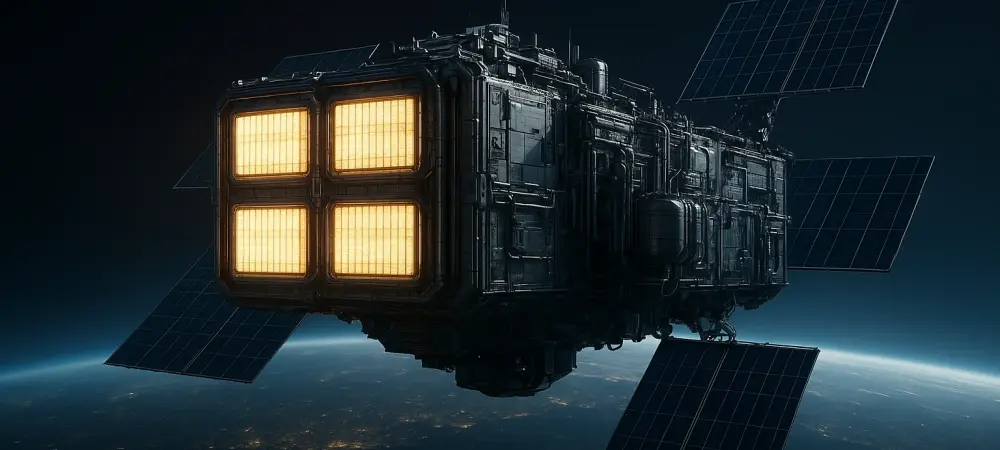
The relentless hunger of modern artificial intelligence for processing power is rapidly outstripping the capacity of terrestrial power grids and cooling systems to sustain them without catastrophic ecological consequences. As of 2026, the digital gridlock on Earth has transformed from a technical bottleneck into a geopolitical and environmental crisis. Major metropolitan areas are reaching a saturation point where the local power grid simply cannot support the installation of another gigawatt-scale data facility without risking rolling blackouts for residents. This reality has catalyzed a profound shift in how the global economy views its most critical asset: data infrastructure. By elevating processing power to Low Earth Orbit, the industry is no longer constrained by the finite surface area of our planet or its fragile water tables.
The migration of server clusters into the vacuum of space represents more than just a novelty; it is a fundamental realignment of the digital supply chain. While early experiments were limited to small-scale edge devices on CubeSats, the infrastructure being deployed now involves industrial-grade modules designed for longevity and massive throughput. This evolution reflects the growing consensus that terrestrial systems alone cannot fulfill the promises of the AI revolution. The orbital environment, once viewed only as a medium for communication, is now being reimagined as a high-performance processing sanctuary where the sun never sets and the cooling medium is the infinite expanse of the universe itself.
The High-Altitude Solution: Relieving Earth’s Digital Gridlock
Terrestrial data centers are currently locked in a struggle against the laws of thermodynamics and the realities of local land-use politics. In regions like Northern Virginia or Dublin, the sheer density of server farms has sparked public outcry over energy consumption and noise pollution. These facilities act as massive heat engines, drawing in cool water and exhausting hot air in a cycle that is becoming increasingly difficult to manage as global temperatures rise. Moreover, the land required for these structures often competes with housing and agricultural needs, leading to a regulatory environment that is hostile to further expansion. The shift toward orbital solutions provides an elegant escape from these grounding limitations, allowing for a vertical expansion of our digital footprint that bypasses the friction of terrestrial planning permissions and resource scarcity.
The strategic transition of infrastructure into orbit addresses the most pressing issue of the AI-driven economy: the power-to-cooling ratio. On Earth, for every watt of power used for computation, a significant fraction must be spent on removing the resulting heat. In the vacuum of space, however, the cooling challenge is flipped. While heat must still be dissipated through radiation, the absence of a convective atmosphere allows for the design of specialized thermal management systems that can operate at extreme temperature differentials. Furthermore, the availability of constant, high-intensity solar radiation provides a zero-carbon energy source that is not subject to the intermittency of terrestrial weather or the carbon footprint of natural gas peaker plants. This abundance of energy transforms the financial model of high-performance computing, making the initial investment in launch costs a gateway to near-zero marginal energy expenses over the lifetime of the hardware.
Why Orbital Infrastructure Matters: The Age of AI
The current wave of generative AI and large-scale language modeling has fundamentally changed the workload profile of modern servers. These next-generation GPUs require power densities that far exceed what traditional data centers were built to handle, often necessitating custom liquid cooling loops and reinforced floor loading. As power requirements climb toward 100 kilowatts per rack, the existing power grids on Earth are struggling to deliver the necessary current without massive infrastructure upgrades that can take a decade to complete. Orbital data centers offer a way to bypass this aging infrastructure entirely, providing a modular and scalable alternative that can be deployed in sync with the rapid advancement of silicon technology. This capability ensures that the growth of AI is not throttled by the slow pace of terrestrial grid modernization.
Beyond the raw physical requirements, the strategic importance of orbital compute lies in its inherent resilience and isolation. Data centers on the ground are vulnerable to a wide array of localized risks, including natural disasters, civil unrest, and physical sabotage of fiber-optic trunks. In contrast, a distributed network of orbital servers provides a layer of redundancy that is physically disconnected from terrestrial vulnerabilities. This infrastructure is not about replacing the Earth-based grid but about building a hybrid architecture where the most sensitive and resource-intensive tasks are offloaded to a more stable environment. This shift allows the global data economy to sustain exponential growth while simultaneously reducing the ecological burden on the planetary surface, creating a more sustainable balance between technological progress and environmental stewardship.
Technological Pillars: The Path to Operational Readiness
Achieving operational readiness in orbit requires the convergence of several high-stakes engineering disciplines, beginning with the economics of launch. For decades, the primary hurdle to any large-scale space project was the exorbitant cost of moving mass from the surface of Earth to Low Earth Orbit. However, the current era is defined by the widespread adoption of fully reusable heavy-lift launch vehicles that have plummeted the price per kilogram to levels that were unthinkable just five years ago. This economic breakthrough has shifted the focus from merely surviving in space to thriving there. With launch costs no longer being the prohibitive factor, companies are now able to deploy more substantial shielding and more robust power systems, ensuring that the hardware can survive the harsh environment for many years without requiring frequent replacement.
The second critical pillar is the management of heat in a vacuum, where traditional methods of cooling are ineffective. Engineers have developed advanced two-phase cooling loops that utilize the phase change of refrigerants to move massive amounts of thermal energy from the server cores to sprawling radiator panels. These radiators, often spanning hundreds of square meters, utilize specialized coatings that maximize emissivity while reflecting incoming solar heat. In tandem with these thermal breakthroughs, the development of radiation-hardened electronics has reached a point where commercial-grade components can be modified to withstand the intense cosmic rays of orbit. By using multilayer graded-Z shielding and sophisticated error-correcting memory, these systems achieve a hardware longevity that rivals the service life of many terrestrial data centers.
Connectivity remains the final technological hurdle, as traditional radio frequency bands are too narrow to handle the massive data flows required for modern AI. The industry is rapidly pivoting toward laser-based optical communication links, which allow for multi-terabit-per-second transfers between satellites and ground stations. These optical links operate at frequencies that are thousands of times higher than radio, enabling the transmission of entire databases in minutes rather than days. Moreover, inter-satellite laser links create a high-speed mesh network in orbit, allowing data to be processed on one satellite and transmitted to another without ever needing to touch a terrestrial node. This seamless integration of compute and connectivity is what allows orbital data centers to function as a unified, global supercomputer.
Expert Perspectives: The Hybrid Infrastructure Model
Industry analysts and technical architects increasingly view the future of global computing as a tiered system where space and Earth operate in a state of high-level synchronization. The prevailing expert consensus suggests that terrestrial data centers will focus on latency-sensitive applications, such as real-time financial trading or local autonomous vehicle coordination, where every millisecond is critical. In contrast, orbital centers are being positioned as the ideal environment for the massive, asynchronous tasks that define the current AI landscape. This includes the fine-tuning of foundation models, batch processing of large data sets, and the management of sovereign cloud environments that require high levels of physical isolation. This division of labor allows for the most efficient use of resources in both domains, ensuring that neither is overwhelmed by workloads for which it is not optimized.
A significant trend highlighted by market experts is the rise of vertical integration among the leaders in this space. The companies most likely to dominate the orbital compute market are those that control the entire lifecycle of the data center, from the launch vehicle and the satellite bus to the server hardware and the software stack. This integration allows for a degree of optimization that is impossible in the traditional, fragmented terrestrial market. For example, a company can design a server board specifically for the thermal profile of their radiator system and the vibrational stresses of their specific rocket. This holistic approach reduces failure rates and increases the overall efficiency of the system, creating a formidable barrier to entry for competitors who must rely on third-party providers for critical components of their infrastructure.
The geopolitical dimension of orbital computing also receives significant attention from strategic advisors. Experts point out that space-based data centers offer a unique solution to the growing demand for data sovereignty. In an era where many nations are concerned about their data crossing foreign borders or being intercepted by hostile actors, a data center in orbit provides a neutral territory that exists outside the conventional physical jurisdiction of any single state. This allows for the creation of “sovereign clouds” that are managed by international treaties rather than local laws. This legal and physical separation provides a level of security that is highly attractive to government agencies and multinational corporations handling sensitive information, further cementing the role of orbital compute as a critical component of global security.
Frameworks: Integrating Orbital Compute into Business Strategy
For enterprises looking to integrate orbital computing into their long-term growth plans, the first step is a comprehensive audit of their data workloads to identify candidates for space-based processing. The ideal tasks for the first phase of adoption are those that are computationally intensive but not highly sensitive to the small latency delays associated with satellite transmission. Large-scale simulations, such as those used in drug discovery or weather forecasting, are perfect examples of workloads that can be offloaded to space to take advantage of the lower energy costs and higher power availability. By identifying these “latency-tolerant” tasks, companies can begin to gain experience with orbital systems without disrupting their core real-time operations, allowing for a gradual and low-risk transition to the new infrastructure.
The second phase of a robust strategy involves the implementation of in-situ processing for space-generated data. As the number of Earth-observation and industrial satellites grows, the volume of data being generated in orbit is reaching a point where downloading all of it to Earth is no longer feasible due to bandwidth constraints and costs. Businesses involved in agriculture, environmental monitoring, and logistics are moving toward a model where the raw data is processed in orbit, and only the actionable insights are transmitted back to the ground. This approach not only saves significant money on data transmission but also accelerates the decision-making cycle, as the “heavy lifting” of the analysis is done at the source. This paradigm shift from “download and process” to “process and download” is a core competitive advantage for companies operating in the modern space economy.
Finally, organizations must consider the long-term implications of data residency and physical security in an increasingly volatile world. Integrating orbital compute provides a level of insurance against terrestrial infrastructure failures and regulatory changes. Strategic frameworks should include the use of orbital servers for the most sensitive corporate intellectual property, ensuring that it remains accessible even if ground-based facilities are compromised. This proactive approach to digital resilience involves building a distributed architecture that spans both Earth and orbit, creating a seamless and nearly indestructible web of information processing. By viewing space not as a distant frontier but as an immediate expansion of their operational environment, business leaders can position their organizations at the forefront of the next great era of industrial evolution.
The transition toward space-based data centers represented a fundamental shift in the global understanding of digital infrastructure and its environmental limits. Stakeholders successfully moved beyond the initial skepticism of orbital computing by demonstrating that the economic and operational benefits of solar-powered processing outweighed the complexities of the vacuum environment. This evolution was not achieved through a single breakthrough but through the steady convergence of reusable rocket technology, advanced thermal management, and high-speed optical communications. The industry recognized that the survival of the AI economy depended on finding a sustainable alternative to the resource-heavy terrestrial grid, and space provided the ultimate release valve.
The integration of these systems into the global economy required a new set of international standards and frameworks that prioritized data sovereignty and physical security in orbit. Policymakers and technologists collaborated to create a resilient hybrid model where the most intensive computing tasks were shifted away from the Earth’s surface, preserving local resources for human needs. This transition allowed enterprises to decouple their compute growth from the finite constraints of the planetary biosphere, ensuring that technological progress could continue without further environmental degradation. By the time the infrastructure was fully operational, the distinction between terrestrial and orbital data had blurred, leaving a legacy of a unified, planet-wide intelligence network that looked toward the stars for its power and its future.