

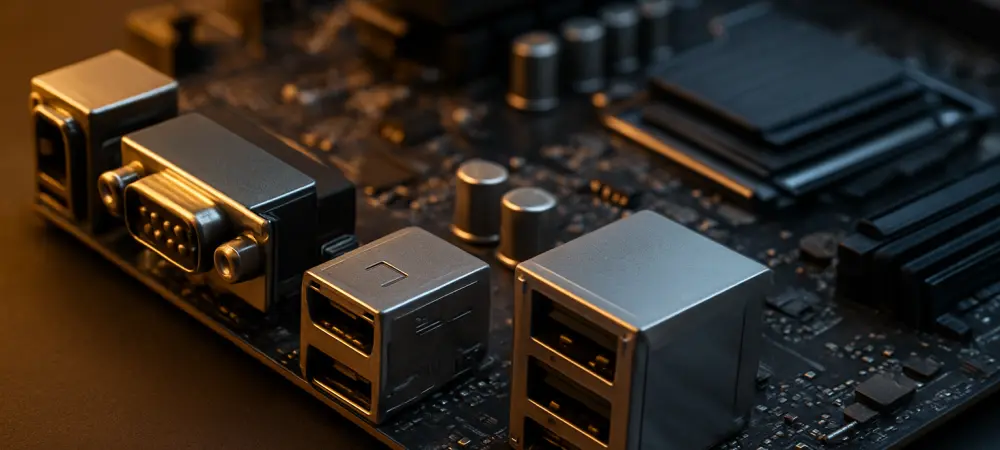
The global move toward USB standardization has significantly lowered the barrier to entry for personal computing by eliminating the need for specialized connector knowledge. The frustration of matching color-coded mini-DIN ports or tightening thumbscrews on a parallel cable has been replaced by the convenience of reversible connectors that carry data, power, and video through a single interface. This convergence represents more than just a convenience for the consumer; it reflects a fundamental shift in motherboard architecture where efficiency and space optimization allow for more powerful onboard components and improved thermal management.
The Decline of Input and Multimedia Interfaces
The Legacy: Human Interface and Gaming Connectors
For a long time, the PS/2 port remained a stubborn fixture on motherboards, even as the first iterations of the Universal Serial Bus attempted to unseat it. The lack of “hot-plugging” capability—where a user had to reboot their entire machine just to recognize a new mouse—became an unacceptable friction point for modern workflows. While niche enthusiasts and certain high-security government installations still occasionally request boards with these legacy ports to prevent hardware-based security vulnerabilities, the majority of modern motherboards have reclaimed that valuable physical space to accommodate more USB 4.0 ports or enhanced wireless networking antennas.
The disappearance of the MIDI/Game port is another significant marker of this transition toward the PC as an all-in-one powerhouse. Modern audio production has since migrated to high-bandwidth Thunderbolt 5 interfaces, which provide the low latency required for professional recording without the need for ancient D-sub architectures. The transition away from these single-purpose connectors has allowed motherboard manufacturers to simplify the rear I/O panel, focusing on versatile ports that can adapt to whatever device is plugged into them, from a high-refresh gaming mouse to a professional MIDI controller.
Streamlining Peripheral Connectivity: The Move to High-Speed Serial Buses
The industry-wide adoption of high-polling rate USB standards has effectively addressed the latency concerns that once kept legacy ports alive. In 2026, even entry-level motherboards feature USB interfaces capable of 8000Hz polling rates, rendering the theoretical advantages of the old PS/2 interrupt system obsolete for all but the most extreme competitive gaming scenarios. This technical evolution has moved the complexity of the connection from the physical connector to the internal controller, allowing for a much cleaner motherboard layout. The consolidation of multiple input standards into a single protocol has also streamlined software development, as modern operating systems no longer need to maintain ancient drivers for specialized hardware interfaces.
Furthermore, the death of the dedicated game port signaled the end of the sound card era for the average consumer. Motherboards now integrate high-end digital-to-analog converters directly into the PCB, utilizing internal lanes that far exceed the bandwidth of those older, external connections. This shift has not only reduced the cost of building a capable multimedia machine but has also freed up internal PCIe slots for high-speed NVMe storage and powerful graphics accelerators. The result is a more cohesive system architecture where every square millimeter of the motherboard is utilized for maximum performance, rather than being dedicated to oversized, legacy connectors that served only a single function.
Industrial Workhorses and the Digital Transition
From Bulk DatThe Obsolescence of Parallel Transmission
The parallel port, once the standard for printers and early external storage, stands as a monument to the physical scale of early data transmission hardware. By 2026, the parallel port has been entirely superseded by the USB-B and USB-C standards in the printing world, which offer significantly higher speeds and a much smaller physical footprint. The removal of this port allowed motherboard designers to significantly reduce the height of the I/O stack, a necessary step in the development of the compact SFF (Small Form Factor) builds that are popular in the current market.
While the parallel port was unique for its simultaneous data transfer, it suffered from “signal skew,” where bits arriving at slightly different times caused errors at high speeds. This inherent flaw made it impossible for the technology to scale with the increasing demands of modern data processing. In contrast, the transition to high-speed serial protocols, which send data bit-by-bit at extremely high frequencies, proved to be a more effective path for long-term growth. Today, the ghost of the parallel port lives on only in legacy industrial environments where decades-old CNC machinery or specialized diagnostic tools require a connection to an era of computing that prioritized physical robustness over streamlined efficiency.
Reliability and Stability: The Enduring Role of the RS232 Interface
Unlike many of its contemporaries, the 9-pin RS232 serial port has managed to maintain a foothold in the professional and industrial sectors well into 2026. The reason for this longevity is its incredible simplicity and reliability; it is a “dumb” port that requires almost no overhead from the CPU to function. In environments where a system crash could result in thousands of dollars in lost productivity, the ability to access a machine via a serial console remains an essential failsafe.
The resilience of the RS232 port highlights a critical truth about motherboard evolution: technical superiority is not always defined by raw bandwidth. In industrial applications, the goal is often consistent, error-free communication over long periods, a task at which the serial port excels. However, even this stalwart of the industrial world is seeing a gradual shift toward specialized “industrial USB” and Ethernet-based control systems that offer more security features. For now, the serial port serves as a bridge between the analog past and the digital present, providing a level of hardware-level stability that modern, more complex protocols sometimes struggle to match in extreme or specialized conditions.
The Competition for High-Speed Standards
Market Viability: Why FireWire Lost the Protocol War
FireWire, also known as IEEE 1394, is often remembered by tech historians as a technically superior standard that was ultimately defeated by market forces. Despite these advantages, FireWire’s adoption was crippled by high licensing fees and a lack of support from major PC chipset manufacturers outside of the high-end creative space. By the time USB 2.0 arrived with “good enough” speeds and a royalty-free model, the fate of FireWire was sealed. In 2026, FireWire is a distant memory, with its specialized tasks now handled by Thunderbolt 5, which offers exponentially more bandwidth and integrates seamlessly with the universal USB-C physical connector.
The story of FireWire serves as a valuable lesson in the importance of industry-wide accessibility over pure performance metrics. The transition away from proprietary and heavily licensed ports has led to a more democratic hardware ecosystem where high-speed data transfer is an expected feature of every port on the motherboard, rather than a premium addition reserved for a select few. This shift has simplified the buying process for consumers, who no longer have to worry about whether their external drive will be compatible with their specific hardware.
The End of Analog Video: From VGA to Integrated Digital Signals
The Video Graphics Array (VGA) port was once the most ubiquitous connection in the computing world, recognizable by its blue 15-pin D-sub connector. Modern high-resolution displays require the precision of digital signals to maintain color accuracy and sharpness, leading to the total dominance of HDMI 2.1 and DisplayPort 2.1. While VGA lingered for years in the corporate world for projector compatibility, it has finally been phased out of modern consumer motherboards, replaced by the much more versatile “Alt Mode” over USB-C, which can carry video, audio, and power through a single cable.
The move away from VGA also allowed for the implementation of robust Digital Rights Management (DRM) and high-quality audio passthrough, features that were simply not possible with an analog connection. On modern motherboards, the space once occupied by a single, bulky VGA port can now house two or three digital outputs, allowing for multi-monitor setups without the need for a dedicated graphics card. Furthermore, the removal of the analog-to-digital conversion circuitry on the motherboard has reduced electrical noise and improved the overall efficiency of the system. While VGA was a reliable workhorse for decades, its retirement marks the final step in the total digitalization of the PC’s visual output.
The New Era of Universal Connectivity
Synthesis: Modern Hardware Architecture and Space Optimization
The consolidation of multiple functions into the USB-C standard has fundamentally changed the way motherboards are designed and manufactured. By utilizing a single, compact interface that can handle everything from 240W power delivery to 80Gbps data transfers, engineers have been able to reclaim significant portions of the rear I/O panel. The reduction in the number of specialized controllers needed for different ports has also simplified the PCB routing, leading to more stable power delivery and reduced electromagnetic interference. This design philosophy has enabled the creation of high-performance motherboards that are thinner and more robust, catering to the needs of both workstation professionals and gaming enthusiasts.
Moreover, the shift toward universal connectivity has encouraged a more modular approach to workstation setups. With a single high-bandwidth port capable of driving multiple 4K displays, external storage arrays, and high-fidelity audio interfaces, the need for a cluttered desk full of specialized cables has vanished. Users can now move between different environments with ease, connecting a single cable to their laptop or desktop to instantly gain access to their entire peripheral ecosystem. The success of the USB-C standard is a testament to the power of technical convergence, proving that a well-designed, universal interface can satisfy the needs of diverse users.
Strategic Implementation: Optimizing Workstations for Current Standards
The transition toward a unified connector ecosystem was the result of years of refinement and industry collaboration. Manufacturers prioritized the user experience by moving away from fragile, orientation-specific ports and embracing a more durable and versatile physical standard. This evolution ensured that the average builder no longer needed to struggle with identifying obscure pinouts or managing a dozen different cable types. Instead, the focus shifted toward understanding bandwidth tiers and power delivery specifications, which offered far more utility than the rigid interfaces of the past.
For those looking to maximize their current hardware potential, the focus should remain on high-quality, certified cables and docking solutions that can handle the full bandwidth of USB 4.0 and Thunderbolt 5. As motherboard manufacturers have largely moved away from legacy ports, investing in a robust external ecosystem is the most effective way to maintain compatibility with specialized equipment. It is also important to pay close attention to the power delivery ratings of the onboard ports, as these can vary significantly between budget and high-end motherboards. By selecting components that adhere to the latest unified standards, users can ensure their systems remain relevant and capable for years to come. The era of specialized port knowledge was a necessary stage in computing history, but the current age of universal digital connectivity has provided a much more flexible and powerful foundation for the future of the industry.