

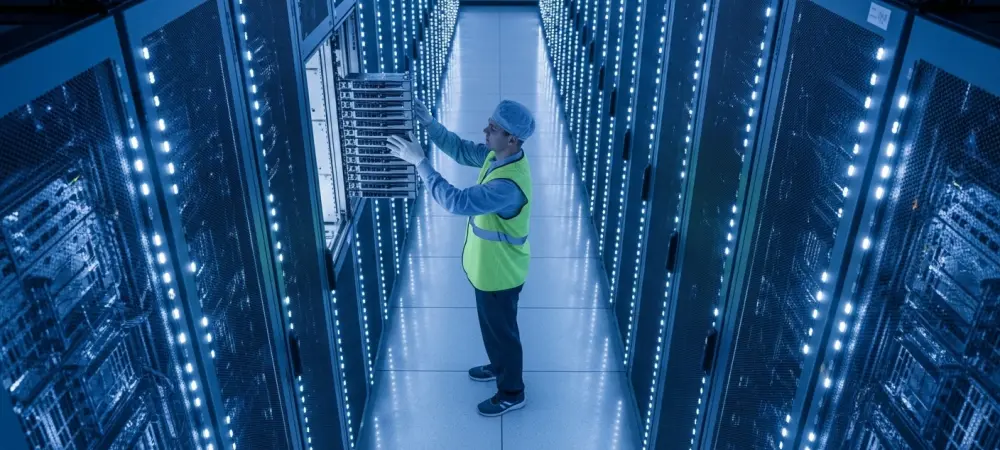
Deep within the humming aisles of a modern hyperscale facility, the rhythmic pulse of thousands of spinning platters and flashing flash modules represents the heartbeat of the global economy. While the world marvels at the fluid brilliance of generative artificial intelligence, the actual stability of these digital empires rests on a variable often overlooked by the casual observer: the physical reliability of the humble storage drive. In the current landscape of 2026, the strategy has shifted from mere hardware procurement to foundational facility planning, where a single percentage point in component failure can oscillate a multibillion-dollar financial model from profit to loss.
This shift marks the end of an era where storage was treated as a disposable commodity. Today, the storage drive has become a primary variable in the complex calculus of data center economics. As organizations integrate massive datasets into every facet of operations, the invisible infrastructure of the storage layer dictates the success of hyperscale cloud environments. The stakes are no longer just about data access; they are about the physical and fiscal survival of the facilities that house the intelligence of the modern age.
The Physical Realities of the AI Data Explosion
The transition from traditional disaster recovery to comprehensive data resilience has fundamentally altered how data centers are constructed and managed. It is no longer sufficient to simply have a backup; infrastructure must now support an environment where data is perpetually active and resilient. This shift has introduced the “Multiplication Factor,” a reality where achieving high durability requires significantly more physical hardware than the raw data size suggests. To maintain the industry-standard durability targets, one petabyte of primary data often necessitates a physical footprint of three petabytes once replicas and erasure coding are factored in.
This expansion creates a direct, uncompromising link between storage density and the operational efficiency of the building. Every additional rack of drives consumes precious floor space and increases the demand for power and cooling, directly impacting the Power Usage Effectiveness (PUE) of the facility. As AI workloads push datasets to unprecedented scales, the “standard” storage lifecycle is being redefined. Facility managers now prioritize drives that offer the highest capacity-to-power ratio, as the cumulative energy cost of keeping petabytes of data spinning or powered on has become one of the largest line items in the operational budget.
The Cascading Economics of Component Failure
Managing a fleet of a million drives reveals a harsh mathematical reality: even a seemingly negligible 1% failure rate translates to 27 hardware replacements every single day. These are not isolated events but triggers for high-stress “rebuild operations” that ripple through the entire infrastructure. When a drive fails, the system must reconstruct that lost data by reading from neighboring hardware, a process that spikes power consumption and generates significant heat. This mechanical stress can, in turn, shorten the lifespan of adjacent components, creating a dangerous cycle of degradation that threatens the stability of the entire rack.
Moreover, the financial burden of these failures extends far beyond the price of a replacement part. Each failure causes resource congestion, as data reconstruction drains internal network bandwidth that would otherwise be dedicated to user workloads. There is also the significant labor overhead to consider, involving the “truck roll” costs of getting technicians on-site and the hours spent navigating the labyrinthine aisles of a hyperscale facility. In a high-density environment, the ability of a component to remain operational for its intended lifecycle is the difference between a streamlined operation and an endless cycle of reactive maintenance.
Archival Storage in the Age of Ransomware and AI Training
The evolution of immutable archives has transformed long-term storage from a dusty compliance checkbox into an operational lifeline. With ransomware threats becoming increasingly sophisticated, the ability to pull from an uncorrupted, “frozen” version of a dataset is the only way many enterprises can guarantee continuity. However, this has created a unique “Idle-to-Maximum” stress test for infrastructure. Systems that may sit relatively quiet for months must be capable of switching to multi-week, high-intensity recovery operations at a moment’s notice, a transition that tests the very limits of a facility’s power and cooling systems.
Furthermore, the rise of AI has introduced the concept of the “Warm Archive.” Unlike traditional backups that were rarely touched, AI training datasets require regular retraining cycles, creating unpredictable thermal and power loads as massive amounts of data are moved. These cycles often lead to localized hot spots during massive data egress, where the heat generated by thousands of drives reading simultaneously can overwhelm standard cooling configurations. Managing these thermal risks is now a central part of archival strategy, ensuring that the archive remains a reliable tool rather than a liability during a crisis.
Strategic Frameworks for Resilient Infrastructure Planning
Designing for the modern era requires a move toward “Failure Intelligence,” where operators shift from reactive troubleshooting to proactive, graceful component retirement. This strategy involves monitoring telemetry to identify drives that are trending toward failure before they actually crash, allowing for data migration during periods of low network activity. By optimizing power envelopes and ensuring consistent thermal output throughout the entire hardware lifecycle, operators can maintain a stable environment that minimizes the risk of cascading failures.
Finally, the internal network fabrics of these facilities must be balanced to handle the massive “East-West” traffic generated by AI checkpoints and data movement. It was once sufficient to optimize for data leaving the building, but today, the movement of data between servers within the facility is just as critical. Strategic planning now involves sizing Uninterruptible Power Supply (UPS) and cooling systems for simultaneous high-intensity utilization across the entire floor. This holistic approach ensures that the facility can withstand the rigorous demands of the AI era without compromising the economics that make hyperscale operations possible. The pursuit of storage reliability proved to be the most effective hedge against the rising costs of energy and labor in the data center sector. Operators who prioritized high-endurance hardware and proactive maintenance frameworks successfully reduced their total cost of ownership by nearly 20 percent compared to those who focused solely on initial procurement price. Moving forward, the industry turned toward liquid cooling and AI-driven predictive analytics to manage the thermal profiles of ever-denser storage arrays. These advancements ensured that the infrastructure remained resilient enough to support the next generation of massive language models. Ultimately, the transition to a reliability-first mindset provided the stability needed for the digital economy to thrive in an increasingly data-dependent world.