

Bridging the Gap Between Low Earth Orbit and the Urban Jungle
The recent public disclosure regarding SpaceX’s strategic intention to establish a terrestrial mobile network has fundamentally altered the competitive landscape for established telecommunications providers across the United States. SpaceX’s Starlink has already redefined rural internet access by blanketing the globe with thousands of satellites, but its latest maneuver moves the battlefield from the stars to the street level. By signaling its intent to develop a terrestrial mobile network, Starlink is transitioning from a niche broadband provider into a direct challenger to established telecom titans. This shift is significant because it addresses the inherent physical limitations of satellite-to-phone communication while threatening to upend the traditional carrier business model.
Industry observers note that the expansion into ground-based infrastructure represents a maturation of the company’s long-term vision. While the satellite constellation provided the necessary coverage for uninhabited or underserved regions, the density of urban environments requires a different architectural approach. The following exploration dives into how this hybrid approach could solve the “dead zone” problem and why the industry is bracing for a massive infrastructure showdown. By integrating these two distinct modes of delivery, the company aims to provide a seamless experience that does not degrade when a user moves from a mountain pass to a metropolitan skyscraper.
This pivot is viewed by many as an admission that space-based signals alone cannot handle the massive data throughput demanded by modern smartphone users. Consequently, the discourse among experts has shifted from whether satellite internet is viable to how quickly a hybrid terrestrial network can be deployed. The implications for the current market leaders are profound, as they face a competitor that is not bound by the legacy constraints of traditional fiber-linked tower networks. As we look toward the next several years of development, the pressure on incumbent operators to defend their market share while innovating their own satellite partnerships has never been higher.
The Mechanics of Market Disruption and Infrastructure Evolution
The High-Stakes Gamble of Financing a Fourth National Carrier
Entering the terrestrial mobile market is a capital-intensive endeavor that has left analysts divided on Starlink’s financial trajectory. Some financial experts suggest that building a competitive 5G footprint could require an investment exceeding $100 billion to secure the necessary macro sites and spectrum depth. This high-end estimate is based on the logic that a national build-out would require between 50,000 and 120,000 macro sites to provide the level of service consumers expect from established giants. From this perspective, SpaceX holds a challenging hand, as the revenue returns on such a massive capital outlay are not guaranteed in a saturated mobile market. However, lean-build proponents argue that SpaceX could leverage its existing financial momentum to establish a presence for a fraction of that cost, potentially around $12 billion. This school of thought suggests that by focusing on a more targeted deployment of 30,000 to 50,000 sites, the company can achieve significant coverage without the bloated budgets of its predecessors. This debate highlights the tension between Starlink’s skyrocketing revenue and its widening net losses, framing the terrestrial move as a high-risk play to secure long-term profitability through a diversified service portfolio. The ability to manage such a massive project while already funding a burgeoning space program remains a central point of skepticism for many Wall Street analysts.
The financial narrative is further complicated by the company’s historical ability to disrupt cost structures. While traditional carriers have spent decades and hundreds of billions on their foundations, Starlink has shown a penchant for vertical integration that could theoretically lower the cost of network hardware. If the company can successfully navigate the complexities of site acquisition and permitting, it may find that its entry into the fourth national carrier slot is more economically viable than the skeptics predict. This financial tug-of-war will likely define the company’s valuation as it moves closer to a potential public offering of its satellite division.
Transforming Satellite Dishes into a Distributed Network of Ground-Level Cells
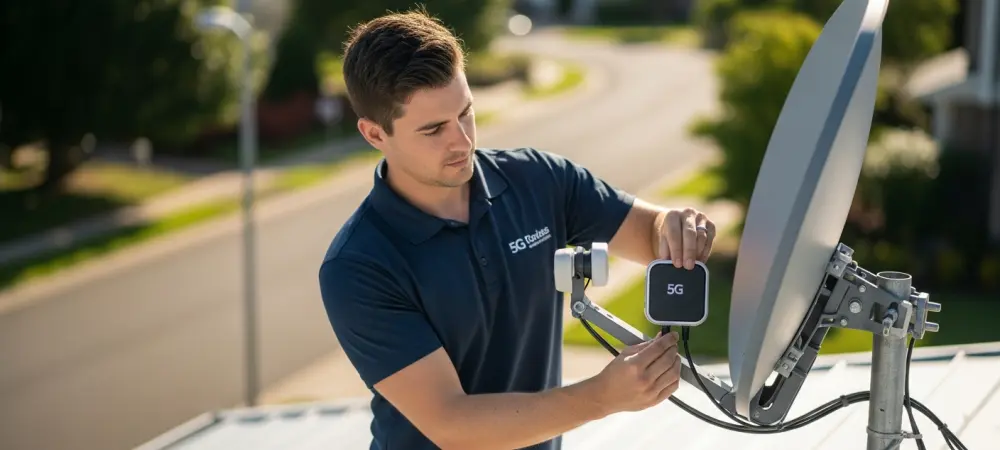
Rather than following the legacy path of building thousands of expensive new towers, Starlink aims to turn its existing customer base into the backbone of its network. By integrating small-cell technology directly into the millions of Starlink dishes already mounted on rooftops across America, the company can create a dense, distributed network with minimal additional land-acquisition costs. This “lean” infrastructure strategy allows Starlink to offload mobile traffic from crowded satellite links to high-capacity terrestrial backhaul. It effectively mimics the success of cable companies that use widespread Wi-Fi hotspots to provide mobile services without owning a full national tower network.
This decentralized approach transforms the customer premises equipment from a simple receiver into a vital node for the broader community. Each rooftop dish could theoretically serve as a localized 5G or 6G tower, providing high-speed connectivity to any passerby with a compatible handset. This method drastically reduces the need for the large-scale “tower farms” that currently dominate the landscape. Moreover, because these dishes are already powered and connected to the satellite backhaul, the incremental cost of adding a mobile radio component is relatively low compared to building an entirely new macro site.
Strategic observers have drawn parallels between this plan and the enterprise models used by major internet service providers who offer public hotspots through residential routers. By utilizing the existing footprint of millions of users, the company can bypass the years of bureaucratic hurdles associated with traditional cell tower construction. This creates a symbiotic relationship between the residential broadband service and the mobile network, where every new satellite internet subscriber inadvertently strengthens the mobile coverage for everyone else. The efficiency of this model could potentially rewrite the rulebook for how national wireless networks are scaled.
Spectrum Optimization and the Engineering Logic of Traffic Offloading
From a technical standpoint, the move toward terrestrial hardware is less about market vanity and more about solving a fundamental physics bottleneck. Direct-to-cell satellite communication is plagued by limited antenna gain and battery constraints on standard smartphones, making it difficult to support high-bandwidth activities. By utilizing dish-mounted small cells, Starlink can move data onto the more robust Ku- and Ka-band payloads, reserving precious satellite-to-phone spectrum for emergency use and remote coverage. This hybrid engineering approach ensures that urban users get high speeds without degrading the service for those in deep wilderness areas, optimizing the utility of every megahertz SpaceX owns.
Engineers emphasize that the small-cell relay acts as a high-powered bridge between the handset and the satellite constellation. A standard smartphone struggling to reach a satellite hundreds of miles away in orbit can easily maintain a high-speed connection to a dish on a nearby roof. The dish then uses its superior hardware to transmit that data to the satellite network or local fiber links. This optimization is critical for maintaining network quality as the number of users grows, as it prevents the relatively thin direct-to-device spectrum from becoming hopelessly congested.
Furthermore, this engineering logic allows for a more flexible use of the spectrum. In densely populated areas, the terrestrial network can handle the bulk of the load, while in sparsely populated regions, the satellites can take over without the need for ground-based equipment. This creates a tiered system of access that maximizes the strengths of both satellite and terrestrial physics. By managing traffic in this manner, the company can offer a consistent quality of service that was previously thought impossible for a satellite-heavy provider, effectively merging two worlds of telecommunications.
Dismantling the Traditional Telco Stack Through Nomadic Connectivity
The most disruptive potential of Starlink’s plan lies in the “unbundling” of the mobile experience, shifting power away from traditional carriers. By dominating “nomadic” access—the spaces where people are stationary but away from home—Starlink forces legacy providers into the narrow niche of providing connectivity only for high-speed moving vehicles. In a future where devices use artificial intelligence to seamlessly hop between Wi-Fi, satellite, and nomadic small cells, the traditional mobile operator becomes just one of many invisible pipes. This trend challenges the common assumption that we need a single carrier for all locations, potentially relegating mobile giants to mere backup providers.
Market analysts describe this shift as a fragmentation of the connectivity stack, where the consumer’s primary relationship is with a service layer rather than a tower owner. If a user can get reliable data through a combination of their home dish and public small-cell nodes, the need for a massive monthly cellular bill from a traditional provider diminishes. This unbundling could lead to a scenario where legacy carriers are forced to compete on wholesale prices rather than retail brand loyalty. The loss of the direct relationship with the customer would be a devastating blow to the business models of current industry leaders.
This disruption is particularly potent for the enterprise sector, where private networks are becoming increasingly common. Some theorists suggest that SpaceX might provide spectrum to businesses to build their own internal 5G networks, which would then be opened to Starlink’s public users in exchange for lower costs. This collaborative model would create a patchwork of connectivity that is more resilient and adaptable than the rigid, centralized networks of the past. As the focus shifts toward this nomadic style of access, the definition of what it means to be a “mobile carrier” is being fundamentally rewritten.
Strategic Takeaways for Navigating the Hybrid Connectivity Era
The convergence of satellite and terrestrial technology suggests that the future of mobile service is no longer a binary choice between towers and space. To stay competitive, industry stakeholders should prioritize the development of multi-access edge computing and devices capable of intelligent network switching. This requires a shift in how hardware is designed, focusing on radios that can transition between diverse frequency bands without dropping calls or data sessions. For manufacturers, the goal is to create a seamless interface where the user is unaware of whether their data is coming from a nearby rooftop or a satellite in orbit. For consumers and enterprises, the recommendation is to prepare for a “connectivity stack” model where redundancy is built into the hardware rather than the service contract. Relying on a single provider for all needs is becoming a legacy approach that lacks the resilience of a hybrid system. Leveraging the installed base of satellite dishes for ground-level coverage proves that infrastructure speed—rather than just spectrum ownership—is the new metric for success in the 5G and 6G eras. Businesses should look toward solutions that offer this multi-layered access to ensure that their operations remain online regardless of local terrestrial outages or satellite solar events.
Redefining the Future of Global Mobility Beyond Conventional Towers
Starlink’s terrestrial ambitions reinforced the theme that the next phase of global connectivity was defined by integration rather than isolation. By bridging the gap between space-based signals and ground-level small cells, SpaceX was not just building a phone company; it was creating a ubiquitous, invisible layer of access that transcended the limits of geography. As the 2027 spectrum auctions approached, the pressure on incumbent carriers to innovate intensified, leading to a more fractured yet resilient telecommunications landscape. The analysis of these trends suggested that the reliance on massive, centralized towers was slowly being replaced by a more distributed and agile infrastructure model.
Ultimately, the winner of this rivalry was the entity that could provide the most seamless transition between the stars and the sidewalk, forever changing how society stayed connected on the move. The study of this transition revealed that the most successful strategies were those that utilized existing hardware to solve modern bandwidth problems. Moving forward, the focus must remain on perfecting the hand-off between satellite and ground systems to ensure that connectivity is treated as a basic utility rather than a localized luxury. This evolution has set the stage for a world where “dead zones” are a historical curiosity rather than a daily frustration.