

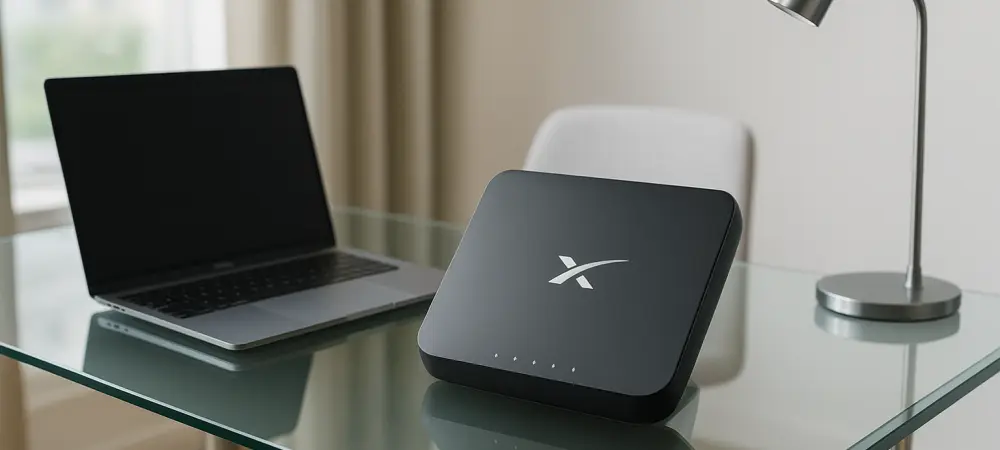
The decision to utilize a 5 GHz tri-band backhaul instead of the 6 GHz spectrum reflects a focus on providing stable connectivity through thick walls and over long distances. As digital demands reach unprecedented heights, SpaceX has formally introduced the Starlink Router 4, marking a pivotal transition in its hardware philosophy toward a professional-grade ecosystem. By releasing this hardware on September 9, 2026, the company addresses the performance gap that often exists between high-speed satellite downlinks and the localized distribution of data within a building. This iteration is not merely a marginal improvement but a complete overhaul intended to transform the Starlink experience from a basic satellite utility into a premium networking solution that rivals top-tier residential mesh systems. The launch signals a clear intent to serve the prosumer market, catering to users who require more than just a functional connection, but rather a robust, low-latency backbone for their data-intensive lives.
Wi-Fi 7 Standards: Architecture and Optimization
The technical foundation of the new hardware rests on a specialized Wi-Fi 7 chipset that has been meticulously tuned for real-world environmental challenges. While the wider networking industry has often prioritized the 6 GHz spectrum for its peak throughput, SpaceX designers recognized that high-frequency waves suffer from significant attenuation when encountering physical obstacles. By doubling down on a tri-band configuration centered on the 2.4 GHz and 5 GHz bands, the Router 4 maintains a high-velocity data stream while ensuring that the signal remains usable in the furthest corners of a residence. This strategic choice allows the router to deliver consistent speeds without the rapid drop-off often seen in short-range 6 GHz implementations. This move prioritizes reliability and sustained performance, acknowledging that a theoretical speed limit is useless if the connection cannot penetrate a standard drywall or brick partition in a typical home.
Beyond the frequency selection, the integration of Multi-User, Multiple-Input, Multiple-Output (MU-MIMO) technology alongside Orthogonal Frequency Division Multiple Access (OFDMA) represents a massive step forward for the platform. These advanced protocols allow the router to communicate with dozens of devices simultaneously, slicing the available bandwidth into smaller, more efficient resource units. This efficiency is particularly critical in the current landscape where a single household might engage in 8K video streaming, competitive online gaming, and multiple high-definition video conferences all at once. To complement this throughput, SpaceX has implemented the WPA3 security standard as the default encryption protocol. This ensures that every byte of data traversing the local network is protected by the most modern cryptographic safeguards available today. By addressing both the capacity for data and the security of that data, the device provides a stable environment.
Network Coverage: Range and Durability Enhancements
One of the most tangible benefits for the average user is the dramatic expansion of the effective coverage area, which has seen a 75% increase over the previous generation. The Router 4 is now officially rated to provide high-quality signal across 3,500 square feet, a substantial leap from the 2,000 square feet limitation of the Gen 3 model. This expansion is intentionally designed to eliminate the notorious dead zones that often plague large suburban properties or sprawling rural farmhouses. Furthermore, the physical construction of the unit has been upgraded to include an IP56 water-resistant rating, providing a level of durability rarely seen in residential networking equipment. This ruggedization allows the router to be safely deployed in semi-exposed environments, such as covered patios, workshops, or marine cabins, where humidity and dust might otherwise compromise delicate electronics. This versatility ensures the hardware performs in diverse conditions. The internal hardware processing power has been scaled to support a maximum of 510 simultaneous device connections, a figure that elevates the Starlink ecosystem into the realm of enterprise-level service. While a typical family might only use thirty to fifty devices, this high ceiling is critical for the modern smart home that is saturated with IoT sensors, smart appliances, and automated security systems. By providing such a vast connection overhead, the Router 4 prevents the technical bottlenecks that occur when a router’s processor becomes overwhelmed by the volume of metadata requests from background devices. This capacity makes the hardware an attractive option for small business owners and event organizers who need to provide reliable public or internal Wi-Fi to large groups of people without the fear of system crashes. It effectively removes the hardware as a limiting factor in the internet experience, allowing the satellite constellation to be the primary driver.
System Compatibility: Integration and Retrofitting
Maintaining a cohesive ecosystem is a priority for SpaceX, which is why the Router 4 features comprehensive backward compatibility with the existing array of satellite antennas. Whether a subscriber is currently utilizing the compact Starlink Mini, the versatile Standard 4, or even the legacy circular dishes from the early phases of the program, the new router integrates seamlessly into their setup. This approach allows users to significantly enhance their internal network performance and range without the logistical hassle or financial burden of replacing their outdoor satellite equipment. By decoupling the internal network upgrade from the outdoor hardware, the company has created a flexible path for users to modernize their homes at their own pace. This ensures that the long-term investment of early adopters is protected while still providing them access to the latest advancements in Wi-Fi 7 technology and localized data management. A major innovation for professional installers and mobile enthusiasts is the inclusion of a Dual Power over Ethernet (PoE) configuration on the rear of the device. Both integrated Ethernet ports are capable of delivering power directly to connected peripherals, which radically simplifies the physical cable management required for a sophisticated network. This feature is a game-changer for the growing community of users living in mobile environments, such as converted vans or maritime vessels, where space is at a premium and every extra power brick represents an additional point of failure. By consolidating power and data into a single-cable solution, the Router 4 facilitates a much cleaner and more reliable installation process. This streamlined design also reduces the overall power consumption of the networking stack, a critical consideration for those relying on solar panels or battery banks. It represents a thoughtful response to the specific needs of the mobile user base.
Operational Strategy: Performance and Implementation
The introduction of the Router 4 places SpaceX in direct competition with high-end independent networking brands that have traditionally dominated the mesh Wi-Fi market. By offering a proprietary solution that is specifically optimized for satellite latency and jitter characteristics, the company provides a more harmonious user experience than third-party alternatives. This move suggests a broader strategy to own the entire connectivity stack, from the orbiting satellites down to the handheld devices in a user’s living room. As data speeds from the Starlink constellation continue to increase with the deployment of newer satellite versions, having a local router that can actually handle those gigabit-plus bursts becomes essential. This hardware ensures that the user’s local network is never the weak link in the chain, providing a level of performance consistency that was previously only available through expensive, manually configured enterprise networking gear.
To maximize the benefits of this new hardware, users should have performed a comprehensive site survey to identify the most central location for the unit, ensuring that the expanded 3,500 square foot range was fully utilized. Professionals often recommended checking the existing cable categories to ensure that the Dual PoE features operated at peak efficiency without signal degradation. The deployment of the Router 4 proved that integrated satellite systems could finally match the sophistication of fiber-based local networks. For those seeking to upgrade, the logical next step involved auditing current device lists to see which ones supported the Wi-Fi 7 standard to take full advantage of the new protocols. Looking ahead, the transition toward such high-capacity hardware suggested that the boundary between stationary and mobile networking would continue to blur, necessitating a focus on durable, multi-purpose equipment that functioned flawlessly in any geographical location.