

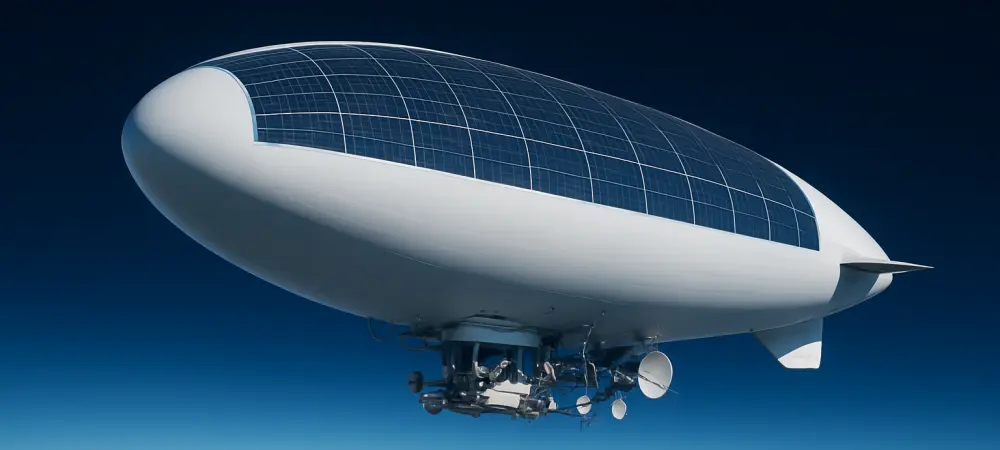
Dominic Jainy stands at the forefront of the next great architectural shift in global telecommunications. As an expert in artificial intelligence and distributed systems, he has closely followed the evolution of the stratospheric layer—a domain that once seemed like a niche experimental zone but is now becoming a critical component of the modern network stack. In our conversation today, Jainy dissects the implications of the recent trials conducted by Softbank and Sceye, which have demonstrated that we can maintain a stable, high-speed network node at an altitude of 20 kilometers. He elaborates on how these high-altitude platforms are no longer just flying cell towers but are evolving into sophisticated airborne edge stations capable of hosting their own mobile cores and web servers to drastically reduce latency for users on the ground.
The discussion highlights the transition from traditional terrestrial RAN and distant LEO satellites to a more integrated 3D network architecture. We explore the technical milestones achieved in the stratosphere, such as the successful 15,000-kilometer journey of the Sceye airship and the achievement of sub-70-millisecond latency for smartphone traffic. Jainy also explains the strategic positioning of HAPS as a high-capacity bridge, specifically for applications in private 5G, disaster recovery, and the burgeoning field of physical AI. Finally, we address the regulatory and logistical hurdles that must be cleared before the target for commercial deployment is reached, while looking at the market forecasts that suggest a multibillion-dollar future for this airborne infrastructure.
With the industry positioning High-Altitude Platform Stations as a critical bridge between terrestrial towers and LEO satellites, how does this middle layer fundamentally change our approach to wide-area connectivity?
The introduction of a stratospheric layer at 20 kilometers above the Earth represents a shift from a 2D infrastructure to a truly 3D communication network. Unlike Low Earth Orbit (LEO) satellites that sit hundreds of kilometers up, HAPS functions as a stationary, elevated node that provides high-quality, high-capacity communications comparable to terrestrial mobile networks. During the recent trials in Japan, we saw this technology demonstrate its ability to handle standard smartphone functions like voice calls, video streams, and disaster alerts without the signal having to travel the vast distances required by satellite systems. This proximity allows HAPS to offer a much shorter radio path than LEO satellites while maintaining a significantly larger footprint than a standard terrestrial tower. By positioning these platforms in the stratosphere, we can fill the massive coverage gaps in rural mountains or out at sea while delivering the low-latency performance that satellite systems often struggle to maintain for high-demand applications. It effectively creates a space bridge that brings the performance of a ground-based tower to an aerial platform, ensuring that even remote users experience a seamless connection that feels as robust as an urban 5G link.
Softbank recently recorded a round-trip latency of 68 milliseconds by hosting a mobile core directly on the aircraft. From your perspective as an AI and networking expert, what does this airborne edge unlock that traditional cloud routing cannot?
The achievement of a 68-millisecond round-trip response is a massive milestone because it proves that we can process data 20 kilometers in the air faster than we can route it through the terrestrial cloud. By putting a mobile core and a web server on board the Sceye craft, Softbank reduced latency by more than 40 percent compared to equivalent internet traffic, which is a game-changer for time-sensitive applications. Imagine a remote-controlled drone operating in a disaster zone; the pilot feels the immediate responsiveness of the controls because the processing is happening right above them rather than in a data center hundreds of miles away. This airborne edge provides a local breakout for traffic, allowing for real-time video transmission and location tracking that feels instantaneous to the end-user. For an engineer monitoring these systems, the reduction in lag isn’t just a number on a screen; it is the difference between a smooth, synchronized operation and a disjointed, dangerous failure in the field. This capability is essential for the era of physical AI, where machines must make split-second decisions based on live sensor feeds without waiting for a distant server to respond.
Can you describe the technical significance of the 15,000-kilometer journey the Sceye platform made from New Mexico to Japan and its ability to remain stationary once it arrived?
The journey itself was a grueling test of endurance and precision, with the Lighter-Than-Air HAPS departing from New Mexico and crossing the vast Pacific Ocean over the course of 13 days. Reaching its destination on August 23 and then spending more than seven days in Japanese-controlled airspace proved that these airships are not just balloons at the mercy of the wind, but true aeronautical vehicles. The most impressive feat was the station-keeping, where the craft maintained its position within a tiny five-kilometer radius despite the unpredictable and harsh stratospheric winds. This level of stability is what allows the stratosphere to work like a terrestrial network location; if the platform drifted too far, the handoffs between ground devices would fail and the signal would drop. Seeing the craft hold its position so tightly gives us confidence that we can deploy these as reliable, permanent nodes in a regional network. It transforms the stratosphere from a transit zone into a fixed piece of real estate where we can confidently park our most sensitive networking equipment.
How does the HAPS architecture specifically benefit private 5G networks and the needs of industrial sectors like mining, maritime operations, or large-scale construction?
For industrial operations that span tens or even hundreds of square kilometers, like an open-pit mine or an offshore wind farm, building a terrestrial 5G network is an expensive logistical nightmare involving dozens of towers and complex backhaul links. A HAPS setup simplifies this by serving the entire operating area from a single platform, acting as a neutral host that can provide different slices of connectivity for various needs. You could have one channel dedicated to high-definition video for remote-controlled asset inspections and another reserved specifically for emergency communications or machine-to-machine sensor data. The recent demo showed that we can even control drones directly from the platform, which is a perfect use case for inspecting hundreds of kilometers of pipeline or power lines without needing a ground crew every few miles. The sensory feedback for operators in these industries is vital—they need to feel the machine’s resistance and see the terrain in high definition without stuttering. HAPS provides that wide-area umbrella of high-capacity data that terrestrial sites simply cannot cover efficiently.
Given that the market is estimated at $1.82 billion this year, how do you interpret the shift toward a neutral-host or as-a-service model for these stratospheric platforms?
The market is currently valued at $1.82 billion, and with projections reaching $3.03 billion by 2032, it is clear that the industry is moving away from experimental one-offs toward a scalable service model. The neutral-host approach is particularly interesting because it allows a single HAPS operator to provide infrastructure to multiple parties, such as public cellular carriers, private industrial firms, and emergency services simultaneously. This shared-network model makes the high cost of stratospheric flight much more palatable, as the expenses are distributed across different clients. We are seeing projects like CROFT in Europe already exploring this, combining HAPS-enabled 5G with satellite backhaul to create resilient networks for remote communities. It is no longer just about “connecting the unconnected” in a general sense; it is about creating a sophisticated, programmable node that can be leased out for specific high-value tasks. This shift is what will finally move HAPS from the IPO brochures of satellite companies into the everyday operational budgets of global telecommunications firms.
What are the primary hurdles that remain before we see the commercial HAPS services target for next year become a widespread reality?
While the technical ability to make a radio connection is proven, the operational reality of running a fleet of these ships reliably and safely is the next major hurdle. We are still tackling significant obstacles related to aviation regulation and spectrum approvals, as flying these massive craft in commercial airspace requires intense coordination with international authorities. There is also the matter of platform endurance; while the 13-day flight was a success, a commercial service will need ships that can stay up for months at a time without coming down for maintenance. The practicalities of getting these HAPS ships into and out of the stratosphere safely through different weather layers remain a point where the industry is still “kicking the tires.” Furthermore, the technology must be affordable enough to compete with other solutions; if the cost of operating the flight outweighs the revenue from the 5G service, it will remain a niche tool for disaster recovery rather than a mainstream utility. We are watching closely to see if the 2027 commercialization target can be met with a fleet that is as robust as the ground-based infrastructure we rely on today.
With talk of space integrated computing networks, how do you envision HAPS working in tandem with GEO and LEO satellites to create a seamless infrastructure?
The vision for the future is a multi-layered 3D network where HAPS, LEO, and GEO satellites all play specialized roles connected by optical links. In this hierarchy, GEO satellites would handle the long-distance traffic and massive backhaul capacity, while LEO satellites provide broader global coverage. HAPS sits at the bottom of this “space” stack, providing the low-latency access layer that actually talks to the smartphones and sensors on the ground. This integration allows for a “space integrated computing network” where data is processed at whichever layer makes the most sense for the specific task. For example, a maritime vessel might use a GEO link for its general internet needs but switch to a HAPS link for high-precision docking maneuvers that require the 68-millisecond latency we discussed. This collaborative approach prevents the different technologies from cannibalizing each other’s markets and instead creates a resilient, ubiquitous network that covers everything from the deepest ocean to the highest mountain peak.
What is your forecast for the role of HAPS in the global connectivity landscape over the next few years?
My forecast for HAPS is that it will move from being an eccentric alternative to a standardized component of the 3D network by 2027. We are currently looking at an addressable market of roughly 330 million SME offices and household premises that are currently unconnected or poorly served by terrestrial networks. As we refine the regenerative payloads and onboard computing capabilities, HAPS will become the primary tool for rapid network deployment in disaster-stricken areas and for providing high-capacity links to the “moving edge,” such as fleets of autonomous vehicles or drones. While it may not replace fiber in dense urban centers, its ability to provide 5G-quality performance over hundreds of square kilometers will make it indispensable for the global industrial and maritime sectors. We are moving toward a world where the “edge” isn’t just a box in a room, but a programmable node hovering 20 kilometers above our heads, and the successful tests we are seeing now are the foundation for that elevated future.