

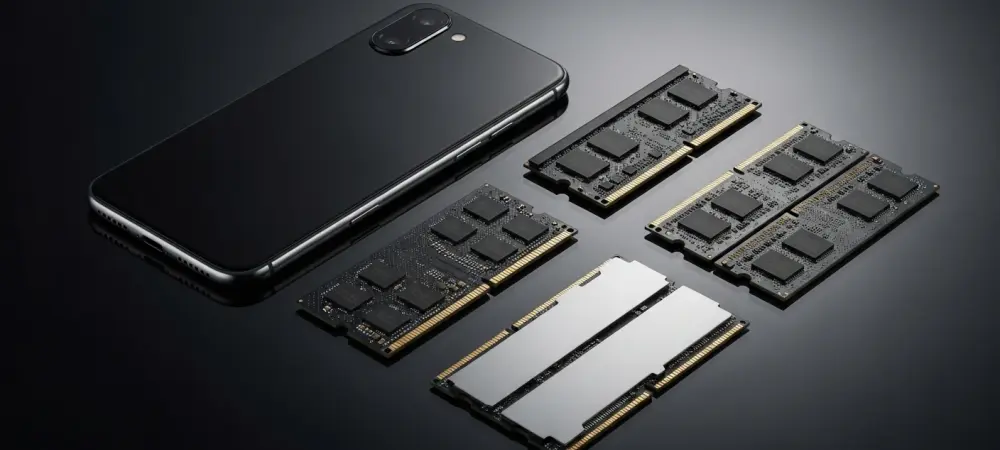
The modern consumer now faces a marketplace where the digital heartbeat of a mobile device, its internal memory, has become the primary driver of record-breaking price tags. As the global smartphone economy matures, the reliance on semiconductor stability has shifted from a theoretical concern to a daily operational hurdle. High-performance RAM and NAND flash storage are no longer just specifications on a box; they are the most volatile elements in the modern mobile architecture.
Key market players are currently navigating a competitive landscape where the Bill of Materials is being rewritten by silicon scarcity. Global supply chain fluctuations have moved beyond simple shipping delays to a fundamental restructuring of hardware manufacturing costs. Consequently, every major brand must now recalibrate its financial roadmap to survive an environment where internal components are becoming more valuable than the exterior design.
Deciphering the Surge in Component Costs and Market Projections
Critical Trends in Memory Pricing and Technological Adoption
A quarterly surge of 50 percent in mobile RAM costs has sent shockwaves through the production lines of every major manufacturer. This volatility is compounded by a 90 percent increase in NAND storage pricing, creating a ripple effect that touches everything from basic data caching to advanced multitasking capabilities. Furthermore, the transition toward 2nm chipsets is adding a massive financial burden to flagship devices that already push the limits of consumer budgets.
Evolving consumer demand for higher storage capacities and faster processing is no longer a luxury but a baseline expectation. As users migrate toward high-definition content and local machine learning tasks, the hardware required to support these functions must grow more sophisticated. This necessity ensures that even as manufacturing techniques improve, the sheer volume of high-grade memory required keeps the total cost high.
Growth Forecasts and Financial Performance Indicators
Retail prices are projected to see significant upward shifts across all tiers, with budget models rising by $30 while premium handsets could see hikes near $200. Data-driven outlooks on inflation within the manufacturing sector suggest that these price points will remain elevated through the current fiscal year. Manufacturers are currently caught in a performance shift, desperately balancing shipment targets against margins that are thinning with every new production batch.
Financial indicators suggest that the industry is entering a phase of forced premiumization. Even in the mid-range segment, the inflation of core components is making it nearly impossible to maintain the price-to-performance ratios of the past. Companies that once thrived on volume are now looking toward software services to offset the diminishing returns on hardware sales.
Navigating Structural Obstacles and Manufacturing Complexities
The entry-level segment is particularly vulnerable, as memory now occupies a staggering 43 percent of the total assembly cost for devices under $200. This saturation leaves almost no room for innovation in other areas like battery technology or display quality. To combat a 20 percent rise in RAM expenditure, mid-range producers are forced to seek aggressive hardware optimizations or risk losing their competitive edge in emerging markets. High-volume producers face a severe margin squeeze that threatens the very existence of affordable mobile technology. Some brands are exploring alternative sourcing strategies or modular designs to mitigate these costs, but the baseline price of silicon remains a rigid barrier. Without a shift in how these devices are engineered, the sub-$200 phone may soon become a relic of a previous economic era.
Compliance, Security Standards, and the Regulatory Environment
International trade regulations continue to exert pressure on semiconductor procurement, often dictating where and how manufacturers can buy their chips. These geopolitical shifts often result in sudden price spikes as brands scramble to find compliant suppliers. Moreover, new sustainability mandates are forcing companies to account for the entire lifecycle of hardware, adding another layer to the already high manufacturing costs.
Data security standards are also demanding more complex and expensive memory modules to handle encrypted workloads. While these regulations protect the consumer, they necessitate hardware that is inherently more costly to produce. Government subsidies in specific regions have attempted to stabilize production, but these localized efforts have yet to cool the global market temperatures.
Future Horizons: Innovation and Industry Transformation
Generative AI integration is rapidly becoming the new standard, driving hardware requirements and costs to unprecedented levels. To run these models locally, devices require massive amounts of high-speed memory that simply did not exist in standard phones a few years ago. The arrival of 2nm processors represents a pinnacle of engineering, but their long-term impact on pricing suggests that the era of cheap flagship power is ending.
Consumer behavior is already shifting as people move away from frequent upgrades in favor of long-term device investments. If local hardware becomes too expensive, the market might see a rise in cloud-based processing to bypass the need for expensive on-device memory. This transition could redefine the smartphone as a terminal for remote servers rather than a standalone powerhouse.
Strategic Outlook and Recommendations
The fundamental shift in smartphone cost structures required a total reimagining of the traditional business model. Original Equipment Manufacturers had to prioritize financial sustainability by adopting tiered pricing strategies that clearly reflected the soaring costs of silicon. The industry demonstrated remarkable resilience, but the necessity of price adjustments proved unavoidable for those wishing to remain solvent in a high-cost environment.
Investment perspectives shifted toward the semiconductor sector as the ultimate gatekeeper of the mobile experience. Stakeholders eventually recognized that hardware efficiency and software-level optimization were the only viable paths forward. Ultimately, the market moved toward a model where longevity and high-value integration replaced the cycle of annual hardware disposal.