

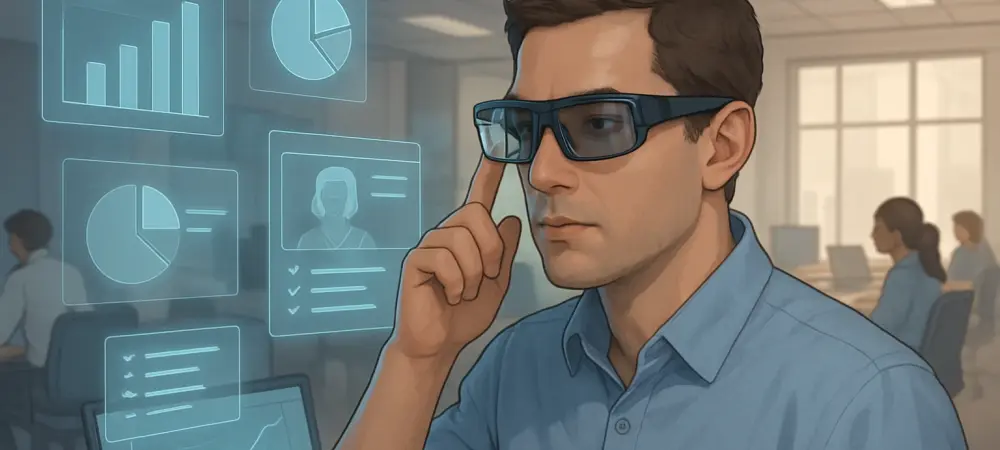
With the world’s biggest tech companies, from Google to Meta, now racing to develop AI-powered smartglasses, we’re standing at the edge of a technological revolution that promises to redefine our relationship with work and each other. To help us navigate this future, we’re speaking with Dominic Jainy, an IT professional and expert in the application of emerging technologies. He has spent his career analyzing how innovations in AI and machine learning are poised to transform our daily lives.
Our conversation will explore why this new generation of smartglasses may succeed where earlier attempts failed, delving into their practical applications across different sectors. We’ll discuss how these devices could revolutionize on-the-job training for skilled trades, streamline logistics in warehouses, and break down communication barriers in global business. We’ll also touch upon the profound social and ethical questions that arise, from data privacy to the new rules of digital etiquette, and consider what it will take for this technology to become a part of our everyday reality.
The article notes that early smartglasses like Google Glass failed. Given the new focus on AI integration with products from Google and Meta, what specific technological and social factors have changed since 2014 that make this new generation of smartglasses more likely to succeed?
That’s the critical question, isn’t it? When Google Glass launched in 2014, it was essentially a solution in search of a problem. It was a fascinating piece of hardware, but it lacked a compelling use case, and socially, people were not ready for a device that could film them at any moment. Today, the landscape is fundamentally different. Technologically, the integration of powerful, on-device AI is the game-changer. These aren’t just displays anymore; they are context-aware assistants that can provide real-time information, from translations to navigational overlays. Socially, the past decade of smartphone ubiquity has normalized the idea of being surrounded by cameras. While privacy is still a major concern, the initial shock has worn off, and we’re more accustomed to navigating those boundaries, which makes the societal barrier to entry much lower this time around.
You describe how smartglasses can guide warehouse workers. Could you walk me through the step-by-step process of how this technology would change a worker’s daily routine, and what specific metrics, such as error reduction or fulfillment speed, might improve?
Absolutely. Imagine a worker starting their shift. Instead of grabbing a scanner and a list, they simply put on their glasses. Immediately, a simple map appears in their field of vision, guiding them with an arrow toward the first item on their list. When they arrive at the correct aisle, the specific bin is highlighted, and the glasses display the item count they need to pick. There’s no more wandering or second-guessing. If an item’s stock is running low, the glasses can display a warning and automatically flag it for restocking. This direct, hands-free guidance would dramatically improve fulfillment speed and all but eliminate picking errors, transforming a physically and mentally taxing job into a far more efficient, guided workflow.
The text suggests AR overlays could help solve the skilled trades shortage. Can you give a detailed, real-world example of how a trainee plumber might use this feature for a repair? How does this accelerate their path to becoming a field-ready professional?
This is one of the most exciting applications. Let’s picture a young apprentice facing a complex multi-valve water heater for the first time. They’re alone on the job site. Instead of feeling intimidated, they look at the unit, and their glasses project a digital overlay directly onto the pipes. Arrows point to the correct shut-off valve, and a step-by-step checklist appears in their peripheral vision. As they work, an animated graphic could show them precisely how to solder a joint correctly. This turns every job into a live training session. It accelerates their path to expertise because they are learning by doing, but with the safety net of a digital expert guiding their every move. They become field-ready and capable of handling more complex tasks much sooner.
For white-collar work, you highlight real-time translation and consensual facial recognition. Can you elaborate on how these two features would work together during an international conference, and what new rules of etiquette might emerge from having instant access to a person’s professional details?
It would fundamentally change global networking. During that international conference, you could walk up to someone, and as they begin speaking in their native language, their words would appear as translated subtitles in your vision. Simultaneously, if they’ve opted-in, a small, unobtrusive card could appear next to them with their name, title, and company. The immediate impact is that you can skip the awkward “what was your name again?” and dive straight into a meaningful conversation. A new etiquette would certainly emerge, where opting in to share your professional details would be seen as a sign of openness and professionalism. It would lower social barriers for everyone, especially for people who are neurodiverse or simply not good with names, making networking more inclusive and efficient.
The article mentions using smartglasses for emergency medicine, like stopping bleeding. Beyond that example, what are some other critical, life-saving applications you foresee in the field, and what steps are needed to ensure the information provided by these apps is reliable and safe?
The potential here is immense. Imagine a paramedic at a multi-car pileup. Their glasses could display vital signs streamed directly from wireless sensors on a patient, leaving their hands completely free to perform life-saving work. An AI in the glasses could analyze the visual data of a burn and instantly recommend the proper course of initial treatment based on a vast medical database. Of course, the stakes are incredibly high. To ensure safety, these applications would need to undergo a certification process akin to what the FDA requires for medical devices. The data would need to be secure and the AI models rigorously tested to prevent misinformation. The goal isn’t for the tech to replace a professional’s judgment, but to augment it with critical, instantly accessible information when every second counts.
What is your forecast for smartglasses becoming as common as smartphones by 2035, and what is the single biggest obstacle—be it technological, social, or regulatory—that stands in the way of that prediction?
I am confident that by 2035, seeing someone without smartglasses in a professional setting will be as unusual as seeing someone without a smartphone today. The productivity and accessibility gains are simply too significant to be ignored. However, the single biggest obstacle standing in our way is not technology—issues like battery life and comfort will be solved through iteration. The true hurdle is social and regulatory, centered on the issue of consent. Specifically, we have to establish a clear, intuitive, and universal system for opting in or out of being recorded or identified by facial recognition. If we fail to build this trust and transparency into the very foundation of these devices, public backlash could stall widespread adoption for a decade, no matter how powerful the technology becomes.