

Future generations will likely look back on the conventional classroom model, where a single teacher attempts to instruct thirty students with wildly different aptitudes and interests, with the same bewilderment we reserve for archaic medical practices. This one-size-fits-all approach to education, a relic of the industrial age, is fundamentally inefficient for nearly everyone involved. Advanced students, capable of moving much faster, are often left bored and disengaged, while those who require more time or a different method of instruction inevitably fall behind. The system struggles to accommodate diverse learning styles, passions, and needs, creating a learning environment that is suboptimal by design. However, a profound shift is underway, driven by the convergence of artificial intelligence and spatial computing. This technological evolution promises to dismantle the rigid, classroom-centric model and replace it with a framework of hyper-personalized learning, effectively providing every student with their own private tutor and paving the way for superior educational outcomes.
The Dawn of Hyper-Personalized Education
Tailoring Learning to Individual Needs
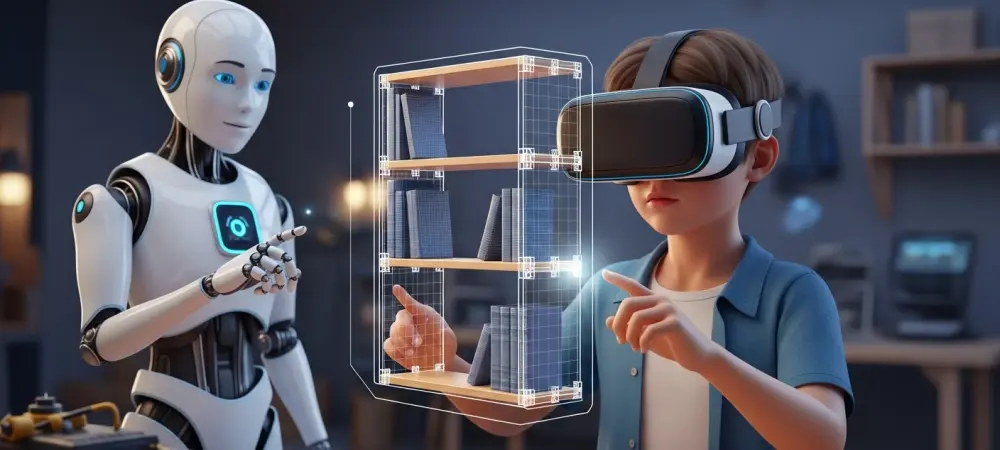
Consider a student who learns best through hands-on activity, a kinesthetic learner who finds traditional lectures and textbook assignments uninspiring. In a conventional setting, this student might be labeled as disinterested or difficult. With the integration of virtual reality, however, education transforms to meet him where he is. Instead of struggling through abstract geometric proofs on a whiteboard, he can enter a virtual workshop to design and build a bookshelf. This immersive project requires him to apply principles of geometry and physics in a tangible, meaningful way. An AI-powered guide within the VR environment can offer real-time feedback, pose challenges, and adapt the project’s complexity based on his progress, ensuring he masters core concepts before moving forward. This approach not only makes learning engaging but also connects academic knowledge to practical application, fostering a deeper, more enduring understanding that far surpasses what can be achieved through rote memorization of formulas and definitions.
In contrast, an academically advanced student often faces the challenge of being held back by the general pace of the classroom, leading to a stifling of her intellectual curiosity. An AI tutor can completely eliminate this barrier by providing a limitless educational horizon. She could delve into critically acclaimed literature far beyond her grade level, engaging in sophisticated Socratic dialogues with the AI about complex themes, character motivations, and literary criticism. The system could even simulate conversations with the authors themselves, allowing her to explore historical context and authorial intent in an interactive, dynamic format. This personalized mentorship ensures she is constantly challenged and intellectually stimulated, allowing her to pursue her passions at a pace that matches her abilities. This model of education nurtures exceptional talent rather than homogenizing it, empowering the brightest students to explore the full extent of their potential without the constraints of a standardized curriculum designed for the median.
Redefining the Educator’s Role
The rise of these powerful educational technologies understandably raises questions about the future of the teaching profession. However, the vision is not one of replacement but of evolution. AI and VR are poised to automate the more mechanical aspects of teaching—direct instruction, drilling, and grading—freeing human educators to focus on what they do best. The teacher’s role will shift from being the “sage on the stage” to the “guide on the side.” In this new paradigm, teachers will act as facilitators, mentors, and classroom managers, or “docents,” who oversee each student’s unique learning journey. They will be responsible for fostering a positive and collaborative learning environment, providing emotional support, and helping students make cross-curricular connections. This transformation elevates the profession, allowing educators to dedicate their time and expertise to the deeply human elements of teaching, such as inspiring curiosity, nurturing critical thinking, and guiding personal development.
This evolved role will require a new set of skills and a significant rethinking of professional development. As students engage with their personalized AI and VR curricula, teachers will become expert curators of learning experiences and interpreters of sophisticated progress data. They will need to analyze the insights provided by AI systems to identify when a student needs encouragement, when to introduce a collaborative project to synthesize individual learning, and how to address social-emotional challenges. Their focus will shift from delivering standardized content to managing a dynamic classroom where dozens of unique educational paths are unfolding simultaneously. They will orchestrate learning rather than simply dispensing information, ensuring that technology serves as a tool to enhance, not replace, the vital human connection at the heart of education. This change necessitates a forward-thinking approach to training, equipping educators with the skills to thrive in a data-informed, student-centered environment.
Preparing Students for a Complex Future
Cultivating Essential Soft Skills
Beyond core academics, the next generation of educational technology is uniquely positioned to cultivate the social and emotional skills critical for success in a globalized world. For many students, particularly those in homogenous communities, opportunities to interact with people from diverse cultural backgrounds are limited. AI-powered avatars within shared virtual reality spaces can bridge this gap, providing a safe and controlled environment to practice cross-cultural communication, collaboration, and empathy. Students can work in virtual teams with AI-driven peers programmed with different communication styles and cultural norms, learning to navigate potential misunderstandings and find common ground. They can engage in simulated negotiations, practice conflict resolution, and develop a more nuanced understanding of different perspectives. This form of experiential learning is invaluable for developing the global competency and interpersonal acuity required to thrive in the modern workforce.
This immersive approach extends to a wide range of soft skills that are difficult to teach through traditional methods. For instance, a student with public speaking anxiety can practice delivering a presentation to a virtual audience of any size, with AI providing real-time feedback on their pacing, tone, and body language until they build confidence. Virtual reality can also host complex, collaborative projects that mimic the agile workflows of today’s leading industries. Students can learn project management, adaptable problem-solving, and effective teamwork by working together in a simulated environment to design a product or solve a multifaceted challenge. This practical, hands-on experience ensures that students do not just graduate with theoretical knowledge but with a portfolio of demonstrable skills that directly translate to the demands of the new world of work, bridging the often-cited gap between education and employment.
The Inevitable Path Forward
The transition to this technology-driven educational model will undoubtedly face significant hurdles. It will demand substantial investment in digital infrastructure, a complete overhaul of curriculum design, and extensive retraining programs for the teaching workforce. Legitimate concerns regarding data privacy, algorithmic bias, and ensuring equitable access for all students must be addressed with thoughtful policy and ethical oversight. Resistance will likely come from those invested in the inertia of the current system. However, to frame this as an optional upgrade is to miss the point. Clinging to an outdated, industrial-era educational framework is a profound disservice to a generation of students who must be prepared for a future of unprecedented complexity and change. The adoption of these technologies is not merely a matter of innovation but a moral obligation to rectify a system that has historically failed to unlock the full potential of countless individuals.
The integration of AI and VR into the educational fabric ultimately represented a pivotal and necessary course correction. Educational philosophy shifted away from the rigid, standardized production line of the past and toward a more organic, human-centric model that celebrated and nurtured the unique capabilities of every learner. This evolution was never just about deploying sophisticated new tools; it was about a fundamental re-evaluation of the purpose of schooling itself. The goal became to cultivate adaptable, creative, and emotionally intelligent citizens capable of navigating a rapidly evolving world. The path required overcoming tremendous institutional inertia and addressing valid societal concerns, but the resulting paradigm shift finally dismantled the one-size-fits-all classroom, consigning it to the annals of history and laying the foundation for a more equitable, engaging, and profoundly effective system of learning.