

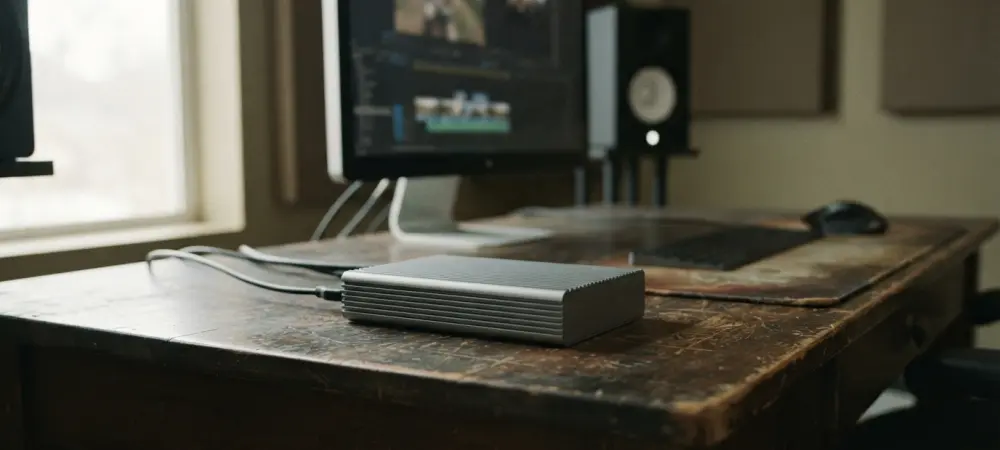
The era of the purely mechanical hard drive seemed to be drawing to a close until economic shifts forced a dramatic reconsideration of archival technology. Seagate aims to provide the massive archival capacity of a mechanical hard drive alongside the near-instantaneous responsiveness of modern solid-state technology. This strategic reintroduction of hybrid storage comes as the industry navigates a period of extreme volatility, where the traditional trajectory of falling price-per-gigabyte has essentially reversed. By launching the FireCuda Forge line, the company is effectively reviving an architectural philosophy that many believed had been permanently retired in favor of pure flash solutions. The current landscape of 2026 demands a radical rethinking of how mass data is stored, as high-definition media and complex datasets continue to outpace the affordability of large-capacity solid-state drives. The Forge serves as a bridge, offering a unified volume that seeks to eliminate the compromise between speed and scale.
Hardware Architecture: The Modular Approach
The FireCuda Forge ecosystem departs from the fixed-configuration hybrid drives of the past by embracing a modular design that places customization in the hands of the end user. Available in base mechanical capacities of 8TB and 20TB, these units do not function as standalone devices but rather as intelligent hosts for a secondary solid-state component. To achieve the performance targets set by the manufacturer, users must provide their own M.2 2280 NVMe SSD, which is then integrated into the system’s logical volume. This shift from a sealed, all-in-one unit to a modular enclosure allows for greater flexibility, as consumers can select an SSD that fits their specific budget or performance requirements. However, Seagate has established strict compatibility guidelines to ensure that the hybrid pairing does not become a bottleneck, requiring PCIe Gen3 or higher and a DRAM cache to maintain the integrity of the data tiering process during heavy workloads. By integrating these user-supplied components, the FireCuda Forge leverages the high bandwidth of the USB4 interface to deliver sequential read speeds reaching up to 2,500MB/s and write speeds of 2,000MB/s. These metrics are a significant leap over historical hybrid solutions, which were often constrained by the slower SATA interfaces of their time. The enclosure effectively creates a single, contiguous storage pool where the operating system sees only one drive letter, despite the underlying complexity of two distinct media types working in tandem. This architecture is particularly beneficial for creative professionals who manage massive video libraries but require the speed of flash for editing and playback. The modularity also ensures that if a user’s performance needs evolve between 2026 and 2028, they can potentially upgrade the NVMe portion of the drive without replacing the entire high-capacity mechanical backbone, extending the functional lifespan of the device.
Market Dynamics: The AI Storage Crisis
The decision to bring back hybrid storage is rooted in the harsh economic realities of 2026, specifically the unprecedented surge in demand for storage components driven by the global AI boom. As data centers consume vast quantities of NAND flash and high-capacity mechanical drives, the consumer market has experienced a sharp inflationary spike. For the first time in over a decade, the cost of large-scale storage has become a primary barrier for the average enthusiast, with high-capacity solid-state drives reaching price points that are nearly triple their historical lows. Seagate’s FireCuda Forge addresses this gap by providing a pragmatic alternative that mimics the value proposition of the early 2010s while utilizing modern throughput standards to stay relevant in today’s demanding digital ecosystem.
Market data indicates that the price of high-end enterprise mechanical drives has surged significantly, with popular models that were once affordable now commanding nearly double their previous value as of mid-2026. This trend is expected to persist through the end of the decade as manufacturing capacity remains tethered to the needs of massive language model training and large-scale data analysis. In this environment, a hybrid solution becomes a necessary compromise rather than a niche experiment. By offloading the majority of the storage burden to a mechanical disk while using a relatively small and affordable SSD for acceleration, Seagate is offering a path forward for consumers who refuse to sacrifice capacity for performance. This strategy also helps mitigate the supply chain pressures on high-density NAND, as the hybrid model requires significantly less flash memory to provide a perceived speed boost, making it a more sustainable product line during periods of supply shortages.
Management Intelligence: The Alkemi Platform
At the heart of the FireCuda Forge experience is the Alkemi intelligent storage platform, a dedicated software layer designed to manage the complex interaction between the mechanical and flash layers. Unlike earlier hybrid technologies that often relied on the host computer’s operating system to determine which files should be prioritized, Alkemi operates autonomously within the drive’s own internal controller. This ensures that the data tiering process remains consistent regardless of the operating system or hardware configuration of the host machine. The platform uses advanced algorithms to monitor data access patterns in real time, identifying which files are frequently utilized and moving them to the high-speed NVMe tier. This process happens silently in the background, creating a seamless user experience where the most critical applications and active projects feel as though they are running natively on a solid-state drive, even when the bulk of the data resides on a hard drive.
The introduction of the FireCuda Forge proved that the storage industry was willing to look backward to find solutions for the economic challenges of the present. By refining the hybrid model with USB4 speeds and modular NVMe slots, the technology successfully addressed the immediate need for high-capacity storage that did not compromise on responsiveness. However, the long-term viability of this approach depended on the software’s ability to maintain data integrity over years of continuous operation. Users who adopted these systems were encouraged to implement rigorous backup strategies, as the complexity of tiered volumes inherently introduced more variables than traditional single-disk setups. This transition paved the way for more intelligent external devices that could adapt to changing workloads. Looking ahead, the evolution of hybrid systems likely focused on deeper integration between local hardware and cloud-based caching, ensuring that data remained both secure and accessible.