

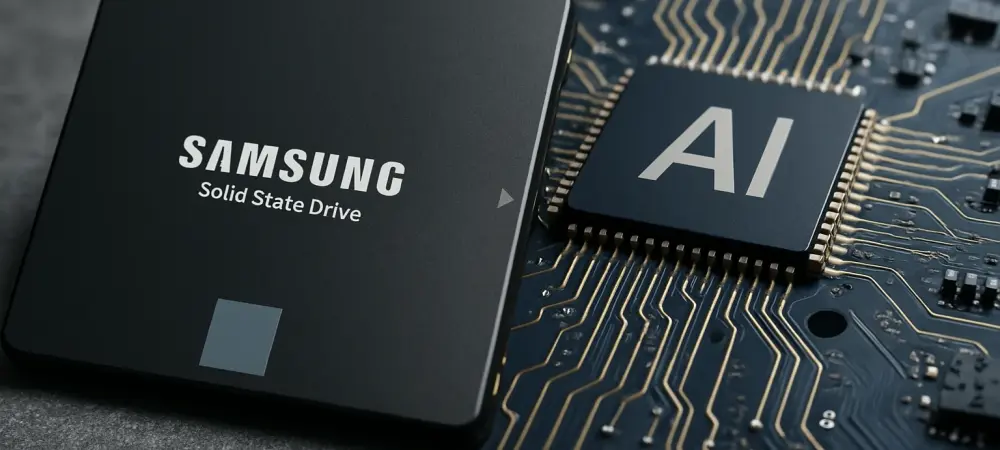
Clearing the Air: Samsung Reaffirms Commitment Amidst an Industry Shake-Up
Widespread speculation regarding the imminent demise of consumer-grade SATA solid-state drives sent shockwaves through the PC hardware market, prompting an official and decisive denial from industry titan Samsung. The rumors, suggesting that the company was forced to reallocate manufacturing resources to satisfy the colossal memory requirements of the artificial intelligence industry, created significant uncertainty. In response, Samsung has moved to stabilize the market by publicly refuting these claims. This analysis examines the origins of this industry-wide anxiety, dissects the powerful economic forces reshaping the semiconductor landscape, and clarifies what Samsung’s statement means for the future of consumer storage in an era increasingly defined by AI’s hardware appetite.
The Legacy of SATA and the Unprecedented Rise of AI’s Memory Demands
For more than a decade, the SATA SSD served as the foundational upgrade for modern computing, delivering a transformative speed advantage over traditional mechanical hard drives that redefined the user experience. Although the faster NVMe interface has since become the standard for high-performance systems, SATA drives have retained their position as a crucial, cost-effective option for mainstream PC builds and legacy system upgrades. This long-standing market equilibrium now faces a formidable challenge: the exponential growth of artificial intelligence. Developing and deploying large-scale AI models demands enormous quantities of high-bandwidth memory and rapid storage, compelling hyperscalers and technology giants to consume a disproportionate share of the global NAND flash supply—the essential building block of all SSDs. This tectonic shift has ignited one of the most significant component shortages in recent history, creating the perfect environment for the very speculation Samsung now aims to put to rest.
Deconstructing the Rumor: Market Pressures, Supply Chains, and Consumer Impact
The NAND Flash Conundrum: A Supply Chain Under Siege
At the center of the recent speculation lies a tangible and intensifying supply chain crisis. The insatiable demand from the AI sector has triggered a fundamental redirection of NAND flash production, pulling resources away from the consumer electronics market. This strategic pivot has caused a steep escalation in component costs, with industry reports showing that the price of a 1-terabit TLC NAND chip has more than doubled in just the last two quarters. This strain is systemic, not isolated to a single company; other manufacturers have reported multi-month delays in securing NAND shipments, highlighting a pervasive bottleneck impacting the entire storage industry. Such scarcity fosters a volatile climate where component makers must make difficult choices about which product categories receive priority.
Beyond the Bleeding Edge: Why SATA Still Matters in an NVMe World
Despite the industry’s forward-looking focus on next-generation NVMe technology, the rumored discontinuation of SATA SSDs resonated so strongly because of their enduring relevance. Sales data from major online retailers indicates that popular SATA models, including Samsung’s own 870 EVO, continue to represent approximately 20% of all best-selling SSDs. For a vast user base of consumers, system integrators, and IT departments, these drives provide an optimal blend of performance, capacity, and value for upgrading older machines or serving as secondary storage. The departure of a market leader like Samsung would create a substantial void, inevitably increasing prices not only for the remaining SATA drives but also for NVMe SSDs, as both compete for the same finite supply of NAND flash.
Samsung’s Reassurance: A Calculated Statement in a Volatile Market
Samsung’s official denial provides a necessary, if temporary, point of stability for the anxious consumer market. By publicly refuting the claims, the company signals to its partners and customers a continued commitment to this vital segment of its business. This statement, however, does not alter the underlying economic realities. The immense profitability and strategic imperative of supplying the AI sector ensure that resource allocation will remain a persistent challenge for all memory manufacturers. While the rumor of a complete and permanent production halt has been debunked, the industry will be closely observing how Samsung and its rivals navigate the ongoing tension between the high-volume consumer market and the high-margin enterprise AI space.
Navigating the AI-Driven Future of Consumer Storage
Although consumers can find short-term relief in Samsung’s announcement, the long-term outlook for consumer storage remains complicated. Industry analysts project that the fundamental imbalance between NAND flash supply and AI-driven demand could extend for years, with a potential rebalancing not anticipated until the next major hardware and manufacturing cycle around 2027. This sustained pressure will likely keep SSD prices elevated across the board and may lead to more subtle adjustments in product strategy. Instead of discontinuing entire lines, manufacturers might opt to streamline their product catalogs, focusing on higher-capacity, higher-margin drives. The future of consumer storage is now inextricably linked to the trajectory of AI, forcing a continuous re-evaluation of production priorities.
Strategic Insights for Consumers and System Builders
The primary lesson from this event is twofold: while the immediate danger to SATA SSD availability has been mitigated, the market forces that spawned the rumor are both real and ongoing. For consumers, this signals that the period of deeply discounted SSDs is likely over for the foreseeable future, and purchasing decisions should be made with an expectation of sustained higher costs. For system builders and IT professionals, this situation highlights the critical importance of supply chain diversification and forward-thinking procurement. Relying on a single product line or manufacturer now carries a heightened risk in this constrained environment. Planning for longer lead times and designing flexibility into hardware configurations will be crucial for navigating the next few years.
A Temporary Reprieve in a Reshaped Industry
In conclusion, Samsung’s denial that it was exiting the SATA SSD business closed a chapter of intense speculation but opened a wider discussion about the new realities of the semiconductor industry. The incident served as a powerful reminder of how the AI boom fundamentally reshaped hardware priorities on a global scale. The consumer market, which had long been the principal driver of innovation and volume, found itself in direct competition with the immense and highly profitable demands of the AI infrastructure sector. While Samsung reaffirmed its position as a pillar of the consumer storage market, its long-term strategy, like that of all major memory producers, was inevitably influenced by the powerful currents of the artificial intelligence revolution.