

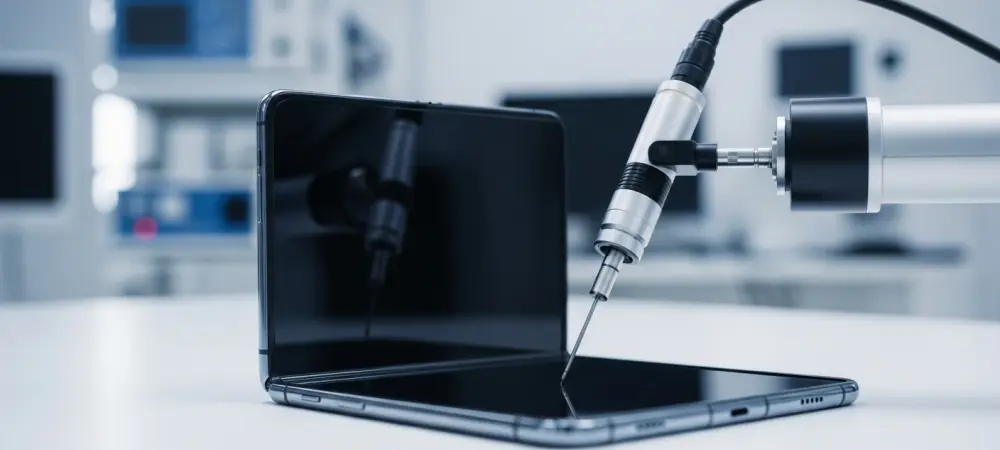
Samsung’s audacious new device unfolds not just once but twice into a sprawling tablet, promising a revolutionary leap for mobile productivity that now faces a harsh reckoning with the laws of physics. This review assesses the groundbreaking Samsung Galaxy Z TriFold, focusing specifically on its structural durability as revealed in a comprehensive stress test. The objective is to determine if the innovative triple-folding design compromises the reliability expected of a modern smartphone, and whether this ambitious leap in technology is a worthwhile investment for consumers.
Innovation on Trial: Is the Tri-Fold Ready for Reality?
The core promise of the Galaxy Z TriFold is a mobile experience without compromise—a phone when you need it, a tablet when you want it. This review puts that promise to the test, moving beyond performance benchmarks to scrutinize the very foundation of the device: its physical resilience. The central question is not whether a triple-folding phone can be made, but whether it should have been released in its current form.
Ultimately, this analysis seeks to provide a clear answer for potential buyers. It weighs the undeniable allure of a futuristic form factor against the practical realities of everyday use. By examining how the device holds up under pressure, this review aims to determine if the Tri-Fold is a true step forward in mobile evolution or a fascinating but fragile misstep.
Unfolding the Design: A Look at the Tri-Fold’s Core Components
At the heart of the Galaxy Z TriFold’s ambitious design is its unique triple-hinge mechanism, an engineering marvel intended to seamlessly transform the device. This intricate system is supported by an Armor Aluminium frame, a material chosen for its supposed balance of strength and lightness. Together, these elements form the skeleton of a device that redefines the boundaries of the smartphone category.
This sophisticated frame houses a dual-screen setup with drastically different properties. The outer display is protected by Gorilla Glass Ceramic 2, offering the robust, scratch-resistant surface users expect from a premium handset. In contrast, the expansive inner screen is made of a much softer plastic, a necessary compromise for flexibility that introduces significant durability concerns. Understanding this fundamental contrast is key to appreciating the device’s performance in the subsequent analysis.
A Gauntlet of Tests: Durability Under Scrutiny
The Tri-Fold’s journey through a series of rigorous tests revealed a device of two extremes. A scratch resistance test immediately highlighted the disparity between its screens. While the durable outer display performed as expected, showing marks at a level six on the Mohs hardness scale, the delicate inner screen proved alarmingly vulnerable. It sustained permanent scratches at a mere level two, meaning even a fingernail could cause lasting damage.
The device’s resilience was further questioned when subjected to heat and debris. Under a direct flame, the inner screen’s pixels suffered permanent damage after only 10 seconds, far quicker than the 17 seconds the outer OLED screen withstood. Moreover, when dust and grit were introduced near the hinges, the mechanism produced audible crunching sounds, raising serious concerns about its long-term functionality and its ability to withstand real-world environments.
However, the most revealing and catastrophic moment came during the structural bend test. When force was applied backward, against the natural folding direction, the Tri-Fold failed spectacularly. The frame snapped with a loud crack, and the screen instantly died. The failure point was not the complex hinges but the thin Armor Aluminium frame, particularly around the antenna lines, which created a critical structural weak point. This outcome was a first for a Samsung foldable, suggesting a profound design compromise.
The Double-Edged Sword: Advantages vs. Structural Flaws
Despite its glaring weaknesses, the Galaxy Z TriFold’s primary advantage remains its revolutionary concept. The ability to carry a device that unfolds into a massive, tablet-like display is a compelling proposition for productivity and media consumption. Furthermore, its outer cover screen demonstrated excellent durability, performing on par with conventional high-end smartphones and providing a reliable interface for quick tasks.
Unfortunately, these advantages are overshadowed by a list of critical disadvantages. The inner screen is exceptionally fragile, making it a constant source of anxiety for any owner. The hinge system, while innovative, is also a potential point of failure due to its susceptibility to debris. Most damning of all is the fundamental structural flaw in its frame. The device’s complete failure under pressure is not a minor issue but a core design oversight that renders its cutting-edge features moot.
The Verdict: Innovation Outpaces Integrity
In its current form, the Samsung Galaxy Z TriFold represents an exciting vision for the future that has arrived prematurely. While the device pushes the boundaries of mobile engineering, its innovative design comes at the direct expense of essential durability. The technology is impressive, but the execution exposes a product that is not yet ready for the rigors of daily life.
The catastrophic failure during the bend test reveals a critical and non-negotiable design flaw. This single point of failure overshadows all of its technological advancements, transforming a would-be revolutionary product into a cautionary tale. Based on this analysis, the device fails to meet the standard of reliability expected from a premium product, making it impossible to recommend for general consumer use.
A Fold Too Far? Final Thoughts and Recommendations
The Galaxy Z TriFold ultimately served as a proof of concept, a device that pushed boundaries but was not prepared for the realities of the consumer market. It was a fascinating glimpse into what the future of mobile devices might hold, but its journey was cut short by fundamental weaknesses. This device was best suited for tech enthusiasts and early adopters who understood and accepted the significant risks involved in owning such cutting-edge, yet unrefined, technology. For anyone who had been considering this device as a reliable daily driver, the advice was clear: wait. The hope was that Samsung would learn from this ambitious experiment and return with future generations that reinforced the frame and addressed the glaring structural flaws. The Tri-Fold was a bold idea, but one that was ultimately a fold too far for its time.