

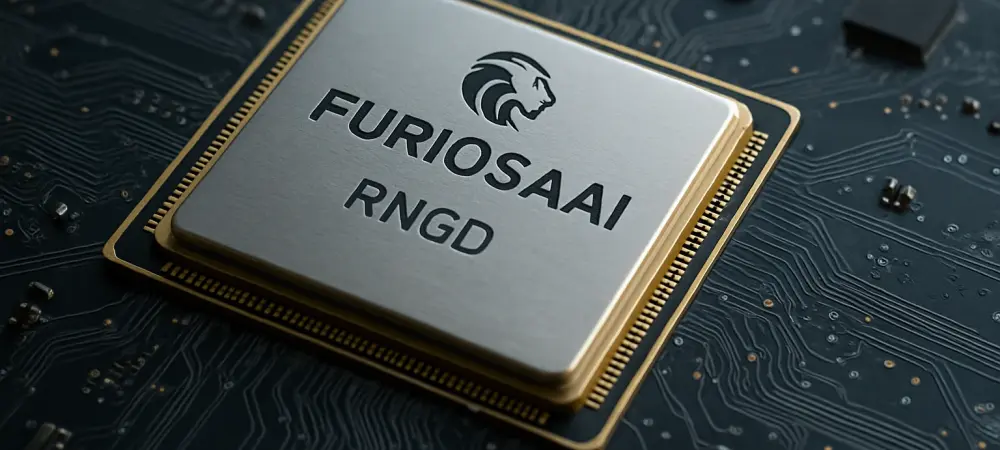
As the computational appetite of artificial intelligence continues to expand exponentially, the silent but staggering rise in operational costs and energy consumption presents a critical bottleneck for widespread deployment. The industry has long sought an answer to the challenge of scaling AI sustainably, a quest that has now led to the emergence of specialized hardware designed to break the existing mold. It is within this demanding landscape that FuriosaAI, a determined South Korean startup, has introduced its RNGD chip, positioning it not merely as another piece of silicon, but as a strategic solution to one of AI’s most pressing problems.
Review Objective A Sustainable AI Challenger
This review serves as a comprehensive assessment of FuriosaAI’s RNGD chip, evaluating its potential as a strategic investment for businesses aiming to navigate the formidable operational costs and power requirements inherent in modern AI inference. The central question is whether this new hardware can effectively unburden organizations from the escalating expenses associated with running large-scale AI models, which have traditionally locked them into a single, dominant hardware ecosystem. The analysis examines if the RNGD chip provides a genuinely viable and power-efficient alternative to the market leadership of established giants like Nvidia. By delving into its architecture, real-world performance metrics, and strategic positioning, this evaluation aims to provide a clear verdict on its capacity to disrupt the status quo. The goal is to determine if FuriosaAI has crafted a niche but powerful tool or a true contender capable of reshaping the economics of enterprise AI.
Introducing the RNGD Chip A Renegade NPU
At its core, the RNGD is a neural processing unit (NPU), a class of microprocessors architected from the ground up for a singular purpose: to excel at the dense matrix computations that form the backbone of deep learning inference. Unlike general-purpose GPUs that must handle a wide array of tasks, the RNGD’s specialized design strips away unnecessary components to focus all its resources on accelerating AI algorithms. This architectural purity is the foundation of its performance and efficiency claims. The chip’s primary function is to execute large language models (LLMs), such as Meta’s widely used Llama family, with what FuriosaAI claims is double the power efficiency of top-tier Nvidia GPUs. This is not just an incremental improvement; it represents a significant leap forward in performance-per-watt. By optimizing for the specific demands of inference—the process of using a trained model to make predictions—the RNGD chip offers a targeted solution for the most common and resource-intensive phase of the AI lifecycle.
This sharp focus underpins the chip’s unique selling point: enabling “sustainable AI computing.” This concept directly confronts the challenge of soaring electricity costs that can render large-scale AI deployments financially prohibitive. For data centers and enterprises running thousands of simultaneous inference tasks, a reduction in power consumption translates directly into lower operational expenditures, making the RNGD a compelling proposition based on total cost of ownership.
Performance Evaluation Real World Validation
The RNGD chip has moved beyond theoretical benchmarks, demonstrating potent performance in running highly demanding AI models. A significant endorsement of its capabilities came when OpenAI utilized the chip for a technology demonstration, showcasing its ability to handle sophisticated, real-world workloads. This application by a leader in the AI field provides a powerful proof point that the RNGD is not just a concept but a practical and effective piece of hardware.
Further industry validation has been provided by LG’s AI division, a major enterprise with significant AI initiatives. Officials from LG praised the chip for its “excellent real-world performance,” a crucial distinction that signals its effectiveness beyond controlled laboratory environments. Such testimonials are invaluable, as they indicate the hardware can deliver on its promises when integrated into complex, pre-existing corporate technology stacks.
The chip’s debut at the 2024 Hot Chips conference, a premier industry symposium, drew considerable attention from key technology players. The presence of engineers from Google, Meta, and Amazon underscores the serious interest the RNGD has garnered among the very companies that operate the world’s largest AI infrastructures. Their attendance suggests that the industry’s incumbents are actively evaluating the chip as a potential component in their future hardware strategies, lending it a degree of credibility that few startups achieve.
Strengths and Weaknesses The Startup Advantage
One of the RNGD chip’s most significant strengths is its specialized architecture, which delivers superior power efficiency for AI inference and, in turn, directly lowers operational costs for its users. Moreover, its emergence contributes to a healthier and less monopolistic hardware market, offering businesses crucial leverage and choice. This market dynamic is further bolstered by the South Korean government’s strategic support for its domestic semiconductor firms, creating a favorable ecosystem for FuriosaAI’s growth and stability. However, as a product from a relatively new company, the RNGD chip faces the monumental task of competing against Nvidia’s deeply entrenched and mature ecosystem. This includes not only hardware but also a vast library of software, developer tools, and a global community of engineers trained on Nvidia’s CUDA platform. Overcoming this inertia is a significant challenge for any newcomer, regardless of the technical superiority of its hardware.
The company’s early history, marked by difficult financial struggles, also presents a double-edged sword. While this period forged a resilient and determined corporate culture, it may raise concerns for some potential customers about long-term stability and support when compared to an established industry giant with decades of market leadership. This contrast between proven grit and perceived risk is a central element of the FuriosaAI story.
Final Verdict A Promising Contender in the AI Hardware Race
The review finds that the FuriosaAI RNGD chip is a highly capable and specialized processor that successfully delivers on its core promise of power-efficient AI inference. Its design philosophy, which prioritizes performance-per-watt for specific workloads, is not just a technical achievement but also a shrewd market strategy that addresses a critical and growing pain point for the entire industry.
The final assessment is that the RNGD represents a credible and compelling challenge in the AI hardware market, particularly for organizations whose operations are dominated by inference-specific tasks. It is not positioned as a universal GPU replacement but rather as a superior tool for a well-defined and economically significant job. This focus is its greatest strength, allowing it to outmaneuver more generalized hardware in its chosen arena. It is recommended that organizations prioritizing energy efficiency and lower operational costs for their AI applications give the RNGD chip serious consideration. For businesses looking to scale their AI services without incurring unsustainable energy bills, this chip offers a pathway to more profitable and environmentally responsible computing.
Concluding Thoughts and Recommendations
The RNGD chip was a noteworthy innovation driven by a clear and prescient vision for sustainable AI, making FuriosaAI a company that was important to watch. The hardware’s journey from a concept to a mass-produced product, validated by industry leaders, reflected a deep understanding of the market’s future needs. This chip was most suitable for companies deploying AI at a significant scale, especially those burdened by the high electricity costs associated with constant inference workloads. While adopting technology from a newer company always carried inherent risks, the strong and public validation from major tech players like OpenAI and LG, along with the keen interest from others, substantially mitigated these concerns and signaled a promising future.