

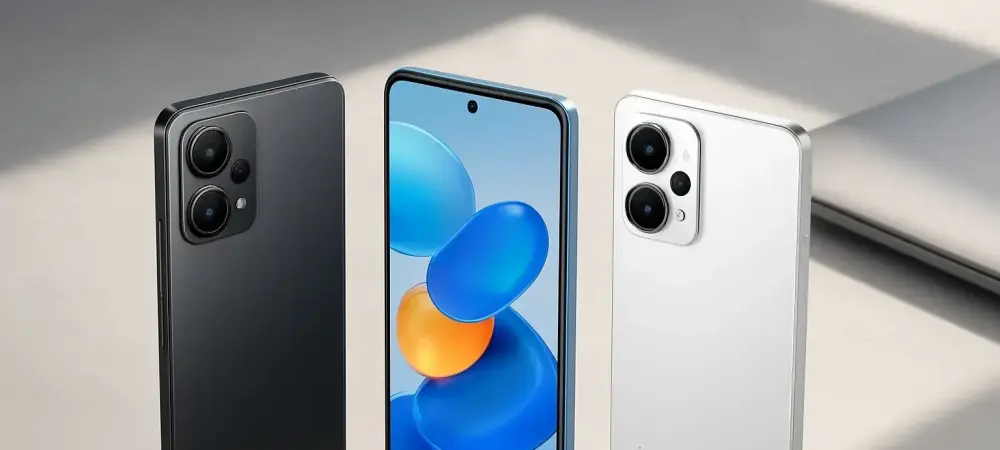
In a strategic move that addresses the diverse connectivity needs and budget considerations of the global market, the latest iteration of the popular Redmi Note series has been officially unveiled, presenting consumers with a compelling choice between two visually identical yet internally distinct smartphones. The new lineup features the Redmi Note 15 (4G) and its more advanced counterpart, the Redmi Note 15 5G. At first glance, the two devices are indistinguishable, both sporting a premium 6.77-inch curved AMOLED display with a crisp FHD+ resolution that promises vibrant colors and deep blacks. A fluid 120Hz refresh rate ensures smooth scrolling and an enhanced gaming experience, while an in-display fingerprint scanner adds to the modern, streamlined aesthetic. This external uniformity extends to the core software and primary imaging hardware. Both models run on the new HyperOS 2.0, which is built upon the latest Android 15, offering a consistent and up-to-date user interface. Similarly, they share a powerful 108MP main camera equipped with Optical Image Stabilization (OIS) for sharper photos and videos, complemented by a 20MP front-facing camera for high-quality selfies, establishing a high-quality baseline for the entire series.
Divergent Paths in Performance and Photography
Beneath their shared exterior, the two models embark on decidedly different technological paths, tailored to specific user priorities. The Redmi Note 15 5G is powered by the Qualcomm Snapdragon 6 Gen 3 chipset, an efficient and modern processor engineered to deliver robust 5G connectivity and dependable performance for demanding applications, streaming, and online gaming. This choice positions the 5G variant as the forward-looking option for those who want to leverage the fastest mobile network speeds available. In stark contrast, the Redmi Note 15 (4G) is equipped with the MediaTek Helio G100-Ultra, a capable chipset focused on delivering a strong and reliable 4G experience without the added cost associated with 5G technology. The divergence continues into the secondary camera systems. The 5G model includes a versatile 8MP ultrawide lens, a feature that significantly expands creative possibilities by enabling users to capture sweeping landscapes and large group photos with ease. The 4G model, however, opts for a 2MP depth sensor, which works in tandem with the main camera primarily to enhance portrait mode photos by creating a more pronounced background blur, or bokeh effect, a more specialized tool compared to the ultrawide.
Endurance and Availability Across a Global Market
The final points of differentiation centered on battery technology, durability, and market positioning, providing a clear set of trade-offs for prospective buyers. The 4G model was designed for maximum endurance, featuring a massive 6,000 mAh battery that promised multi-day use for many users, though it came with a more standard 33W charging capability. Its IP64 rating provided solid protection against dust ingress and water splashes from any direction. The 5G version took a different approach to power management, incorporating a slightly smaller but more advanced 5,520 mAh silicon-carbon cell, which offers greater energy density. This was paired with significantly faster 45W charging to reduce downtime. Furthermore, its superior IP66 ingress protection rating ensured it could withstand powerful jets of water, making it a more rugged and durable device. These distinct feature sets were reflected in the launch pricing. The Redmi Note 15 (4G) started at an accessible €229/£179 for the 6/128GB model, offered in Glacier Blue, Purple, Forest Green, and Black. The more advanced Redmi Note 15 5G was priced from €279/£199 for the identical configuration and was available in Glacier Blue, Mist Purple, and Black, with pre-orders having opened on January 5.