

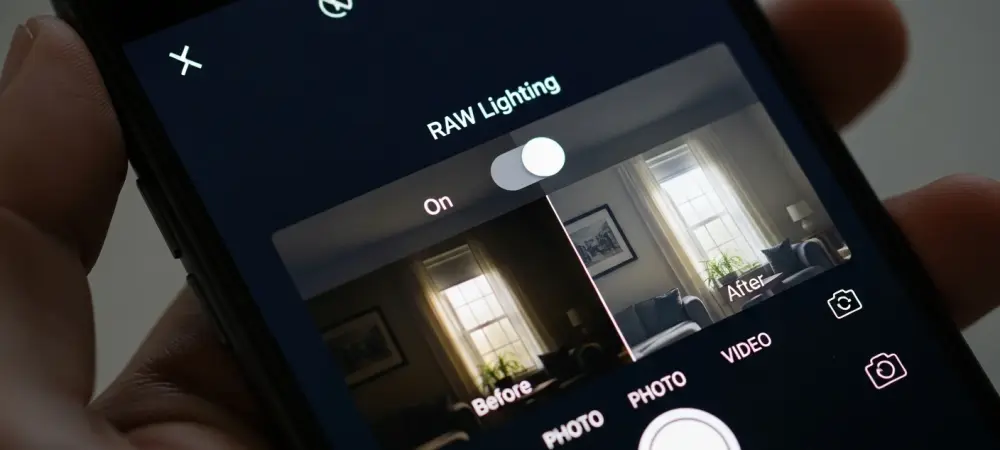
As the smartphone photography world grapples with the consequences of overzealous AI enhancements that often produce hyper-realistic yet soulless images, a new philosophy championing authenticity is quietly taking hold. The ‘Raw Lighting’ camera feature represents a significant advancement in mobile computational photography, moving away from aggressive processing. This review will explore the evolution of smartphone image processing, the key features of this new technology, its performance metrics, and the impact it has on the user experience. The purpose is to provide a thorough understanding of the technology, its current capabilities, and its potential future in an industry often dominated by heavy-handed AI enhancements.
The Shift Toward Photographic Authenticity
Vivo’s introduction of the ‘Raw Lighting’ feature marks a deliberate pivot toward naturalism in smartphone photography. The core principle of this technology is a calculated reduction of artificial intelligence and high-dynamic-range (HDR) processing, aiming to capture images that more faithfully represent the scene as the human eye sees it. This move is particularly relevant today, as a growing contingent of users and critics express fatigue with overly saturated colors, unnaturally brightened shadows, and smoothed-out textures that have become hallmarks of computational imaging.
This push for authenticity places the feature at the forefront of a broader industry conversation. While competitors have often focused on maximizing the “wow” factor through computational tricks, ‘Raw Lighting’ caters to a demand for subtlety and realism. It acknowledges that the goal of photography is not always to create a perfect image, but to preserve a moment with integrity.
In-Depth Look at the Software Enhancements
The Raw Lighting Mode in Focus
The primary component of the camera update is the ‘Raw Lighting’ mode itself, which functions by intentionally minimizing the computational effects that typically alter a photograph. Its technical objective is to produce more realistic images by preserving the natural interplay of light and shadow, retaining fine detail without artificial sharpening or noise reduction. This approach results in a final image that is closer to what the sensor captures, providing a cleaner and more organic base.
This method benefits photographers who prefer to have greater control over the final edit, as the file is less influenced by the manufacturer’s processing decisions. For casual users, it offers a “what you see is what you get” experience, capturing scenes with a subtlety that is often lost in standard camera modes.
Refined Teleconverter and Creative Filters
Beyond the headline feature, the update delivers several other key camera improvements that enhance creative flexibility. A refined teleconverter offers cleaner and more detailed zoomed-in shots, which is complemented by the addition of new filter styles designed to provide distinct aesthetic looks without overpowering the original image.
Furthermore, specialized scenario-oriented modes have been included to optimize camera settings for specific conditions. These additions work in concert with ‘Raw Lighting’ to provide a comprehensive toolkit, allowing users to switch between a purely authentic capture and more stylized, creative outputs.
User Experience and Interface Upgrades
The software update also introduces tangible user-facing improvements that refine the shooting process. A notable addition is the new two-finger zoom gesture for the Stage Dual View feature, a small but significant ergonomic enhancement for the Vivo X200 Ultra.
Such quality-of-life upgrades contribute directly to a more seamless and intuitive photography experience. By reducing friction in the user interface, these changes allow photographers to focus more on composition and capturing the moment, rather than navigating complex menus or gestures.
The Update Delivery and Technical Details
This suite of enhancements is being delivered through a substantial software update for the Vivo X200 Ultra. The package is identified by the build number PD2452C-A-16.1.13.1.W10.V000L1 and requires a 1.54 GB download, indicating the significance of the changes included. This update is built upon the foundation of Android 16, ensuring it integrates the latest system-level optimizations and security protocols.
Vivo is deploying this software via a staged rollout, a common practice that allows the company to monitor for any unforeseen issues before making it available to all users. Consequently, owners of the X200 Ultra may experience a delay of several days before the update notification appears on their device, ensuring a stable and reliable installation process for everyone.
Real-World Application and Performance
In practice, the ‘Raw Lighting’ feature demonstrates its strengths most clearly in well-lit environments. During portrait photography, it preserves natural skin textures and tones that are often smoothed over by aggressive AI. Similarly, in landscape shots, the feature captures subtle gradations in light and color, avoiding the overly punchy and artificial look characteristic of HDR-heavy modes.
This technology serves two distinct user groups effectively. Professional and enthusiast photographers gain a cleaner, more malleable base image that is ideal for manual post-processing. At the same time, casual users who simply prefer a more natural aesthetic can achieve authentic-looking photos straight from the camera without needing to dive into complex settings or editing software.
Limitations and Industry Context
Despite its advantages, the ‘Raw Lighting’ approach is not without its challenges. In situations with extreme dynamic range, such as a backlit subject or a dark interior with a bright window, traditional HDR processing might still produce a more visually pleasing and usable image by recovering details from deep shadows and bright highlights. Similarly, in very low-light conditions, computational noise reduction remains essential for a clean shot. When compared to similar “pro” or “natural” modes from competing brands, Vivo’s implementation stands out for its commitment to reducing processing rather than just altering its style. While other systems may offer more color-neutral profiles, ‘Raw Lighting’ appears to be a more fundamental shift in processing philosophy, positioning it as a distinct choice in a crowded market.
The Future of Computational Photography
The introduction of features like ‘Raw Lighting’ signals a potential inflection point for the future of computational photography. It points toward a broader industry trend of returning granular control to the user, allowing them to choose between a fully automated, computationally enhanced image and a more authentic, unprocessed one. This shift empowers users to define their own photographic style.
Looking ahead, the principles behind this technology could be integrated into other areas, most notably video recording, where over-processing can be even more distracting. The long-term impact of this trend may influence future smartphone camera design, encouraging manufacturers to prioritize not only computational power but also the quality of the raw data captured by the sensor.
Final Assessment and Key Takeaways
This review found that the ‘Raw Lighting’ feature was a commendable and significant step toward photographic authenticity in the smartphone market. It successfully provided a compelling alternative for users disillusioned with overly aggressive image processing, offering a more natural and realistic rendering of scenes straight from the camera. Its implementation represented a mature understanding of a growing segment of the market that values subtlety over spectacle.
Ultimately, the feature and its accompanying software enhancements solidified the Vivo X200 Ultra’s position as a top-tier camera phone for discerning photographers. It challenged the prevailing industry notion that “more processing is always better” and demonstrated the powerful appeal of realism. This move not only enhanced the device’s capabilities but also contributed to a vital industry-wide conversation about the true purpose of computational photography.