

Dominic Jainy stands at the forefront of the next great industrial leap, where the virtual intelligence of artificial intelligence finally finds its physical form through advanced robotics and private 5G infrastructure. As an IT professional with deep roots in machine learning and blockchain, Jainy has spent his career dissecting how emerging technologies move from experimental laboratory phases to mission-critical industrial applications. Today, he helps enterprises navigate the complex transition from traditional wireless setups to robust, private cellular networks designed to support the heavy data demands of autonomous vehicles, humanoids, and “agentic” AI systems. His insights offer a window into a future where factories and supply chains are not just automated, but truly intelligent and self-optimizing.
The following discussion explores the evolving “pull” of private 5G driven by physical AI, the cost-to-performance advantages of cellular over Wi-Fi, and the significant market growth projected for the humanoid robotics sector. We also examine the role of private networks as testbeds for global 5G standards and the emergence of “AI-on-RAN” as a transformative force for industrial efficiency.
How has the relationship between telecommunications providers and industrial enterprises shifted recently, specifically regarding the move from a “push” to a “pull” market dynamic for private 5G?
For years, the telecommunications industry was essentially knocking on the doors of factory owners, trying to sell private 5G as a solution in search of a problem. We called this the “push” phase, where the technology was marketed based on its theoretical potential rather than a desperate need from the end-user. However, the emergence of physical AI—specifically robotics and complex automation—has completely flipped that script into a “pull” dynamic. Now, it is the robot manufacturers and industrial tech vendors who are the ones demanding private 5G because their machines simply cannot function at peak performance on legacy networks. Companies like Boston Dynamics and AgiBot are now explicitly recommending private 5G as the preferred connectivity medium for their products in industrial settings. They realize that for a robot to move with the fluid, reliable precision required in a busy plant, the underlying network must be mission-critical. This shift is massive because it means 5G is no longer a luxury “extra” but a foundational requirement for the hardware these companies are buying.
The term “physical AI” is becoming a major buzzword in the sector. What does this look like in a practical industrial environment, and how is it influencing the growth of private 5G networks?
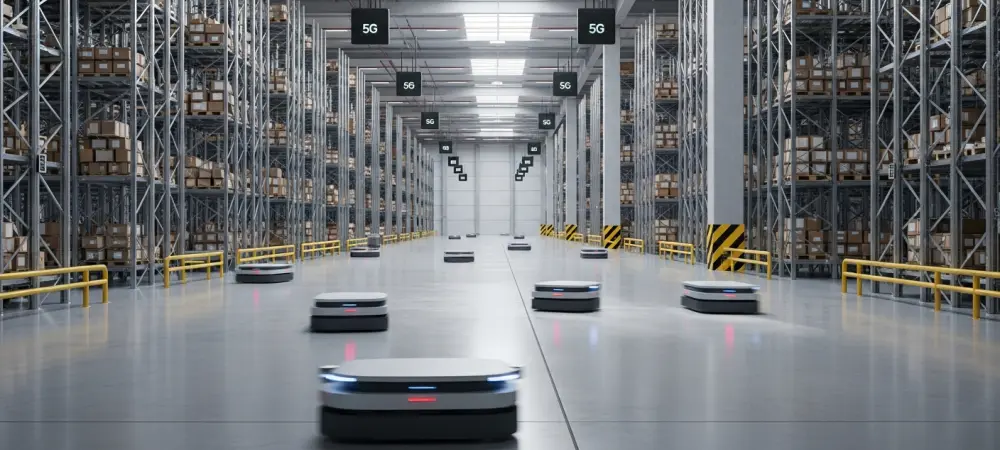
When we talk about physical AI, we are describing the integration of intelligence into moving parts—things like autonomous guided vehicles (AGVs), drones, cranes, and even semi-humanoid systems. This trend is the primary engine behind the private 5G market, which is projected to reach $6.6 billion through 2029 with a compound annual growth rate of about 34 percent. In a practical sense, you see this in “greenfield” facilities where every forklift and sensor is part of a multi-site, multi-national deployment. The sheer volume of data generated by machine vision and video analytics requires a level of reliability that only 5G can provide. Jensen Huang of Nvidia has popularized the term, but for the boots on the ground, it means having a network that supports predictive maintenance and remote operation without a hitch. As physical AI takes hold, we expect the total market for these technologies to surge anywhere from $430 billion to over $2 trillion depending on how you define the scope.
Industrial leaders have traditionally relied on Wi-Fi for their internal connectivity. What are the specific performance and cost advantages driving giants like John Deere or BP to replace their Wi-Fi infrastructure with private 5G?
The debate between Wi-Fi and 5G has largely moved past the “one or the other” stage, but when it comes to massive industrial sites, the numbers for 5G are hard to ignore. We are seeing cases where private 5G cost-effectively replaces Wi-Fi because it requires significantly less hardware to cover the same area. For example, at a John Deere site, they were able to replace 82 Wi-Fi access points with just four 5G radios, while BP saw a similar reduction from a range of 60-80 points down to only four. In a logistics setting like CJ Logistics, the difference was even more stark, moving from 300 Wi-Fi access points to just 22 cellular radios. Beyond just the hardware count, 5G offers superior performance in terms of latency and mobility, which is critical when you have robots moving between indoor and outdoor environments. Reducing the infrastructure complexity by such a wide margin not only lowers the initial capital expenditure but also significantly cuts down on long-term maintenance and troubleshooting.
The prospect of humanoid robots in the workforce is a major topic of interest. Based on current market projections, how do you see humanoids reshaping the global manufacturing landscape over the next decade?
Humanoid robots are quickly becoming the core solution to the manufacturing labor shortages we see across the globe. Morgan Stanley is already pegging the humanoid market in China alone at $15 billion by 2030, which is actually double what the entire private 5G sector is expected to be worth by then. If we look further out, the wider ecosystem for these robots could surpass $5 trillion by 2050, driven by the need for factory labor. Goldman Sachs projects that we will see about 1.4 million humanoid units in operation globally by 2035, representing a $38 billion market. China is expected to be a major player here, potentially delivering over 11 million units by 2035 thanks to heavy government subsidies and focused factory deployments. These robots are not just lab experiments anymore; they are being designed to walk into existing warehouses and perform tasks that were previously only possible for human workers.
Could you share some of the most compelling real-world applications where private 5G and physical AI are already delivering measurable business value?
We have some incredible data points from companies that have already moved past the pilot phase into full operational status. At Fulin Precision, a Chinese auto components manufacturer, they have deployed 100 semi-humanoid robots which resulted in a 50 percent reduction in manual delivery costs. In the aviation sector, Air New Zealand is using robot-tethered drones at their Auckland Airport warehouse for automated “high-bay” stock counting, which keeps workers safe and ensures inventory accuracy. We also see valet parking robots at Lyon-Saint Exupéry Airport in France that have increased parking efficiency by 50 percent through optimized space management. Even in cargo handling, Lufthansa has seen a 75 percent improvement in operational process speed at their LAX facility thanks to robotic integration. These are not just incremental gains; they are transformative shifts in how business is conducted, all made possible by the low latency and high reliability of the 5G backbone.
There is increasing talk about “AI-on-RAN” and “agentic AI” in the context of network management. How are these technologies being used to optimize the networks themselves?
The concept of “agentic AI” is fascinating because it refers to AI that can take proactive steps to improve network operations, especially in complex, multi-site deployments. For instance, the Norwegian shipping company Color Line is using an agentic AI solution for autonomous network optimization, which includes adaptive power control for their vessels. This system, developed through a collaboration involving BubbleRAN, Nvidia, and Telenor, allows the network to self-heal and optimize energy efficiency in real-time. Similarly, NTT East in Japan has been evaluating RAN intelligent controller (RIC) functionality from 26 different vendors to mitigate interference and optimize transmit power. By moving AI processing directly to the Radio Access Network (RAN), companies can achieve level-something network automation that was previously impossible. This reduces the burden on IT staff and ensures that the network is always performing at the level required by the robots it supports.
Why are private 5G environments considered better testbeds for these sophisticated AI and network trials than larger, public mobile networks?
Private 5G environments offer a controlled, “miniature” version of the 5G standard that is far less complex than a massive public operator network. Because the infrastructure footprint is typically dedicated to a single organization, it is much easier to converge AI processing and RAN control without worrying about the millions of variables present in a public macro-scale grid. We are seeing the “network as a platform” concept materialize much faster in these venues because the goals are more defined—whether it is a single factory, a campus, or a power grid. Proofs-of-concept for AI-on-RAN are already live in the US, China, and Japan, focusing on edge-based AI inference that requires immediate response times. These private networks act as working prototypes for the features that will eventually be monetized by the wider telecoms industry. They allow us to test the “bells-and-whistles” capabilities of the 5G standard in a real-world setting where the value of precise positioning and integrated sensing is immediately obvious.
What is your forecast for the future of private 5G and physical AI?
My forecast is that we are entering an era where connectivity and capability become indistinguishable, as the $6.6 billion private 5G market becomes the essential nervous system for a multi-trillion dollar physical AI economy. By 2035, I expect to see a global landscape where over a million humanoid units are seamlessly integrated into the workforce, supported by “AI-on-RAN” architectures that allow networks to self-optimize for energy and interference without human intervention. We will move away from the “zero-sum” 5G versus Wi-Fi narrative and instead see a hybrid infrastructure where 5G handles the mission-critical, high-mobility tasks like autonomous mining trucks and high-bay drones. Ultimately, the successful integration of integrated sensing and precise positioning will turn the network itself into a value-added layer, rather than just a pipe for data. The companies that embrace this convergence now, seeing the network as a fundamental part of their AI stack, will be the ones that dominate the industrial landscape for the next thirty years.