

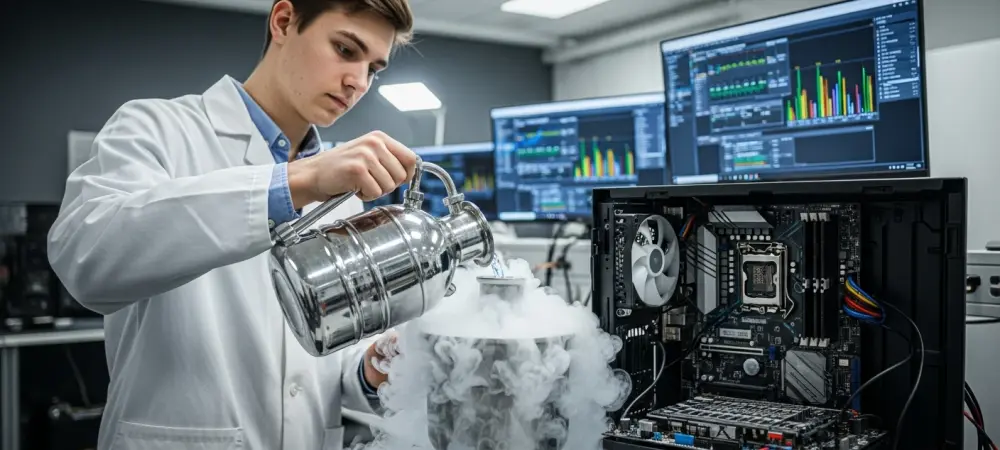
While traditional computer science classrooms often remain tethered to static textbooks and abstract software theory, a high school in Poland has radically redefined vocational training by turning a sports hall into a high-stakes hardware laboratory. This initiative departs from the standard curriculum by placing students directly into the high-pressure world of competitive overclocking, where the objective is to push silicon beyond its manufacturer-rated limits. Rather than simply learning how to assemble a PC, these teenagers are mastering the delicate interplay between voltage, clock speeds, and extreme thermal management. The program serves as a vivid reminder that the most profound engineering insights often occur at the physical boundaries of a device’s capabilities, where the threat of hardware failure becomes the most effective teacher. By integrating professional-grade equipment into a secondary school environment, the institution is bridging the gap between being a passive technology consumer and a specialized hardware engineer capable of managing complex systems.
The Shift Toward Practical Hardware Engineering
Professional Mentorship and Technical Standards
The success of this educational model is largely attributed to the presence of a faculty member who is a recognized figure within the Polish overclocking community. This professional connection allows the school to move beyond consumer-grade cooling solutions and introduce students to the complexities of using liquid nitrogen (LN2). Cooling a processor to temperatures below -190 degrees Celsius requires more than just pouring a substance; it demands a deep understanding of insulation, condensation prevention, and the physics of heat transfer. Students must learn to prep their motherboards with specialized coatings to prevent moisture from short-circuiting the electronics as the extreme cold meets the ambient air of the gymnasium. This level of technical rigor ensures that the students are not merely playing games but are practicing the same methodologies used by professional benchmarkers and industrial hardware testers worldwide.
Transitioning from theoretical knowledge to this hands-on approach requires a fundamental shift in how failure is perceived within the classroom. In a typical academic setting, a broken piece of equipment might be viewed as a costly mistake or a disciplinary issue. However, in this competitive environment, pushing a power supply until it fails or hitting a “silicon wall” where a CPU becomes unstable is treated as a critical data point. This “trial-and-error” philosophy encourages students to take calculated risks and document the specific conditions that led to the hardware’s limits. By witnessing the physical consequences of over-volting a component, participants develop a visceral understanding of electrical engineering principles that no diagram could ever replicate. The mentorship provided by an industry expert ensures that these failures are analyzed logically, turning every “bricked” component into a valuable lesson in the resilience and fragility of modern circuitry.
Integration of Industry Competition
The events are structured as full-scale tournaments, transforming the school’s athletic facilities into a temporary tech hub that mirrors professional esports and hardware expos. To add another layer of realism, these sessions are often livestreamed to a wider audience, requiring students to communicate their technical processes clearly while under the pressure of a ticking clock. This competitive format fosters a unique sense of community and collaboration, as students frequently share tips on BIOS settings or cooling configurations. The diversity of the hardware involved is also significant; the participants do not just work with the latest flagship units but also optimize vintage systems and laptops. This variety teaches them that the principles of performance tuning are universal, whether they are working with a legacy processor or a modern multi-core powerhouse designed for high-end workstations.
Building on this atmosphere of professional competition, the school has successfully attracted corporate sponsors who recognize the value of this specialized training. Major hardware manufacturers provide high-performance components, such as AMD Ryzen 5 7600x processors and NVIDIA GeForce RTX 4060 graphics cards, as prizes for the top performers. This involvement from the private sector validates the students’ efforts and provides them with access to the same technology they will likely encounter in the professional workforce from 2026 to 2028. By winning these components, students are further incentivized to explore the nuances of hardware architecture and software benchmarking tools. This synergy between education and industry creates a pipeline where young enthusiasts can transition into careers in systems administration, hardware design, or thermal engineering with a level of practical experience that far exceeds their peers.
Future Implications for Technical Education
Beyond the Classroom: A Vocational Blueprint
The Polish model suggests that the future of technology education lies in the synthesis of gaming culture, competitive sport, and rigorous engineering. As traditional computer science roles become increasingly specialized, the ability to understand the physical layer of computing—how energy is converted to heat and how that heat limits performance—becomes a rare and valuable skill set. This program demonstrates that when students are given the autonomy to experiment with expensive, professional-grade equipment, they rise to the challenge with a level of dedication that is rarely seen in standard lecture halls. The “gamification” of hardware tuning does not diminish its scientific value; instead, it provides the necessary engagement to keep students focused on complex problem-solving for hours at a time. This blueprint could easily be adapted by other vocational schools looking to modernize their curricula and provide students with a tangible edge in the job market.
This practical approach also addresses the growing disconnect between the digital and physical worlds in modern education. While many students are proficient in software and coding, fewer possess the mechanical intuition required to troubleshoot hardware at the component level. By forcing participants to interact with the physical properties of silicon and electricity, the overclocking tournaments create a more holistic understanding of technology. Students leave the program knowing that software does not exist in a vacuum; it is entirely dependent on the thermal and electrical health of the underlying hardware. This realization is crucial for anyone looking to work in data center management or high-performance computing, where efficiency and thermal stability are the primary drivers of operational success. The initiative proves that hands-on experimentation remains the gold standard for developing deep technical expertise in an increasingly complex world.
Long-Term Value and Actionable Outcomes
Looking forward, the implementation of such high-intensity technical programs offers a clear path for revitalizing vocational training in the technology sector. Educators and administrators should consider moving away from purely simulation-based learning and toward environments where students can interact with hardware in its “limit states.” The primary takeaway from the Polish high school initiative is the importance of fostering a culture where technical risks are encouraged and industry-standard tools are accessible. To replicate this success, institutions should seek partnerships with local tech firms to secure hardware donations and professional mentors who can guide students through the complexities of extreme cooling and performance tuning. This strategy not only enhances student engagement but also ensures that the skills being taught are directly applicable to the needs of the modern tech industry. The final results of these overclocking tournaments demonstrated that a hands-on, high-stakes environment significantly accelerated the students’ technical proficiency. Participants moved beyond the role of consumers and began to view hardware as a moldable resource that could be optimized through precision and patience. The school effectively transformed a niche hobby into a rigorous academic discipline, proving that the most effective way to learn is through the direct application of theory in a challenging, real-world context. Educators who adopted these methods saw a marked increase in student retention and a deeper mastery of electrical and thermal principles. This model has already provided a successful framework for how vocational schools can bridge the gap between classroom theory and the demanding realities of the professional technology landscape, ensuring that the next generation of engineers is prepared for the physical challenges of computing.