

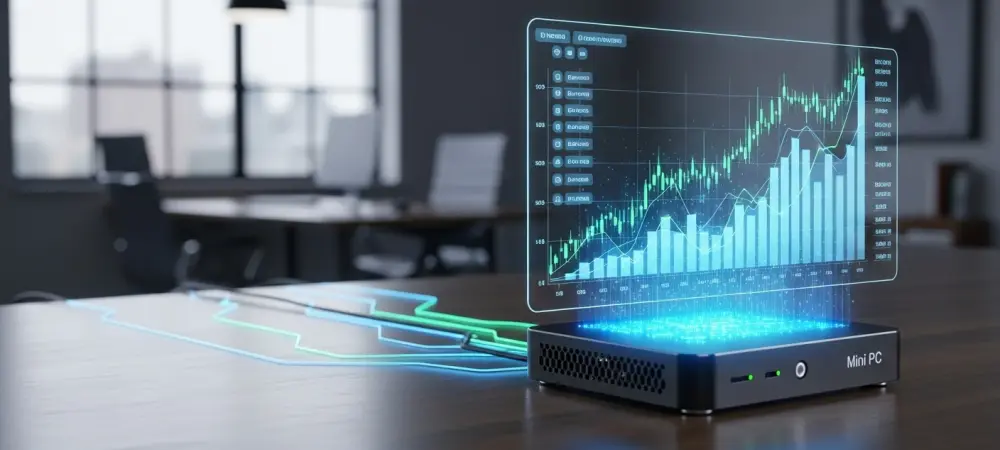
The quest to bring sophisticated artificial intelligence out of the cloud and into our homes has taken a significant leap forward, with enthusiasts now experimenting with powerful AI agents on compact, personal hardware. A recent deep dive into running the OpenClaw AI agent on a small form factor MSI Cubi Mini PC has pulled back the curtain on this exciting new frontier, revealing not only the incredible potential of localized AI but also a startlingly high financial barrier that could keep it out of reach for the average user. While the prospect of an AI assistant with full access to a local machine—capable of managing files, browsing data, and executing commands—is tantalizing, this pioneering effort highlights critical hurdles in usability, security, and especially cost that the industry must overcome before personal AI becomes a mainstream reality. The journey from a complex installation process to a jaw-dropping operational bill paints a vivid picture of the current state of personal AI: powerful, promising, and prohibitively expensive.
The Linux Advantage and Security Hurdles
The initial phase of deploying the personal AI agent proved to be a significant technical challenge, particularly on the world’s most popular desktop operating system. The user’s attempts to install OpenClaw on Windows were met with persistent difficulties, a common frustration reported within the developer community for cutting-edge AI software. However, the experience transformed dramatically after a switch to a Linux distribution. This pivot to the open-source OS was met with immediate success, underscoring a growing trend where Linux provides a more stable and straightforward environment for running complex AI models. The MSI Cubi Mini PC’s full compatibility with Linux was instrumental in this success. Yet, with operational control came a new, more profound set of concerns. Granting an AI agent complete autonomy over a personal computer introduces significant security risks. An AI with the ability to open any file, access all local data, and execute system commands is a powerful tool, but it also represents a potential single point of failure that could be exploited for data leaks or malicious attacks, raising fundamental questions about trust and control in an AI-driven environment.
The Unseen Price of Personal AI
Beyond the initial setup and security dilemmas, the most shocking revelation from this experiment was the staggering operational cost associated with running the AI agent. The user was impressed by OpenClaw’s capabilities but soon discovered the financial unsustainability of its current model. The system relies on API calls that are paid for via a token system, and even moderate use for daily tasks quickly racked up an alarming bill. After just one week, the projected cost was $150, leading to an estimate that full-time, intensive use could easily surpass $1,000 per month. This prohibitive expense presented a major barrier to the widespread adoption of such technology. In response, the user expressed a strong hope that future AI developments would focus on reducing token sizes and optimizing efficiency to drastically lower these costs. Furthermore, a plea was made to developers to improve the installation process for Windows to make personal AI more accessible to the vast majority of PC users. This experience solidified that while compact hardware like the Cubi Mini PC is perfectly capable of hosting these powerful agents, the underlying software and its economic model required significant maturation before personal AI could truly be considered a viable consumer technology.