

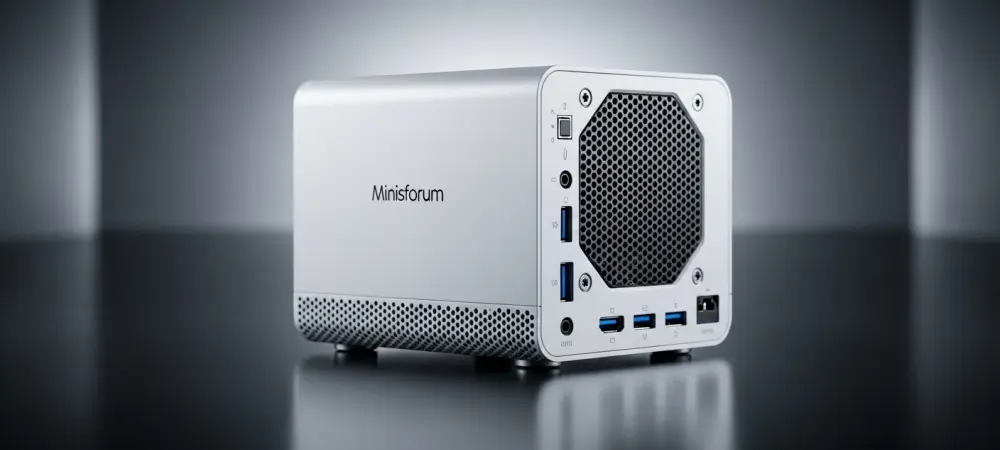
The long-standing compromise between raw desktop power and limited desk space has consistently forced enthusiasts and professionals to choose one over the other, but Minisforum is aiming to erase that divide with the launch of its AtomMan G1 Pro. This high-performance Mini PC is specifically engineered to cater to the demanding needs of modern gamers and content creators who require substantial processing and graphical capabilities without the footprint of a traditional tower. Encased in a compact, 3.8-liter white chassis that evokes a sleek, modern aesthetic, the device packs an impressive hardware configuration powered by a robust 350W internal power supply. By integrating top-tier components into a design that emphasizes both style and efficiency, the G1 Pro presents a compelling argument for the future of small form factor computing. The system is positioned as a premium solution, with a launch price of $1,428, reflecting its ambition to compete with larger, more established desktop setups while offering the distinct advantage of portability and space-saving design.
Power and Performance Under the Hood
At the heart of the AtomMan G1 Pro lies a formidable combination of processing and graphics hardware designed to handle intensive workloads with ease. The system is driven by the AMD Ryzen 9 8945HX processor, a flagship chip built on the Zen 4 architecture that features an impressive 16 cores and 32 threads, providing immense multi-threaded performance for complex tasks like video rendering, 3D modeling, and high-frame-rate gaming. This powerful CPU is paired with a desktop-class NVIDIA GeForce RTX 5060 graphics card, ensuring that users have access to the latest advancements in real-time ray tracing and AI-accelerated graphics. To harness the full potential of this hardware, Minisforum has implemented a sophisticated power delivery system with multiple user-selectable performance modes. The most aggressive setting, “Beast Mode,” allows the CPU and GPU to draw a combined total of up to 245W, with the GPU alone capable of reaching a 145W peak. For balanced performance, “Gaming Mode” caps the total at 225W, while “Office Mode” reduces it to 205W for quieter operation during less demanding tasks.
Advanced Cooling and Expansive Connectivity
To manage the significant heat generated by its high-end components within such a compact enclosure, Minisforum equipped the AtomMan G1 Pro with its 3rd-gen Glacier Cooling system, an advanced thermal solution rated to handle a 300W thermal load. This sophisticated system utilized five copper heat pipes to efficiently draw heat away from the CPU and GPU, which was then dissipated by 3600 RPM silent fans through a two-sided exhaust design, ensuring stable performance even under sustained pressure. The Mini PC also offered a versatile array of connectivity options, featuring both USB-C and USB-A ports on the front panel for easy access, with additional USB-A, USB-C, HDMI, and DisplayPort outputs on the rear, alongside a high-speed 5G LAN port. While the base configuration included a generous 32 GB of RAM and a 1 TB SSD, the G1 Pro was designed for future-proofing, providing significant expandability. Users had the option to upgrade the memory to a massive 96 GB of SO-DIMM RAM and increase storage to 8 TB by populating its two 4 TB NVMe SSD slots, making it a highly adaptable and long-lasting investment. The device became available for purchase on the JD e-commerce platform.