

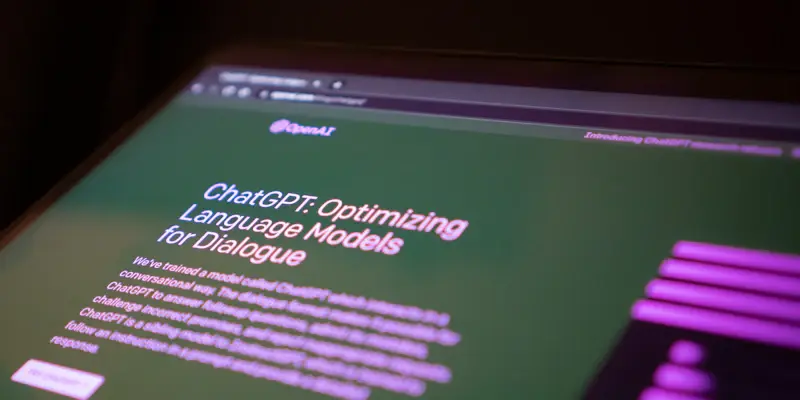
OpenAI has taken the next step in artificial intelligence with the introduction of its latest model, o1-pro. Revealed through the developer API, the o1-pro aims to set a new benchmark in reasoning capabilities and handling complex tasks. Reflecting substantial advancements from its predecessor, o1, this model is set to serve higher-level computational needs but comes with a significant price tag. OpenAI’s commitment to delivering enhanced AI functionalities is evident in the o1-pro’s design, which boasts an array of groundbreaking features.
A Leap in Reasoning and Computational Power
Enhanced Reasoning Capabilities
The o1-pro’s primary appeal lies in its significantly improved reasoning abilities, designed to handle intricate tasks with unparalleled efficiency. By leveraging extensive computational resources, the model ensures consistently higher quality responses, crucial for applications requiring sophisticated problem-solving techniques. This upgrade is not just a mere enhancement; it is a redefinition of how AI can process and interpret data for more accurate and meaningful outputs.
Supporting these advancements is the o1-pro’s ability to work with a 200,000-token context window, allowing it to process larger and more complex datasets simultaneously. This feature is particularly beneficial for tasks that rely heavily on context and continuity over extended operations. The wider token window means the AI can understand and predict outcomes more accurately, making it a more reliable partner for developers working on advanced projects.
Moreover, the model’s multimodal input capabilities add another layer of versatility. o1-pro can interpret and integrate various types of data inputs—whether text, images, or other forms—into a cohesive response. This multimodal capability is crucial for autonomous systems that must interpret multiple data sources simultaneously to make informed decisions.
Supporting Developers and Integration
Another notable feature of the o1-pro is its seamless API integrations, which simplify the implementation process for developers. OpenAI has placed a strong emphasis on user experience by ensuring that the integration of this advanced model into existing systems is as smooth as possible. This focus on ease of integration is critical for developers seeking to enhance their applications with minimal downtime and reconfiguration.
In addition to seamless integration, OpenAI requires a minimal entry investment for developers wishing to access the o1-pro. The AI model is available to those who have already spent at least $5 on OpenAI’s API services. This prerequisite ensures that only committed and potentially high-impact projects gain access to the o1-pro, aligning the model’s capabilities with serious professional applications primarily aimed at AI agents designed for autonomous task execution.
The structured output feature further enhances the model’s practical utility. By providing outputs in a pre-defined structure, the o1-pro reduces the need for additional processing or formatting, streamlining the workflow for developers and end-users alike. This feature is particularly beneficial for applications where consistency and reliability of outputs are paramount, such as data analysis, automated reporting, and advanced decision-making systems.
The Cost of Superior Performance
Premium Pricing Justification
The introduction of o1-pro comes with a premium price tag, reflecting its advanced capabilities and the significant computational resources required for operation. The model is priced at $150 million per input token and $600 million per output token. This cost is twice as high as that of GPT-4.5 for entry and ten times that of the standard o1 version. OpenAI justifies these high costs by underscoring the o1-pro’s superior reliability and performance on particularly challenging tasks.
This pricing strategy highlights the model’s targeted user base—organizations and developers who require a high-performing AI with enhanced specialized functionalities. The financial commitment ensures that only serious projects, which can leverage the o1-pro’s capabilities to their fullest extent, are undertaken. In sectors where precision, reliability, and advanced reasoning are crucial, such as finance, healthcare, and advanced research, the o1-pro’s cost is seen as a worthy investment.
Initial Feedback and Real-World Performance
Initial benchmarks of the o1-pro have shown incremental improvements over the standard o1, particularly in coding and mathematical applications. These areas benefited significantly from the model’s heightened reasoning and computational power. Early feedback from ChatGPT Pro users, however, has been mixed. Some users noted that while the model excelled in structured tasks, it struggled with more creative or unstructured prompts, such as solving Sudoku puzzles or interpreting optical illusions.
These initial user experiences have raised questions about the o1-pro’s efficacy in real-world scenarios where inputs may not always be clear or structured. Despite these concerns, OpenAI remains confident that the o1-pro’s increased computational power and sophisticated reasoning abilities will ensure higher-quality responses, especially for complex problems.
The company’s spokesperson emphasized the model’s ability to “think harder,” ensuring that it can tackle more complicated issues than its predecessors. This assurance aims to address the needs and expectations of the developer community, who demand more reliable AI solutions.
Future Considerations
Progressive Improvement and Value Realization
The o1-pro represents a significant investment in AI technology, positioning itself as an indispensable tool for advanced applications. While its premium pricing underscores the substantial computational resources required, the model’s capabilities promise significant returns for complex problem-solving demands. OpenAI’s emphasis on reliability and structured outputs makes the o1-pro particularly attractive for applications where precision and consistency are non-negotiable.
Future adoption of the o1-pro will depend on the consistent delivery of concrete and significant enhancements in real-world scenarios. Developers and organizations will be closely watching to see if the model can reliably justify its considerable cost through tangible improvements in functionality and performance. As the AI landscape continues to evolve, the o1-pro may set new standards for what advanced AI can achieve.
Expanding Potential and Industry Impact
OpenAI has pushed the boundaries of artificial intelligence with the launch of its newest model, the o1-pro. Released via the developer API, the o1-pro is designed to establish a new standard in reasoning capabilities and the ability to manage intricate tasks. Building upon the achievements of its predecessor, the o1, this latest model is crafted to meet advanced computational demands, though it comes with a substantial price tag. OpenAI’s dedication to providing enhanced AI functionalities is evident in the o1-pro’s sophisticated design, which includes a host of groundbreaking features. This innovative model aims to elevate the efficiency and effectiveness of AI applications even further, making it a significant milestone in the field. The o1-pro is not just a tool for today’s needs but a gateway to future possibilities, reflecting OpenAI’s ongoing pursuit of excellence in artificial intelligence. The advancements in the o1-pro underline OpenAI’s mission to push forward the limits of what AI can achieve.