

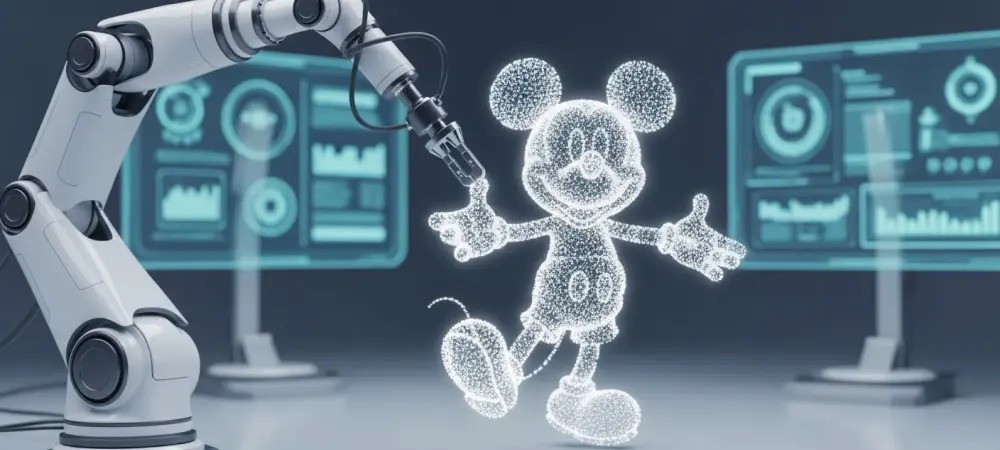
In a move that sent shockwaves through both Hollywood and Silicon Valley, Disney has forged a groundbreaking $1 billion, three-year partnership with OpenAI, even as it takes legal action against Google for copyright infringement. This dual strategy highlights the complex and rapidly evolving relationship between creative industries and artificial intelligence. To unravel the implications of this landmark deal and the launch of the new ChatGPT-5.2, we sat down with Dominic Jainy, a seasoned IT professional with deep expertise in AI and its business applications. We explored the strategic thinking behind Disney’s bold AI embrace, the creative challenges of animating iconic characters without their voices, and what the increasing accuracy of AI models means for the future of professional work.
Considering Hollywood’s AI concerns, Disney’s $1 billion investment and three-year deal with OpenAI is a major move. Can you walk us through the strategic thinking that likely led to this, and what it signals for other major studios grappling with AI integration?
This wasn’t just a deal; it was a strategic masterstroke in a very tense environment. Hollywood has been deeply worried about AI, focusing on copyright, jobs, and remuneration. Instead of fighting a rising tide, Disney, with this $1 billion investment, chose to partner with a leader and help steer the ship. CEO Bob Iger called it an “important moment,” signaling a shift from a defensive posture to one of proactive, controlled engagement. By collaborating on how its IP is used, Disney gets to “thoughtfully and responsibly extend the reach of our storytelling,” setting a powerful precedent for other studios. They are essentially showing the rest of the industry that the best way to protect your creators and works is not to build walls, but to build partnerships where you dictate the terms.
The agreement allows Sora to generate videos with over 200 Disney characters but excludes talent voices. Could you explain the technical and creative process OpenAI might use to capture a character’s essence without their iconic voice, and what metrics might define success for these videos?
This is a fascinating creative and technical puzzle. Without the voice, the entire emotional weight falls on the visual performance. OpenAI’s Sora will likely be trained intensively on the vast Disney animation catalog to learn the specific physics, mannerisms, and emotional expressions of each of the 200-plus characters—how Mickey Mouse bounces, how a Pixar character conveys surprise through its eyes, or the specific swagger of a Marvel hero. The process will rely on incredibly detailed user prompts to guide the action in these short social videos. Success won’t be about photorealism, but about authenticity. The key metrics will be fan engagement and shareability, but also brand integrity. The ultimate test is whether a fan can watch a short, silent clip and feel, “Yes, that’s exactly how that character would act.”
Disney’s partnership with OpenAI was announced on the same day it sent a cease-and-desist to Google for copyright infringement. What key differences in OpenAI’s and Google’s approach to data and collaboration might explain this dual strategy? Please elaborate on the industry implications.
This dual strategy is a clear message to the entire tech industry: collaborate with us respectfully, or face legal consequences. The key difference lies in the approach. The OpenAI deal is a licensing arrangement built on mutual respect and consent. Disney is an active, paying partner, ensuring its IP is used responsibly while also investing in the technology’s development. On the other hand, the cease-and-desist letter to Google suggests Disney believes its copyrighted material was used for AI training without permission or compensation. This sends a clear signal that studios are willing to embrace AI, but only through partnerships that honor creative rights and establish clear financial terms. It draws a line in the sand between sanctioned, collaborative innovation and what they perceive as unauthorized data scraping.
OpenAI claims GPT-5.2 Thinking has 30% fewer errors than its predecessor. Can you provide an example of how this increased accuracy translates to a real-world benefit for professionals building presentations or spreadsheets, and what technical milestones likely enabled this jump in performance?
That 30% reduction in errors is a massive leap for professional use cases. Imagine a marketing analyst using the AI to create a spreadsheet summarizing quarterly performance. The previous version might have hallucinated a key sales figure or misinterpreted a data trend, forcing the analyst to meticulously double-check every single cell. With GPT-5.2 Thinking, there’s a significantly higher probability that the generated spreadsheet is accurate from the start, saving valuable time and reducing the risk of basing a critical presentation on flawed data. This jump in performance likely comes from more refined training techniques and possibly acquiring specialized model training startups, allowing the model to better distinguish between factual patterns and statistical noise, making it a more reliable tool for complex, multi-step projects.
What is your forecast for the relationship between major creative studios and AI firms over the next five years?
I foresee a future defined by a blend of high-stakes partnerships and contentious legal battles. The Disney-OpenAI deal is the blueprint for the collaborative path, where studios license their valuable IP to AI firms in controlled, lucrative arrangements to create new forms of fan engagement and internal tools. However, not every AI company will be willing or able to pay for this access. We will simultaneously see studios become much more aggressive in litigating against firms they believe are training models on their content without permission. This will force a clear bifurcation in the AI industry: those who build their models on licensed, proprietary data through partnerships, and those who risk protracted legal fights over fair use and copyright. The next five years will be about establishing the definitive rules of engagement for AI in the creative landscape.