

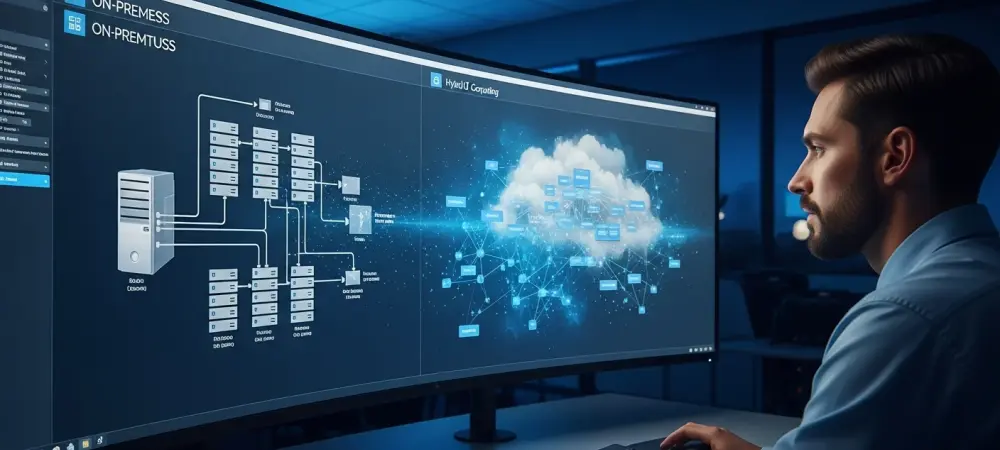
The race to deploy autonomous AI systems at scale has pushed enterprises to a critical architectural crossroads, forcing a decision between keeping artificial intelligence workloads close to sensitive data within their own firewalls or embracing the expansive scalability of cloud-native platforms. This choice is far more than a technical detail; it fundamentally shapes an organization’s approach to data security, governance, and operational efficiency. As the AI landscape matures, the debate intensifies, pitting the controlled, secure environment of on-premises solutions against the agile, integrated ecosystems offered by public cloud giants.
Defining the Architectures: On-Premises and Cloud-Native AI Platforms
At the heart of this comparison lie two distinct philosophies for building and deploying enterprise AI. The on-premises and hybrid approach, championed by platforms like Teradata’s Enterprise AgentStack, prioritizes running AI agents directly where mission-critical data resides. This model is designed for organizations in highly regulated industries like finance and healthcare, where data sovereignty and security are paramount. Teradata’s strategy centers on enabling the “autonomous enterprise” by providing a unified, end-to-end solution that collapses the complexity of moving from an AI pilot to a production-scale system, directly addressing the common hurdles of data silos and governance gaps. In contrast, cloud-native AI architectures, exemplified by offerings like Databricks’ Mosaic AI and Snowflake’s Cortex, are built on the premise that AI should operate within a vast, integrated cloud data ecosystem. These platforms leverage the inherent scalability and managed services of the cloud to accelerate development and deployment. Databricks tightly integrates its AI capabilities within its lakehouse architecture, while Snowflake embeds AI functionalities directly into its data cloud via its Native App Framework. Their philosophy is one of speed and seamless integration for organizations that have already committed their data gravity to the cloud, offering a streamlined path for developing AI applications that operate near the data rather than directly on-premises.
Head-to-Head Comparison: Key Differentiators and Capabilities
Deployment Flexibility and Data Proximity
The most significant differentiator between these two approaches is where AI models and agents physically execute in relation to the data. Teradata’s Enterprise AgentStack is engineered for maximum flexibility, allowing agents to run on-premises, in the public cloud, or in a hybrid configuration. This capability is crucial for industries where moving sensitive customer or patient data outside a secure perimeter is not an option. By co-locating agent execution with data storage in Teradata Vantage, the platform minimizes latency and eliminates the security risks associated with data transfer, giving it a distinct “edge” in complex, real-world scenarios.
Cloud-native platforms such as Snowflake Cortex and Databricks Mosaic AI optimize for a different paradigm. They emphasize running AI applications near the data but strictly within their respective cloud ecosystems. While this approach offers powerful scalability and simplifies orchestration for cloud-based data, it can present a significant barrier for organizations bound by data sovereignty mandates or those operating in air-gapped environments. For these companies, the requirement to move or replicate data to the cloud introduces compliance challenges and performance penalties that an on-premises or hybrid model is specifically designed to avoid.
Architectural Approach and Ecosystem Integration
The underlying architectural design and vendor philosophy also reveal a stark contrast. Teradata positions its AgentStack as a vendor-agnostic “neutral layer” for agentic AI execution. It is constructed upon four distinct pillars—AgentBuilder for creation, Enterprise Model Context Protocol (MCP) for secure data access, AgentEngine for deployment, and AgentOps for management. This architecture is intentionally open, supporting popular open-source frameworks like LangGraph and CrewAI to prevent developer lock-in. The goal is to provide a standardized, interoperable platform that can integrate with a diverse set of tools and systems. Conversely, solutions from Databricks and Snowflake are characterized by their deep, proprietary integration. Mosaic AI is intrinsically woven into the Databricks lakehouse, and Cortex is a native component of the Snowflake data cloud. This tight coupling offers a seamless, highly orchestrated user experience, as the AI tools are designed to work perfectly with the underlying data platform. However, this convenience comes at the cost of potential vendor lock-in, making it more difficult for organizations to adopt a multi-cloud strategy or integrate tools from outside the platform’s walled garden. The choice becomes one between the flexibility of an open ecosystem and the streamlined efficiency of a closed one.
Multi-Agent Collaboration and Scalability
When it comes to executing complex AI workflows involving multiple agents, the technical mechanisms employed by each approach differ significantly. Teradata AgentStack facilitates multi-agent collaboration through a “shared workspace” model. This design allows multiple agents to interact and share information via a common memory space, which analysts suggest is more reliable and efficient than simple chat-based protocols. Such protocols can be prone to cascading errors, similar to a “game of Telephone,” where information degrades with each handoff. AgentStack’s shared-state model is engineered for greater accuracy in complex, long-running tasks. Furthermore, its AgentEngine leverages standard technologies like Docker and Kubernetes, enabling consistent and scalable deployment across any on-premises or cloud environment. Cloud-native platforms, by their very nature, leverage the immense scalability of their underlying cloud infrastructure. Orchestration of AI workflows and multi-agent systems is typically handled through managed services that are optimized for that specific cloud environment. While this provides enormous scaling potential for tasks that are well-suited to the cloud, it relies on the platform’s proprietary tooling for coordination. This approach standardizes execution behavior within a single ecosystem but may lack the cross-environment portability offered by container-based deployment engines like the one used by Teradata.
Overcoming Hurdles: Challenges and Strategic Considerations
Despite their strengths, both architectural models present unique challenges. For on-premises and hybrid solutions like Teradata’s AgentStack, a key hurdle is proving the reliability and stability of complex, long-running multi-agent systems in real-world production environments. The theoretical advantages must be validated with concrete customer evidence. Additionally, there is a risk that if its third-party integrations are not sufficiently deep and robust, the platform could inadvertently become a “walled garden,” shifting the burden of complexity back onto the customer to connect external tools and systems. On the other hand, cloud-native AI platforms face persistent challenges related to data governance, security, and latency. For highly regulated organizations, the process of moving massive volumes of sensitive data to the cloud to be processed by AI models introduces significant compliance and security risks. The physical distance between the data’s point of origin and the cloud data center can also introduce latency, which may be unacceptable for real-time decision-making applications in fields like fraud detection or industrial automation. These considerations often become primary obstacles that prevent such organizations from fully embracing a cloud-only AI strategy.
Final Verdict: Choosing the Right AI Strategy for Your Enterprise
The decision between an on-premises or a cloud-native AI strategy ultimately hinged on an organization’s unique priorities regarding data gravity, security posture, and existing technological investments. The analysis indicated that a one-size-fits-all solution did not exist; instead, the optimal choice was dictated by specific business and regulatory contexts. For enterprises operating in risk-averse industries like finance, banking, and healthcare, Teradata’s Enterprise AgentStack presented a superior choice. Its emphasis on hybrid flexibility, low-latency access by running agents where data resides, and adherence to strict governance mandates directly addressed the core requirements of these sectors. In contrast, cloud-native platforms like Databricks’ Mosaic AI and Snowflake’s Cortex were better suited for organizations that were already deeply invested in a specific cloud data ecosystem. These platforms offered unparalleled speed in development and massive scalability for cloud-based data, making them ideal for businesses that prioritized agility and were not constrained by the same stringent data sovereignty rules. Ultimately, the verdict was clear: organizations had to align their AI architecture with their foundational data strategy, choosing the path that best protected their most valuable asset while empowering them to turn it into autonomous action.