

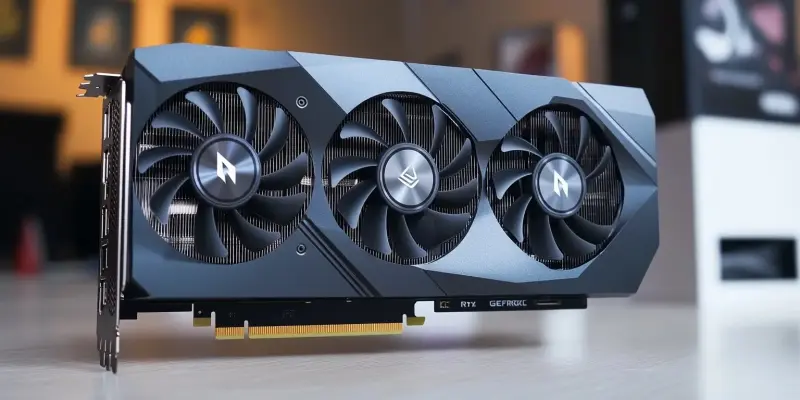
As Nvidia gears up for the highly anticipated launch of its next-generation RTX 5090 graphics card, recent rumors have stirred discussions about its potential power consumption. Initial speculations posited that this new flagship GPU would require a hefty 600W, a figure that alarmed many PC enthusiasts. However, emerging leaks, notably from a trusted source, Kopite7kimi, now suggest this card might consume slightly less power than previously thought. While the exact details are still shrouded in uncertainty, this reduction, albeit minimal, is seen as a positive sign for gamers and tech aficionados eagerly awaiting the official specifications.
Power Consumption Changes
Initial Speculations and Recent Leaks
The first speculations around the RTX 5090’s power requirements pointed to an extensive 600W demand. This number, while daunting, was in line with expectations for a top-tier GPU seeking to dominate the high-end gaming market. Such power consumption naturally raised concerns among potential users about the need for equally powerful and possibly expensive power supplies to handle this behemoth. However, recent leaks have slightly alleviated these fears. Renowned leaker Kopite7kimi has hinted at a possible downward adjustment in the power requirements.
According to these sources, the Nvidia RTX 5090 might consume less power than the initial 600W estimate, potentially ranging between 550W and 580W. Though this reduction seems minor, it is certainly better news for those building new rigs or upgrading their systems. Slight as it may be, this change indicates Nvidia’s ongoing efforts to balance cutting-edge performance with more manageable power demands. Such measures are in accordance with broader industry trends emphasizing improved energy efficiency without compromising on benchmark performances.
Context and Comparisons
The conversation about the RTX 5090’s power consumption doesn’t exist in a vacuum. It surfaces in a landscape where the RTX 5070 Ti has also seen similar speculation adjustments. Initially rumored to require around 350W, the RTX 5070 Ti could now potentially need only 285W, showcasing a notable reduction in energy requirements. This development naturally sparked curiosity about whether a similar recalibration might apply to its more powerful counterpart, the RTX 5090.
By highlighting these potential revisions, the industry underscores a crucial trend: high-efficiency performance needs not only involve increasing power but also optimizing how that power is used. Nvidia’s anticipated tweaks to power consumption reflect broader efforts within the tech industry to deliver superior performance while ensuring energy use is kept in check. This dynamic balance is increasingly vital as GPUs become ever more integral not just to gaming but also to demanding tasks such as AI processing and intricate computational work.
Anticipated Market Implications
Robust Power Supply Requirements
Despite the potential recalibration in power consumption, there is little doubt that the RTX 5090 will demand a robust power supply. This remains consistent with the expectations for a GPU designed to offer unprecedented gaming experiences and support the most graphically intensive applications. The advanced architecture and performance capabilities of the RTX 5090 imply that even reduced, its power requirements will outstrip those of many current cards.
Ensuring a reliable and capable power supply is therefore still paramount for anyone considering upgrading to this upcoming flagship model. It is worth noting that with higher performance usually comes significant energy demand, a fact true for flagship devices across various technology sectors. Hence, potential buyers should still be prepared for investing in robust power infrastructure to accommodate the advanced demands of the RTX 5090. As always in the world of high-performance technology, preparation and power planning go hand in hand.
Pricing Considerations
As Nvidia prepares for the much-anticipated release of its next-generation RTX 5090 graphics card, recent rumors have sparked discussions about its potential power consumption. Initial speculations suggested that this cutting-edge GPU would demand a substantial 600W, a figure that left many PC enthusiasts concerned about power usage and heat generation. However, new leaks, primarily from the well-known source Kopite7kimi, indicate that this card might actually consume slightly less power than initially feared. Although the precise details remain unclear, this slight reduction in power consumption is viewed positively by gamers and tech fans who eagerly look forward to the official specifications. This news has provided a glimmer of hope for those who feared the impact of a 600W draw on their systems. Some even speculate that this decrease might contribute to more efficient cooling solutions and potentially lower noise levels during intense gaming sessions or heavy computational tasks. As the launch date approaches, excitement continues to build over what advancements the RTX 5090 will bring to the table.