

Dominic Jainy is a seasoned IT professional with a profound understanding of how high-performance hardware intersects with cooling efficiency and acoustics. Having closely followed the evolution of thermal management in artificial intelligence rigs and enthusiast workstations, he brings a unique perspective to the recent collaboration between Noctua and Antec. This partnership marks a significant milestone as the legendary Austrian cooling brand moves beyond individual components to influence the very architecture of the PC chassis, aiming to redefine what a silent, high-performance build looks like in today’s demanding hardware landscape.
Noctua has traditionally focused on optimizing internal components rather than designing the housing itself. Why was the Antec Flux Pro’s layout chosen as the foundation for this collaboration, and how does the specific airflow over the power supply shroud improve thermal performance for modern, high-wattage graphics cards?
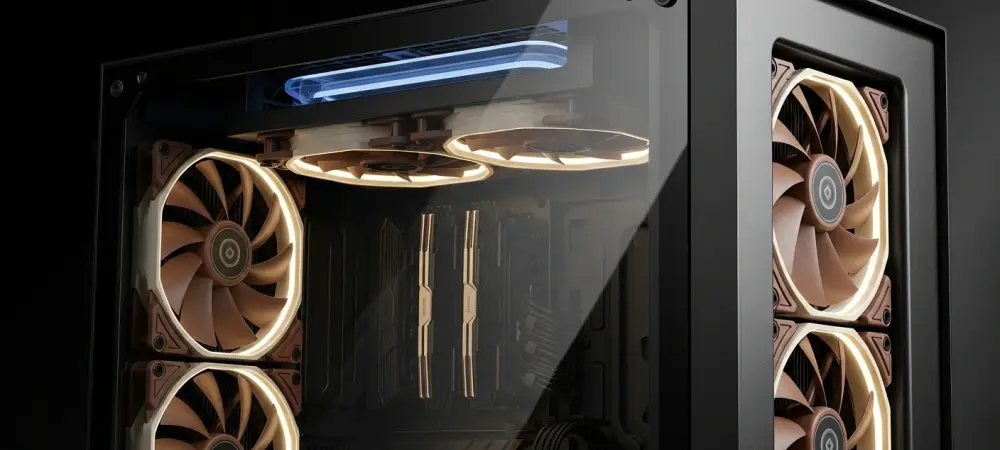
The decision to build upon the Antec Flux Pro layout stems from its sophisticated approach to “flow-through” ventilation, which aligns perfectly with Noctua’s engineering philosophy. Modern graphics cards, particularly high-wattage units like the RTX 5080, generate immense heat that often gets trapped in the lower chamber of traditional cases. By utilizing the Flux Pro’s design, which supports fans directly above the power supply shroud, Noctua can drive fresh air straight into the GPU’s intake, significantly dropping temperatures compared to standard configurations. It’s a pragmatic foundation that allows them to apply their fan technology to a 530 x 245 x 545mm tower that is already optimized for high-volume air movement. This specific layout ensures that the GPU isn’t just recirculating its own hot exhaust, creating a tangible difference in both thermal headroom and sustained clock speeds.
Many silent-system enthusiasts prefer solid side panels for sound dampening, yet this chassis exclusively features tempered glass. Could you explain the technical trade-offs regarding acoustic performance in this scenario and why glass was deemed necessary to maintain the ventilation efficiency required for this specific fan configuration?
There is a long-standing debate regarding glass versus solid steel panels, but in this specific collaboration, the choice was driven by the necessity of the airflow path. To achieve the cooling efficiency Noctua demands for its flagship fans, the internal pressure and directional flow must be meticulously maintained without the vibration risks sometimes associated with thin, non-insulated metal panels. While solid panels can house foam dampening, glass provides a rigid, non-porous barrier that prevents air leakage, ensuring the four 140mm fans can move air exactly where it’s needed. Noctua has hinted that while glass is the current priority to showcase the internal thermal engineering, the rigid nature of the tempered glass actually helps contain certain high-frequency fan noises that might otherwise cause a thin metal panel to resonate. It’s a trade-off where structural integrity and airflow pathing were prioritized to ensure the fans could operate at lower, quieter RPMs while still moving massive amounts of air.
With support for dual 420mm radiators and up to four 140mm fans, this case targets the extreme cooling market. What specific installation challenges do builders face when maximizing these large-scale cooling options, and how can the internal layout accommodate four 3.5-inch drives without obstructing critical air paths?
Maximizing a build with dual 420mm radiators is a logistical puzzle because the sheer surface area of those radiators can easily choke off the rest of the system if not managed correctly. Builders must be incredibly precise with cable management and the sequence of installation to ensure that these massive cooling units don’t overlap or block the 10Gbps USB-C header and other front I/O connections. The genius of this layout lies in how it segregates the storage; by positioning the four 3.5-inch drive bays away from the primary intake “wind tunnel,” the case maintains a clear path for the 140mm fans to push air toward the motherboard and GPU. It requires a disciplined build process, but the result is a system that can handle the thermal load of a workstation without the “clutter” of cables and drives interfering with the cooling physics.
From graphics cards to peripherals like gaming mice, specialized engineering collaborations are becoming a staple of the high-end hardware market. Given the anticipated premium pricing for this case, how does it integrate into a broader ecosystem of noise-optimized hardware, and what metrics determine a successful acoustic partnership?
This case is the cornerstone of a burgeoning ecosystem where silence is treated as a premium feature, sitting alongside the Noctua-edition graphics cards and even specialized peripherals like the Pulsar Feinmann F01 mouse. A successful partnership is measured by more than just decibel levels; it’s about the “acoustic profile” or the quality of the sound, ensuring there are no whining motors or turbulent air “whooshing” noises. When a user invests more than the standard $180 MSRP of the base Flux Pro, they are paying for a curated experience where the case, the fans, and even the GPU work in a coordinated harmony. We look at metrics like the noise-to-thermal ratio—essentially, how much cooling can you get for every decibel of sound—and this case aims to set a new benchmark by integrating Noctua’s signature brown-and-beige engineering into every corner of the airflow path.
What is your forecast for the future of silent PC case design?
I believe we are moving toward a “total system” approach where the chassis is no longer just a static box but an active participant in thermal management through intelligent, integrated ducting and variable-speed fan arrays. In the coming years, I expect to see more 3D-printable components, much like the fan grills Noctua recently released for the Framework Desktop, allowing users to customize the internal aerodynamics of their cases for specific hardware layouts. We will likely see the disappearance of the “all-mesh” versus “solid-panel” divide in favor of hybrid designs that use specialized materials to absorb specific sound frequencies while maintaining high-pressure airflow. Ultimately, the future of silent design will be defined by components that don’t just run quietly, but actively adapt their acoustic footprint based on real-time thermal demands, making the “jet engine” PC startup a thing of the past.