

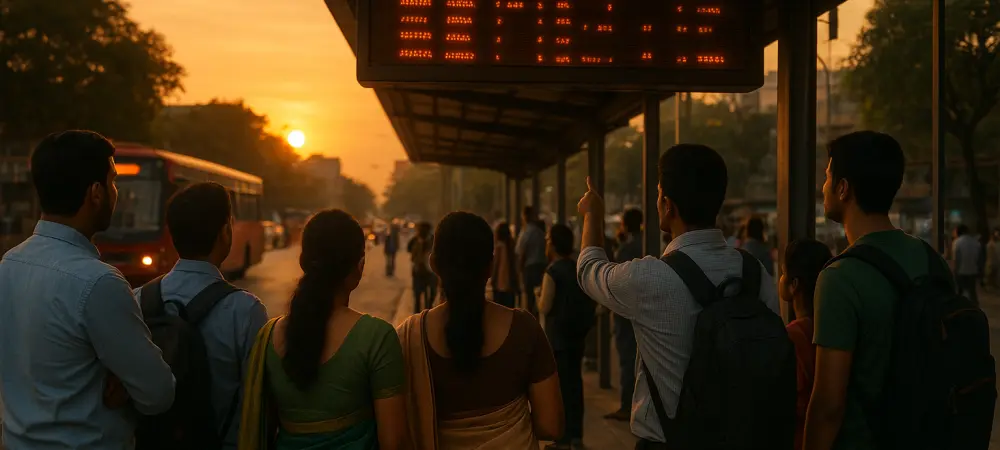
Developing reliable bus arrival predictions in Indian cities requires accounting for the intense travel-time variability caused by high levels of mixed traffic. In large urban hubs, the diversity of road users creates a high-entropy environment where a single bus might encounter everything from slow-moving freight carts to rapid lane-splitting motorcycles. Traditional GPS-based arrival estimates often fall short in these scenarios because they rely on simplistic linear extrapolations that cannot account for the sudden bottlenecks typical of Indian thoroughfares. Researchers have addressed this challenge by focusing on three distinct cities—Delhi, Mysore, and Surat—to develop a framework capable of navigating different levels of infrastructural maturity. While Delhi presents a case of extreme congestion in an open-road setting, Surat offers a more controlled environment through its Bus Rapid Transit system. This comparative approach ensures that the resulting AI framework is not just a theoretical exercise but a practical tool designed to enhance the daily lives of millions of commuters who currently face significant uncertainty regarding their transit schedules.
Categorizing Urban Traffic Through Embedded Clustering
The core innovation of this research involves a two-step framework designed to manage the inherent heterogeneity of urban bus routes. First, the team conducted a rigorous temporal analysis to select input features based on actual time-based patterns rather than just raw data availability. This ensured that the models were training on the most influential factors, such as peak-hour surges or recurring midday lulls. Following this, the researchers implemented deep embedded clustering to group road segments with similar spatio-temporal travel behaviors. This technique allows the AI to recognize that a bus moving through a dense market district requires a different predictive logic than one traveling on a suburban arterial road. By clustering these segments, the system creates specialized sub-models that focus on internally consistent data, preventing the noise of one congested area from skewing the predictions for the rest of the route. This localized approach represents a significant leap forward in transit technology, offering a level of granularity that was previously unattainable with generalized algorithms.
Comparing Neural Architectures for Optimal Performance
To identify the most resilient technological foundation, the study compared three advanced deep-learning architectures: Long Short-Term Memory, Convolutional LSTM, and a variant equipped with an attention mechanism. The findings demonstrated that there is no one-size-fits-all solution for bus arrival predictions; the best architecture depends on the specific traffic dynamics of the city. In the highly unpredictable mixed traffic of Delhi, the attention mechanism proved essential, as it allowed the model to focus on the most relevant historical segments while discounting random fluctuations. In contrast, the more stable environment of Surat’s dedicated bus lanes allowed even simpler models to perform with high precision. This discrepancy highlights the importance of city-specific calibration in transit technology. By selecting an algorithm that matches the local operational reality, transit authorities can achieve higher reliability without over-investing in unnecessary computational complexity, ensuring that the system remains both effective and cost-efficient for the city.
Future Implications for Urban Mobility Systems
The study concluded that a cluster-aware approach significantly enhanced prediction reliability by capturing localized patterns that traditional models often overlooked. It was found that the effectiveness of the framework remained contingent upon the quality of the input data and the specific spatio-temporal characteristics of each urban environment. Moving forward, transit planners recognized that the integration of this AI framework could transform the commuter experience by providing real-time, high-accuracy arrival updates through mobile applications and digital station displays. The research provided a practical roadmap for authorities to develop more scalable systems by prioritizing data-driven segment grouping and selecting algorithms tailored to their unique city layouts. Furthermore, the transition toward these specialized models allowed for better resource allocation, as agencies could identify and address specific segments with chronic delays. By leveraging these insights, Indian cities were able to start modernizing their networks, making them more responsive to the needs of a growing urban population.