

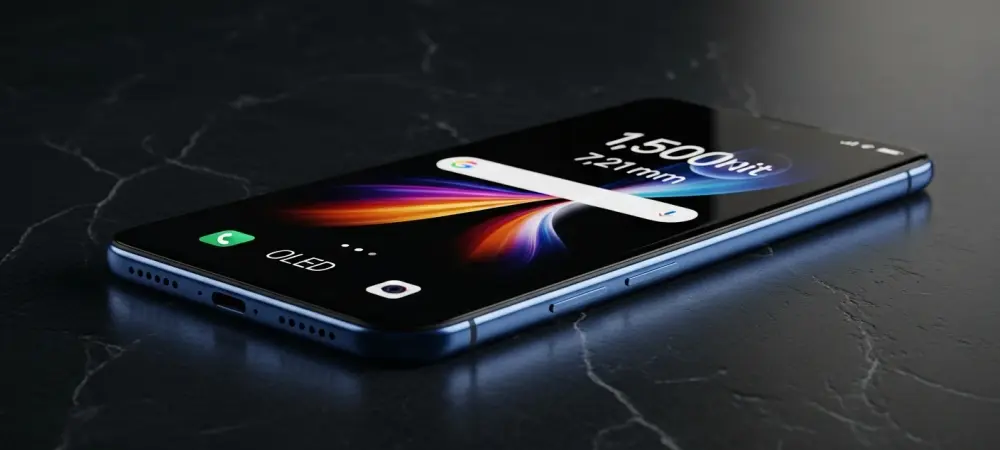
Dominic Jainy is a seasoned IT professional whose expertise spans the critical intersections of artificial intelligence, machine learning, and the evolving landscape of mobile hardware. With a career dedicated to understanding how complex systems integrate into daily life, he offers a unique perspective on the engineering trade-offs that define modern consumer electronics. In this discussion, we explore the shifting paradigms of smartphone design, focusing on the tactical choices manufacturers make regarding battery density, display health, and long-term device sustainability. We delve into the nuances of the dual-battery configuration strategy, the physiological impact of high-brightness OLED panels, and the tension between ruggedized industrial standards and the right to repair.
Offering a 7,000 mAh battery increases device thickness to nearly 8 mm and weight to 193 grams. How does this weight-to-stamina trade-off change daily ergonomics, and which specific user habits justify the extra bulk over a slimmer 5,200 mAh alternative?
The jump to a 193-gram chassis is immediately noticeable the moment you slide the device into a pocket or attempt to use it one-handed for an extended period. At nearly 8 mm thick, this variant trades that “disappearing” feel of a slim phone for a sense of dense, rugged reliability that appeals to a very specific demographic. If you are a power user who frequently faces 24-hour runtimes without a power outlet, the extra bulk becomes a secondary concern compared to the peace of mind of two full days of intensive use. For those who rely on their phones for navigation during long commutes or back-to-back video conferencing, the added weight serves as a physical reminder of the massive 7,000 mAh reservoir at their disposal. In contrast, the 177-gram variant feels significantly more agile at just 7.21 mm, making it the superior choice for users who prioritize fashion and portability over extreme endurance.
Both battery variants support 68-watt charging, meaning the smaller unit recharges to full significantly faster. How does this “top-up” speed influence how a user manages their day, and what are the long-term wear implications for a smaller battery being cycled more frequently at these speeds?
The 68-watt charging standard is a transformative tool, but its utility scales differently depending on which capacity you choose. With the 7,000 mAh model, you are looking at a full 0-to-100% recovery in roughly 45 minutes, which is impressive for such a large cell, but the 5,200 mAh unit hits that finish line much faster, catering to a “dash-and-go” lifestyle. However, from a technical standpoint, the smaller battery will naturally undergo more frequent charge cycles to maintain the same level of uptime, which can lead to faster chemical degradation over several years. Using high-wattage charging on a smaller cell creates more heat per square millimeter of surface area, potentially stressing the components more than the larger, more heat-diffuse 7,000 mAh counterpart. Users who opt for the smaller capacity should be mindful of these frequent cycles, perhaps utilizing software-based charging limits to preserve the battery’s health over the device’s five-year support window.
High-brightness OLED panels reaching 1,500 nits often use PWM flicker at 120 Hz for dimming. What are the common symptoms for users sensitive to this flicker, and what technical settings or habits can help mitigate eye fatigue when using such vibrant screens?
Sensitivity to Pulse Width Modulation, or PWM, is an often-overlooked physiological hurdle where the rapid flickering used to control screen brightness triggers headaches, nausea, or intense eye strain. At a frequency of 120 Hz, the flicker is technically invisible to the naked eye, but the brain still processes the rapid on-off transitions, especially when the 1,500-nit display is dialed down to lower brightness levels in dark rooms. For users who start to feel a dull ache behind their eyes after scrolling for twenty minutes, the best mitigation strategy is to keep the brightness slightly higher and use an external blue-light filter or specialized “extra dim” software overlays that don’t rely on hardware-level flickering. It is also helpful to look away from the vibrant 6.78-inch screen every few minutes to allow the ocular muscles to relax from the high-contrast stimulus. While the color reproduction and HDR support on these panels are stunning, the hardware-level dimming remains a hurdle for a small but vocal percentage of the population.
Meeting IP68 and IP69 ratings for dust and water resistance requires precise workmanship, especially when using varied materials. How do these certifications impact the long-term repairability of a phone, and what should buyers consider when balancing aesthetic exclusivity against these rugged durability standards?
The achievement of IP68 and IP69 ratings is a double-edged sword; it provides incredible protection against high-pressure water jets and submersion, but it necessitates a fortress-like assembly that often involves aggressive adhesives and tight tolerances. This precision workmanship means that opening the device for a simple battery swap or a screen replacement becomes a high-stakes operation that can easily compromise the original seal. When you look at the exclusive Pantone Country Air blue finish, you are seeing a marriage of high-end aesthetics and industrial-grade protection that few devices manage to balance. Buyers must realize that while the phone is built to survive a drop into a pool or a dusty construction site, that same durability makes it a “closed box” for the average hobbyist. It is a trade-off where you gain immediate environmental security at the potential cost of more expensive or difficult professional repairs down the line.
A five-year security update policy is a common benchmark, yet some regional requirements are pushing for even longer support. What are the primary hardware bottlenecks that prevent manufacturers from extending support further, and how can users keep their data safe once official updates cease?
The primary hardware bottleneck for long-term support isn’t just the processor’s speed, but rather the underlying driver compatibility and the degradation of the flash storage and battery over half a decade. As operating systems become more complex, they require more overhead, and a mid-range chipset that feels snappy today might struggle with the security protocols of 2030. Furthermore, manufacturers are often tethered to the support windows provided by component suppliers, making it difficult to push past that five-year mark without significant investment. Once official security updates cease, users can protect themselves by being extremely cautious with third-party app stores and ensuring they use encrypted cloud backups for their most sensitive data. Transitioning to a “read-only” mindset for older devices—using them for media consumption rather than banking or primary communication—is a practical way to extend the utility of the hardware while minimizing digital risk.
What is your forecast for the future of smartphone battery configurations?
I believe we are entering an era where the “one size fits all” approach to hardware is finally dying, and we will see more manufacturers adopting the dual-configuration model to satisfy both the aesthetic-driven and the utility-driven segments of the market. We will likely see the 7,000 mAh threshold become a new standard for “Pro” or “Ultra” variants, while thinner models will rely on advancements in silicon-carbon anode technology to pack 5,000 mAh into even slimmer profiles than the 7.21 mm we see today. Eventually, software will play a larger role in this choice, with AI-driven power management bridges that can make a 5,200 mAh cell behave like a much larger unit by aggressively hibernating background processes based on predicted user behavior. The ultimate goal is a device that feels weightless in the hand but possesses the endurance of a dedicated power bank, and the current trend of offering consumers a choice between the two is the most honest middle ground we’ve seen in years.