

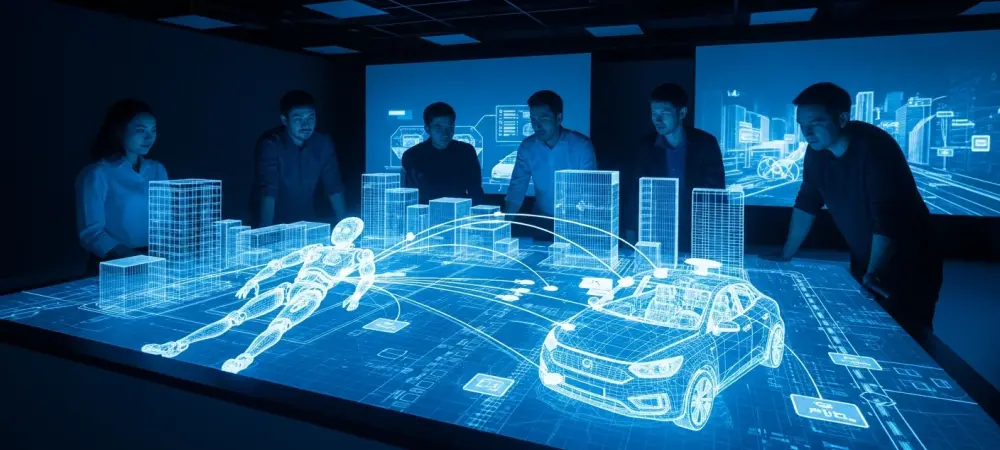
The once-distinct worlds of autonomous vehicles and humanoid robotics are now colliding with unprecedented force, forging a new technological frontier defined by a unified intelligence capable of navigating both highways and households. The emergence of Physical Artificial Intelligence represents a significant advancement in the robotics and autonomous systems sectors. This review explores the evolution of this technology through the lens of a landmark industry development: Mobileye’s acquisition of Mentee Robotics. The analysis will cover the key technological features, strategic synergies, and performance metrics that define this new powerhouse. The purpose of this review is to provide a thorough understanding of the technology’s current capabilities and its potential future trajectory in shaping both autonomous driving and humanoid robotics.
The Strategic Convergence of Automotive and Robotic AI
The integration of autonomous driving principles with humanoid robotics is not merely an intersection of interests but a strategic convergence of necessity. The acquisition of Mentee Robotics by Mobileye has created a new entity poised to lead the Physical AI landscape by merging deep expertise in safety-critical automotive systems with advanced, general-purpose humanoid platforms. This move underscores the growing understanding that a unified AI stack is required to master complex, human-centric environments, whether that environment is a busy city street or a dynamic warehouse floor.
This unified approach seeks to develop systems that can do more than follow pre-programmed instructions. The goal is a form of AI capable of comprehensively understanding context, inferring the intent of surrounding humans, and operating with a verifiable level of safety. The philosophical and technological foundation that allows a car to safely navigate an intersection with unpredictable pedestrians is the same foundation needed for a robot to work collaboratively alongside a human counterpart without incident. This convergence marks a shift from task-specific automation toward general-purpose physical intelligence.
Key Technological Pillars and Core Components
Mobileye’s Safety-Critical Autonomy Framework
Mobileye’s contribution to this partnership is built on a foundation hardened by two decades of experience in the unforgiving automotive sector. Its technology has evolved from simple driver-assistance navigation to a holistic, context-aware reasoning system designed for full autonomy. This framework is not just about perception; it is about prediction and provably safe decision-making. At its core is the Responsibility-Sensitive Safety (RSS) model, a mathematically grounded framework for defining and verifying safe behavior, ensuring an autonomous system will never be the cause of an accident.
This safety model is supported by an advanced multimodal perception suite that fuses data from various sensors to create a rich, redundant model of the world. Perhaps most importantly, Mobileye brings unparalleled experience in productizing complex AI for high-volume, safety-critical applications. This involves rigorous validation processes, system-level redundancies, and the ability to scale production with precision manufacturing partners—a skill set that is directly transferable and invaluable for the commercialization of humanoid robotics.
Mentee’s Vertically Integrated Humanoid Platform
Mentee Robotics brings a radically different yet complementary approach to the table, centered on agile and efficient learning for its humanoid platform. The company’s core AI architecture is designed to sidestep the traditional data-collection bottlenecks that have long plagued robotics development. Instead of relying on massive, manually labeled datasets or constant human teleoperation, its system leverages human-to-robot mentoring, where the robot learns new skills by observing human demonstrations in a naturalistic way. This is coupled with a focus on few-shot learning, enabling the robot to generalize and proficiently execute new tasks after seeing only a handful of examples.
This software innovation is supported by a tightly coupled, vertically integrated hardware stack. By developing critical components in-house—including high-torque-density actuators, precision motor drivers, and practical robotic hands with motor-based tactile sensing—Mentee ensures its hardware and software are perfectly synchronized. This integration is crucial for minimizing the “Sim2Real” gap, allowing skills learned in its simulation-first training paradigm to transfer effectively to the physical world. This vertical approach provides the control needed to optimize performance, cost, and ultimately, scalability.
Synergistic Advancements and Emerging Trends
The true power of this merger lies in the synergistic feedback loop created by combining these two technology stacks. This is not a simple portfolio expansion but the creation of a compounding advantage where breakthroughs in one domain directly accelerate progress in the other. For instance, Mentee’s sophisticated vision-language-action models, designed to help a robot understand nuanced human commands, can be integrated into Mobileye’s autonomy stack. This will significantly enhance an autonomous vehicle’s ability to interpret complex, long-tail scenarios involving human gestures or unusual situations that defy simple rule-based logic.
Conversely, Mobileye’s established safety-first culture and its RSS framework provide a crucial missing piece for the robotics industry. By applying a formal, mathematically verifiable safety model to humanoid behavior, the combined entity can build the trust and reliability necessary for large-scale deployment in human environments. This convergence is setting a new trend in the industry, suggesting that the future of Physical AI will be defined not by isolated advancements in either cars or robots, but by a unified development process that validates AI in safety-critical applications first before deploying it more broadly.
Applications in Transformative Markets
The practical applications of this integrated Physical AI are being targeted at the two most transformative markets of our time: autonomous driving and humanoid robotics. For robotics, the Mentee platform, now supercharged by Mobileye’s technology, is being positioned as a powerful labor multiplier. Rather than replacing human workers, these humanoids are designed to be collaborative partners, taking on repetitive, strenuous, or dangerous tasks, thereby freeing up human capital for more creative and strategic work across industries like logistics, manufacturing, and elder care.
Simultaneously, the insights gained from developing a robot that can physically interact with the world will flow back to improve autonomous vehicles. The challenge of creating a fluid, adaptable humanoid that can manipulate objects and navigate cluttered spaces forces the development of a more robust and generalized world model. This deeper understanding of physical interaction and human intent will directly address the long-tail performance issues that have been a persistent challenge for autonomous driving, pushing the technology closer to full, unsupervised operation in any environment.
Overcoming Core Industry Challenges
The path to widespread adoption of Physical AI is littered with significant technical hurdles, primarily the “Sim2Real” gap, the immense data requirements for training, and the difficulty of ensuring provable safety in unstructured environments. The Mobileye-Mentee entity is uniquely positioned to address these market-limiting obstacles head-on with a multi-pronged strategy. Mentee’s simulation-first paradigm, which focuses on developing breakthrough techniques to minimize the discrepancy between virtual training and real-world performance, directly tackles the Sim2Real and data-dependency problems. This allows for rapid, cost-effective skill acquisition without extensive physical prototyping.
On the safety front, Mobileye’s RSS model provides the answer to the critical question of verification. Instead of relying solely on millions of miles of testing, RSS offers a formal, transparent set of rules that can mathematically prove a system’s decisions are safe. Applying this model to robotics establishes a clear framework for defining, validating, and enforcing safe behavior, a necessary step for regulatory approval and public acceptance. Together, these strategies form a comprehensive approach to de-risking the development and deployment of advanced Physical AI systems.
Future Outlook and the “Mobileye 3.0” Vision
This acquisition heralds the beginning of what the company calls the “Mobileye 3.0” vision, a strategic expansion beyond automotive into the broader domain of general-purpose Physical AI. The development timeline is ambitious, with the first on-site, autonomous proof-of-concept deployments with customers already underway this year. The roadmap targets series production and broad commercialization by 2028, a timeline made feasible by leveraging Mobileye’s established infrastructure for AI training, its stringent safety standards, and its deep relationships with high-volume manufacturers.
The long-term impact of creating a unified Physical AI stack extends far beyond its initial target markets. By solving the core challenges of perception, planning, and safe interaction in the physical world, the combined entity is laying the groundwork for future breakthroughs in a wide array of fields. The creation of a single, scalable intelligence that can power both a car and a robot represents a foundational shift in how we approach AI development, moving from specialized, narrow systems toward a more universal and adaptable form of artificial intelligence.
Concluding Assessment
The strategic union of Mobileye’s automotive-grade safety systems and Mentee Robotics’ versatile humanoid platform represents a watershed moment for the field of Physical AI. The review of their combined technological pillars has shown a clear and compelling logic behind the convergence, addressing core industry challenges with a uniquely comprehensive toolset. The integration of a mathematically grounded safety framework like RSS with an agile, simulation-first learning architecture created a formidable competitive advantage. This approach not only accelerated development timelines but also established a credible path toward regulatory approval and public trust, two of the most significant barriers to mass adoption.
This merger has set a new industry standard, demonstrating that the future of intelligent systems lies not in isolated silos but in a unified stack where safety and adaptability are developed in tandem. The resulting entity is not merely a stronger player in two separate markets; it is the pioneer of a new, integrated one. The combination of Mobileye’s production expertise with Mentee’s innovative design has forged a clear path to scalable, real-world deployment, positioning this new powerhouse to define the trajectory of Physical AI for the next decade and beyond.